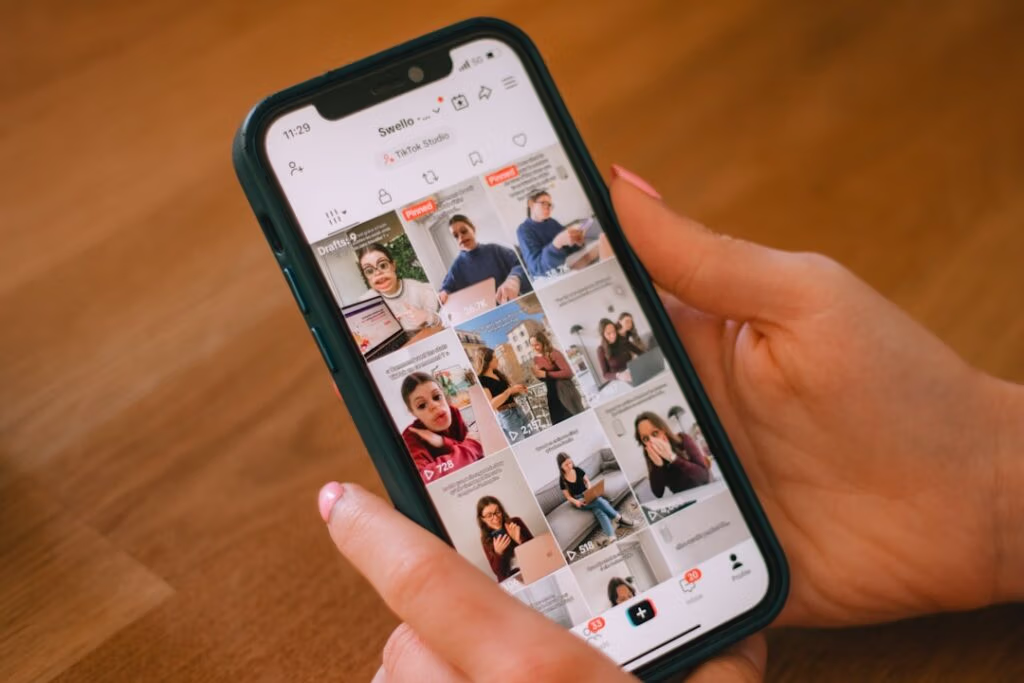
The online search paradigm is undergoing a radical transformation. Social platforms such as YouTube, TikTok, and Instagram account for more than 60% of product discovery, while 43% of Generation Z in the U.S. identifies TikTok as their primary search tool, surpassing Google and Instagram. This change is not a marginal phenomenon, but a structural reconfiguration of digital discovery behavior that requires a complete overhaul of traditional SEO optimization strategies.
Analysis of industry data shows that. Nearly half (46%) of Gen Z adults exclusively or predominantly use social media to conduct research, with More than one-third (35%) of Millennials adopting the same behavior. This is a generational shift in the way information is searched, evaluated and validated, requiring an integrated multichannel SEO strategy capable of presiding over all touch points of the digital customer journey.
The Decline of the Google Monopoly: Analysis of the Social Search Phenomenon
Social media research is not just a complementary channel, but an alternative discovery ecosystem with completely different logic, algorithms and formats than traditional research. Google usage among Gen Z decreased by 25% compared to Gen X, with Gen Z's 46% and Millennials' 35% preferring social media to traditional search engines.
The motivation for this behavioral shift is not limited to generational preference. Prabhakar Raghavan of Google acknowledged that “almost 40% of young people prefer TikTok or Instagram over Google Search or Maps” for local recommendations. The data show that users are looking for visual, trend-based and community-driven content rather than scrolling through text links and advertisements.
Structural Differences between Traditional Search and Social Search
Social platforms function as predictive search engines based on algorithmic behaviors and preferences. Up to 41% of users use TikTok for research, while 76% have discovered brands and products through social media. This means that discovery occurs not only when the user actively searches, but also through passive exposure in the personalized feed.
The traditional search model is based on explicit intent: the user formulates a query and gets results ranked by relevance. Social search reverses this logic: the algorithm predicts the user's needs and delivers content before a search is even formulated. It moves from a model pull (the user actively searches) to a model push (the platform anticipates the question).
Search Behaviors by Category: Where Users Search in 2026
Analysis of search categories shows precise segmentation among the channels used. Gen Z users mainly turn to social apps for trends related to fashion, beauty, food and DIY projects, while using Google for important purchases, places to visit and professional services.
This fragmentation requires strategic mapping of channels according to content type and user intent. Categories with a strong visual and experiential component (dining, travel, beauty, fashion) perform better on social, while high-value transactional and complex informational searches remain the preserve of traditional search engines.
Engagement Rate and Performance by Platform
TikTok records engagement rates ranging between 2.88% and 7.50% depending on the number of followers, while Instagram stands between 1.77% and 3.65%. This data highlights that TikTok maintains its position as the best performing platform in terms of interaction with content, followed by Instagram, which still retains significantly higher levels of engagement than Facebook and X.
From an advertising point of view, for every dollar invested in TikTok ads, brands record an average return of $4.13, compared to $3.21 on Instagram. However, Instagram maintains the lead in direct shopping conversions, with 18% of users making in-app purchases monthly.
Multichannel SEO Strategy: Operational Framework for 2026
Building an integrated SEO strategy requires abandoning the vertical model geared exclusively toward Google and adopting a horizontal approach that optimizes visibility across all discovery channels relevant to the target audience. The framework consists of four basic pillars.
1. Optimizing Social Profiles as an SEO Asset.
Each social profile should be configured as a landing page optimized for internal platform search. Critical elements include consistent usernames between platforms, display names containing relevant keywords, structured bios with industry terminology, and trackable links to the main site. If content is not optimized for internal platform search, organic discovery opportunities are lost. Social Media SEO is about making sure your brand is found when users are actively searching for what you offer.
Consistency of company information (NAP: Name, Address, Phone) across all digital channels strengthens entity signals and contributes to brand authority on both social and traditional search engines. Implementing UTM parameters on social profile links enables precise tracking of traffic and proper attribution of conversions from each channel.
2. Platform-Specific Keyword Research.
Each social platform has its own search algorithm and content categorization system. TikTok is the most influential platform for search among young audiences, with keywords in captions, hashtags mixed between generic and specific, on-screen text, and spoken keywords in videos being transcribed by the algorithm.
On Instagram, keywords should be integrated into profile names, bios, captions, image alt-texts and hashtags. On YouTube, titles, descriptions, tags and transcripts of videos are the main elements for indexing. LinkedIn favors long-form content with naturally embedded keywords, which also often appear in Google search results.
3. Creating Optimized Platform-Native Content.
The most common mistake is to republish the same content on all platforms without adaptation. Each channel requires specific formats, tones, and structures. The customer journey in 2026 spans multiple platforms: TikTok creates demand through authentic and entertaining content, Instagram validates and converts with in-depth searches and tagged content, YouTube justifies purchase decisions with detailed reviews and comparison videos.
Content should respond directly to the specific search intent of each platform, using optimized formats: short vertical videos for TikTok and Instagram Reels, informational carousels for LinkedIn and Instagram, long-form educational videos for YouTube, text threads for X and LinkedIn. Integration of on-screen text, subtitles, and transcripts improves accessibility and algorithmic indexing.
4. Integration with GEO (Generative Engine Optimization).
AI platforms such as ChatGPT, Perplexity, and Google AI Overviews use social content as a source for generated mentions and responses. Social content increasingly serves as source material for AI responses. Public posts, reviews, and discussions on platforms such as Reddit and LinkedIn inform how AI tools summarize brands and products.
Optimizing content for AI engines requires clear structuring, original data, authoritative citations and schema markup when applicable. Content must be constructed to be easily extractable, synthesizable and citable by LLMs. To learn more about this strategy, we recommend reading the complete guide on GEO (Generative Engine Optimization).
Technical Implementation: Operational Checklist for Italian Brands
Practical implementation of multichannel strategy requires a systematic, data-driven approach. Below are the key operational steps for Italian brands and publishers.
Audit of Current Discovery Channels
- Traffic analysis by source: identify in Google Analytics the percentages of traffic from organic search, social media, referral and direct, segmenting by device and demographics.
- Customer journey mapping: tracing multi-touch conversion pathways to understand which channels serve as the first point of contact, which as support, and which as the final conversion.
- Competitive gap analysis: analyze the presence and performance of key competitors on each industry-relevant social platform.
- Identifying social keywords: use the native search tools of TikTok, Instagram and YouTube to identify the most frequent queries related to your industry.
Technical Configuration of Social Profiles
- NAP Standardization: ensure absolute consistency of name, address and phone across all digital channels (website, Google Business Profile, social profiles).
- UTM tracking implementation: configure UTM parameters on all links in social profiles to accurately track traffic and conversions.
- Bio optimization and descriptions: include relevant keywords in the bios, maintaining natural and value-oriented language for the user.
- Complete compilation of metadata: enhance all available fields (business category, hours, services, certifications) to maximize relevance signals.
Multichannel Content Production Plan
- Content hub strategy: create high-quality pillar content (in-depth article, long-form video, original research) and decline it into channel-specific formats.
- Sequential publication schedule: planning a cascading release that maximizes coverage without saturating the overlapping audience across platforms.
- Optimization for internal search: integrate target keywords into titles, descriptions, tags, hashtags and spoken/on-screen content according to the specifications of each platform.
- Cross-channel call-to-action: include tracked links to in-depth content on the site to convert social traffic into qualified visits.
To ensure that the content produced is also optimized for AI engines, it is critical to integrate the principles of the AI-proof content creation based on E-E-A-T and original data.
Performance Measurement: KPIs for Social Search
Measuring the effectiveness of a multichannel SEO strategy requires specific metrics that go beyond traditional Google ranking indicators. Critical metrics include:
Visibility and Discovery Metrics
- Impressions from internal search: monitor how often content appears in each platform's native search results (available via native analytics from TikTok, Instagram, YouTube).
- Click-through rate (CTR) from search: percentage of clicks obtained from search impressions, an indicator of the effectiveness of headlines, thumbnails and snippets.
- Share of voice social: comparison of one's own brand mentions with those of key competitors on each platform.
- Ranking position by keyword target: ranking in internal search results for identified strategic keywords.
Engagement and Conversion Metrics
- Engagement rate by traffic source: comparison of engagement generated by users from social search, organic feed, and paid traffic.
- Bounce rate and dwell time: analysis of the behavior on the site of users from each social channel to identify the quality of traffic.
- Multichannel assisted conversions: using Google Analytics multichannel reports to track the contribution of each social touchpoint to the conversion process.
- Customer Lifetime Value (CLV) by acquisition channel.: assessment of the long-term value of customers acquired through each discovery channel.
In a context of Increasing prevalence of zero-click search, it is critical to integrate brand visibility KPIs and not just direct traffic metrics.
Case Study: Integrated Strategy for Fashion E-commerce
An Italian sustainable fashion brand implemented a multichannel SEO strategy with the following results in 6 months:
- TikTok: creation of educational content on the topic of sustainability in fashion, with keywords optimized for searches such as “sustainable Italian fashion” and “eco-friendly brands.” Result: +340% impressions from internal search, average engagement rate of 5.2%.
- Instagram: publication of informative carousels on materials and production processes, optimized with alt-text and strategic hashtags. Result: +180% visits to profile from search, +95% clicks to website from profile.
- YouTube: production of long-form videos on “behind the scenes” of sustainable production, SEO-optimized with titles, descriptions and keyword-rich transcripts. Result: first page placement for 12 strategic keywords, +220% traffic from YouTube.
- Google Search: technical optimization of the site and creation of pillar content on sustainability, integrated with social content. Result: +60% of organic traffic, average improvement of 15 positions for competitive keywords.
The integrated approach generated an overall 125% increase in e-commerce conversions, with a 30% reduction in cost per acquisition compared to previous paid-only campaigns.
Common Mistakes and How to Avoid Them
Implementing a multichannel SEO strategy has recurring critical issues that can undermine results:
Acritical Replication of Content
Publishing identical content on all platforms ignores differences in algorithmic, format, and user behavior. Each platform requires specific adaptations: a 10-minute YouTube video must be cut into 60-second clips for TikTok, with catchy initial hooks and explanatory on-screen text.
Lack of Consistency in Structured Data
Inconsistent business information between website, Google Business Profile and social profiles sends contradictory signals to algorithms, damaging the authority of the brand entity. It is critical to maintain a centralized document with all canonical information for use on each channel.
Optimization Only for Algorithms, Not for Users
Forced use of keywords, spam hashtags, and purely SEO-optimized content with no real value to the user generates negative engagement and algorithmic penalties. Social search rewards authenticity and usefulness, not keyword density.
Absence of Tracking and Correct Attribution
Without implementing UTM parameters and configuring multichannel goals in Google Analytics, it becomes impossible to measure the true effectiveness of each channel and optimize the budget accordingly. Last-click attribution systematically underestimates the contribution of social touchpoints in the awareness and consideration phase.
To avoid technical issues that may affect the overall indexing, it is advisable to consult the guide on the’crawl budget optimization.
The Future of Discovery: Trends 2026 and Beyond
The evolution of digital discovery shows clear trends that will influence SEO strategies in the coming years:
AI-Powered Search Integrated into Social Platforms
Social platforms are implementing AI-based search features that provide content summaries similar to Google AI Overview. This means that social content will have to be structured to be interpretable and synthesizable by AI algorithms, not just human users.
Multimodal Voice and Visual Search
Search is shifting to multimodal modes that combine text, image, video, and voice. Platforms are developing increasingly sophisticated visual (search for products using photos) and voice search capabilities. Content will need to be optimized for discovery through these new query paradigms.
To understand how to optimize for voice search, we recommend the in-depth study on Siri AI 2026 and Apple's Answer Engine..
Community-Driven Search
Reddit, Discord and private forums are becoming favorite search engines for Gen Z, who seek authentic answers from trusted people. Reddit functions as a crowdsourced knowledge hub, with many users adding “Reddit” to Google searches to avoid promotional content.
Brands will need to develop authentic community management strategies, participating in relevant conversations without appearing promotional. The insight on the community management in 2026 Provides operational guidelines.
Search Everywhere Optimization (SEVO)
Search no longer begins or ends with Google. Consumers search across AI platforms, social media, YouTube, Instagram, forums, Reddit and countless other spaces. AI assistants draw from this entire ecosystem, treating all public information as search data.
The concept of SEO is evolving from traditional search engine optimization to optimizing organic presence on every platform where signals of reputation, discovery, and authority exist. This holistic approach represents the future of digital visibility.
FAQ
Should I abandon Google SEO completely to focus on social media?
Absolutely not. Google maintains a dominant market share for transactional, complex informational, and B2B searches. The correct strategy is. supplementary: maintain robust traditional SEO optimization and complement social search optimization to preside over all relevant discovery channels for their target audience. Google remains the dominant search engine with the highest market share, but layering in other areas such as social media and AI is important to capture audiences wherever they are searching.
Which social platforms should I prioritize for research in 2026?
The choice depends on the target demographic and industry. Among Gen Z, three social platforms are more used than Google (65%): YouTube (77%), Instagram (77%) and TikTok (73%). For more mature targets, YouTube, Facebook and LinkedIn maintain relevance. Prioritization should be based on audience overlap data with your target audience and analysis of industry-relevant conversations on each platform.
How can I measure the ROI of social search optimization?
Implementing UTM parameters on all links from social profiles enables accurate tracking in Google Analytics. It is critical to configure multichannel goals and analyze assisted conversion paths to understand the contribution of each social touchpoint. Key metrics include: traffic from internal platform search, engagement rate from users from search vs. feed, assisted conversions, and CLV by acquisition channel. The right approach involves a multitouch attribution model that recognizes the value of social in awareness and consideration, not just in final conversion.
Can AI-generated content work for social search?
Content generated entirely by AI tends to lack authenticity, a crucial element for success on social media. 52% of consumers are concerned about unreported AI content, and 46% are uncomfortable with AI influencers, so transparency and authenticity remain critical. The recommended approach is to use AI as a tool to support research, optimization and production scaling, while maintaining human oversight and customization at all times. To learn more, see the guide on How to distinguish AI slop from quality AI content.
How do you integrate social search with GEO strategy for AI engines?
AI platforms such as ChatGPT, Perplexity and Google AI Overviews use social content as a source for citations and summaries. The integrated strategy involves: publishing structured, citable content on social (with original data, authoritative sources, markup when possible), optimizing social profiles as entities recognizable by AI algorithms, authentic participation in relevant communities (Reddit, forums, LinkedIn) where AIs draw information, and monitoring brand mention in AI results. To implement this strategy, it is useful to consult the guide on how to set up a GEO monitoring system.
Conclusions: Towards a Truly Omnichannel SEO
The year 2026 marks the end of Google's monopoly as the one-stop shop for digital discovery. Social platforms account for over 60% of product discovery, with users actively seeking authentic and human content over branded ads, especially during the research and purchase decision phase.
Effective SEO strategy in 2026 requires an integrated multichannel approach that optimizes visibility on Google, social platforms, AI engines, and communities. It is not about replacing one channel with another, but building a consistent and authoritative presence across all relevant touchpoints for your target audience.
Italian brands that implement this strategic approach, supported by authentic content, original data and platform-specific technical optimization, will gain a significant competitive advantage in an increasingly fragmented and competitive digital landscape.
Have you implemented a multichannel SEO strategy for your brand? Share your experience in the comments and discuss the critical technical issues encountered in integrating traditional discovery channels and social search.