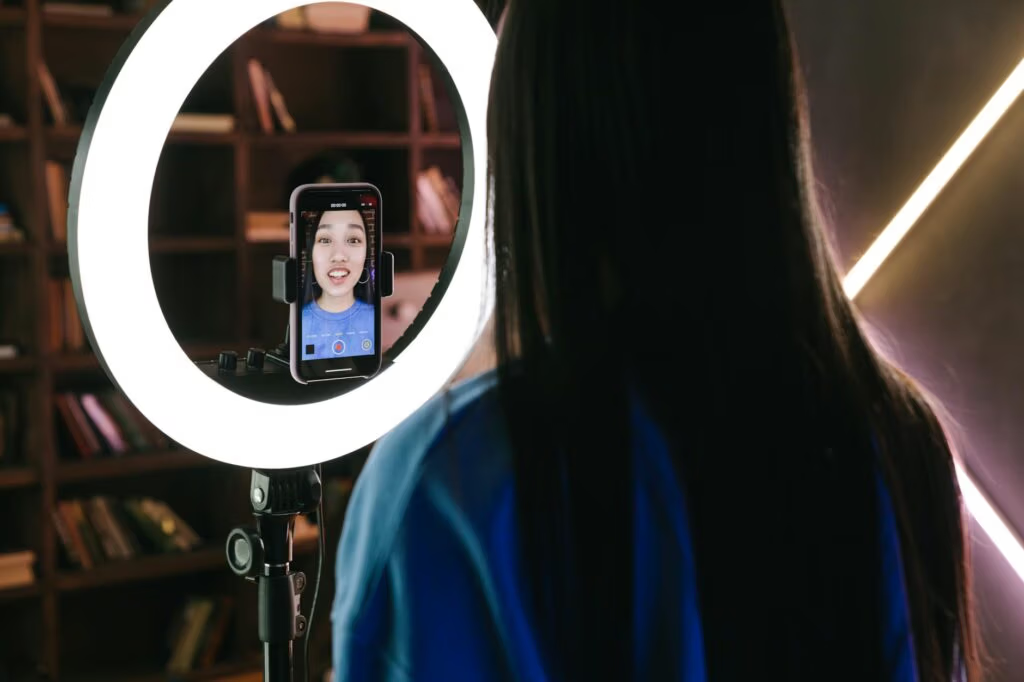
Analysis of digital consumption data in 2026 shows a radical transformation: 82% of global internet traffic is video content, with short-form videos driving the largest share of engagement. For brands operating in Italy, planning a short-form video strategy is no longer an experimental option, but an operational necessity that can be documented through concrete performance metrics.
Distribution on platforms such as Instagram Reels, TikTok, and YouTube Shorts requires a differentiated technical approach. Each ecosystem operates with distinct algorithms, specific audience behaviors, and different content expectations. Success on TikTok, Instagram Reels, and YouTube Shorts is not about simply reusing the same content across all three platforms: each ecosystem operates with distinct algorithms, audience behaviors, and content expectations. Understanding these nuances separates creators who occasionally go viral from those who build sustainable, revenue-generating presences.
This tutorial provides an operational framework for developing, producing, and optimizing a scalable short-form video strategy by integrating artificial intelligence tools for content generation and editing.
Analysis of the Short-Form Video Panorama in 2026: Performance Data and User Behaviors
Understanding the short-form video market requires analysis of specific metrics. 66% of marketers consider short-form content to be the most engaging format, while short-form videos receive 2.5 times more engagement than long-form videos. These indicators quantify the effectiveness of the format in capturing the user's attention.
From the perspective of optimal durability, 33% of marketers believe that the optimal length for a short-form video is between 31 and 60 seconds. However, videos under 1 minute average a 50% engagement rate, far outperforming static formats.
Strategic investment in the format is growing significantly: 26% of marketers plan to invest more in short-form video content, representing the highest investment in any format to date. In addition, 57% of marketers already using short-form video will increase their investment in the format.
Traffic Distribution and Virality Potential.
The organic distribution potential of short-form videos exceeds that of other content formats. 47% of marketers say short-form videos are more likely to go viral, a figure that reflects the platforms' algorithmic effectiveness in rewarding short content with high completion rates.
On the user behavior front, 63% of consumers say they prefer short videos when they want to learn about a product or service. This preference translates into concrete opportunities for brands that structure informational content in short-form format.
Algorithmic and Strategic Differences between TikTok, Instagram Reels, and YouTube Shorts
Effective editorial planning requires understanding the technical specifics of each platform. Success in short-form video requires understanding that TikTok, Instagram Reels, and YouTube Shorts are not interchangeable: each platform has developed its own culture, content expectations, and strategic advantages.
TikTok: Superior Engagement Rate and Interest-Based Algorithm.
TikTok remains the undisputed king of engagement in short-form videos, with an engagement rate of 2.80% in 2024 and projected at 3.15% in 2026, offering interaction rates that far exceed other platforms. The TikTok algorithm operates through a interest graph rather than a social graph.
TikTok's For You Page is powered by an interest graph - it predicts what each user wants to see based on past behavior, not who they follow. This architecture allows content from unknown accounts to reach massive audiences quickly.
One significant change in 2026 concerns the initial distribution: TikTok now shows new videos first to existing followers before distributing them to non-followers. This slightly reduces the “instant viral from scratch” advantage that made TikTok famous, but the platform still offers the greatest potential for rapid virality than any other platform.
Instagram Reels: Aesthetics, Sharability and Business Integration.
52% of social users gravitate toward short-form (under 60 seconds) videos on Instagram to drive their interactions. Instagram's algorithm favors specific metrics: Instagram's algorithm analyzes view time, likes per reach, and particularly values “sends per reach”-when users share your Reel via DM.
The platform requires more attention to aesthetic quality than TikTok. Reels thrive on aesthetics + emotion + relatability. Instagram reads captions as blog posts now. It is therefore recommended to use keyword-rich captions, not just hashtags.
YouTube Shorts: SEO, Discoverability and Long-Term Monetization.
YouTube Shorts represents the latest entrant in the short-form video war, and although its engagement rates (0.40% projected for 2026) are lower than its competitors, it offers a unique strategic value that is impossible to ignore.
The main advantage is integration with the world's second largest search engine. YouTube Shorts benefits from integration with the world's second largest search engine, creating discoverability benefits that extend well beyond the immediate moment of publication.
From a time perspective, TikTok optimizes for immediate engagement - most of a video's impact occurs in the first 24-48 hours. YouTube Shorts optimizes for sustained performance - a Short can continue to get views for weeks or months through search and recommendations.
Editorial Planning: Building a Strategic Content Calendar for Video Short-Form
Sustainable production of short-form video content requires a structured planning system. The most effective approach is to treat short-form videos as a product, not as occasional posts.
Repeatable Series Framework vs. Random Content
Build repeatable series, not random posts. A “series” makes it easier to create, easier to measure, and easier for viewers to recognize. It is recommended to define 3-5 recurring formats that can be replicated weekly:
- One problem, one solution: 30-45 seconds, a clear takeaway
- Mini demo: 45-90 seconds, shows the product in action
- Myth vs. reality: 30 seconds, fast interrupt pattern
- Before/after: 15-45 seconds, visual payoff
This approach reduces the cognitive load of creation and enables progressive optimization of formats that generate better performance.
Optimal Publication Frequency
3-5 short-form videos per week are perfect. The texture exceeds the raw volume. Channels that publish consistently grow in subscriber the 67% faster.
The batching strategy-creating multiple videos in a single session-makes it possible to maintain consistency without compromising quality or burning time resources. It is recommended that specific blocks of time be dedicated to batch production (e.g., 4 hours per week to produce 5-8 pieces of content).
Multi-Platform Editorial Calendar
The optimal approach in 2026 is a dual-platform or tri-platform strategy. The consensus of experts in 2026 is a dual-platform strategy: use TikTok for cultural speed, trending moments and social commerce. Use YouTube Shorts for compound growth, SEO and long-term channel equity.
For brands with limited resources, we recommend identifying a primary platform based on strategic objectives:
- TikTok: When prioritizing viral reach and engagement over immediate monetization
- YouTube Shorts: When maximum long-term earning potential and channel growth is desired
- Instagram Reels: For brand aesthetics, loyal followers and commerce integration
Once the primary platform is identified, it is recommended that content be adapted for secondary platforms rather than simply republishing identical files. The key is to adapt content for each platform rather than simply republishing identical files: remove platform-specific watermarks before republishing (TikTok watermarks reduce reach on YouTube and Instagram), adapt captions and hashtags.
Technical Specifications and Production Best Practices for Each Platform.
Technical production of short-form videos requires adherence to precise specifications to maximize algorithmic distribution.
Optimal Video Length by Platform
The optimal duration depends on the platform and type of content, but the data suggest 15-35 seconds for YouTube Shorts, 15-30 seconds for TikTok, and 15-45 seconds for Instagram Reels. However, it is recommended that completion rate be prioritized with respect to arbitrary duration-a 45-second video that 70% of viewers completely watches outperforms a 15-second video that only 40% completely watches.
Vertical Format and Mobile-First Design
Since most short-form video content is consumed on smartphones, designing with a vertical-first mindset is nonnegotiable: stick to 9:16 or square formats to cover maximum screen space. Use large, high-contrast captions for silent viewers.
Updated technical specifications for 2026 include:
- Instagram Reels: Files under 4 GB, 30 FPS, maximum duration 3 minutes (if recorded in-app) or 15 minutes (if uploaded)
- TikTok: Android 72MB / iOS 278.6MB / Desktop 1GB, 23-60 FPS, maximum duration 10 minutes (most effective under 60 seconds)
- YouTube Shorts: 9:16 vertical format, maximum duration 60 seconds
Hook in the First 2-3 Seconds
Capture attention quickly: hook viewers in the first 2-3 seconds with a bold image, question, or statement. A high audience retention rate, especially in the first few seconds, signals to YouTube that your video is engaging, increasing its likelihood of being pushed to a wider audience on the Shorts shelf.
Operational strategies for effective hooks:
- Start in mid-action: don't waste time with “hello” or “welcome,” start in the middle of the most exciting action
- Creating an information gap: Ask a question or present a problem that requires resolution
- Pattern visual interrupt: Use rapid movements, scene changes, or unexpected visual elements
Treat hooks as a KPI: track 2-second views, 3-second views, and viewing time by hook style.
Integration of AI Tools for Short-Form Video Production.
Artificial intelligence has transformed the video production process from a resource-intensive activity to an accessible workflow for even small teams. The No. 1 change in short-form video trends for 2026 will be AI.
AI Video Generators: Overview of Main Platforms
Google's Veo 3.1 model is the best AI video generation all-arounder on the market, with strong adherence to prompts to stay close to your image references and textual prompts, great realism combining video and audio generation.
Key AI platforms for video generation in 2026 include:
- Google Veo 3.1: Native 4K output, character consistency, vertical video support (about $19.99/month via Gemini Advanced)
- Runway Gen-4.5: #1 benchmark score, motion brushes, scene consistency (from $12/month)
- Kling 2.6: Simultaneous audio-visual generation, video up to 2 minutes, free tier available
- Luma Ray3: 4K HDR Hi-Fi, superior physics simulation (from $7.99/month)
- Pika 2.5: Pikaswaps, Pikaffects, quick 42-second renderings (from $8/month)
For brands that need comprehensive workflows, ByteDance's CapCut has integrated OpenAI's Sora 2 and Google's Veo 3.1 directly into its editing interface, allowing it to generate high-quality clips and immediately cut them into TikTok-ready formats.
Production Workflow with AI: From Concept to Final Video
The operational process for integrating AI into short-form video production follows these steps:
- Script generation: Use LLM (GPT-4, Claude, open-source models such as Qwen or LLaMA) to generate scripts based on strategy briefs
- Visual asset creation: Generate reference images or B-roll videos via AI video platforms
- Editing and compositing: Assemble clips, add text overlays, effects and transitions
- Cross-platform optimization: Export in formats and aspect ratios specific to each platform (16:9, 1:1, 9:16)
- Scheduled publication: Distribute through multi-platform scheduling tools
If you want a plan for 2026, build a repeatable pipeline: capture or generate good footage once, cut it into many formats, version it by audience, and ship it consistently.
Workflow Automation with AI Agent
For high-volume teams, the implementation of AI agents as digital colleagues allows much of the creative process to be automated. Manus takes a different approach: instead of just being a video generator, it acts as an AI agent that can orchestrate complex tasks across multiple AI models, representing a powerful tool for advanced users who want to automate the entire video creation pipeline.
The integration of agent marketing workflow allows production to scale up from 3-5 weekly videos to 15-20 without proportionally increasing the team.
SEO Optimization for Video Short-Form: YouTube Shorts, TikTok and Instagram
Optimization for discoverability is a critical factor for organic distribution. The social search on TikTok and Instagram requires specific SEO approaches.
YouTube Shorts SEO
YouTube Shorts SEO: add keyword-rich descriptions, captions, and looping content for better discoverability. Key elements include:
- Title: include primary keyword in the first 40 characters
- Description: Use the first 2-3 lines for secondary keywords and context
- Hashtag: 3-5 targeted hashtags (#Shorts is mandatory for ranking)
- Custom thumbnail: even if shorts are vertical, a custom thumbnail improves CTR in searches
TikTok SEO
TikTok has become a search engine. TikTok SEO tip: Say keywords aloud and insert them into on-screen text and captions - TikTok indexes audio now.
Critical elements for TikTok SEO:
- Spoken audio: pronounce keyword target during the video
- On-screen text: keyword overlay in the first 3 seconds
- Captions: detailed descriptions with natural keywords
- Hashtag: mix of trending and niche (3-5 total)
Instagram Reels SEO
Instagram reads captions as blog posts now. It is therefore recommended to:
- Writing keyword-rich captions of 150-300 characters
- Use line breaks to improve readability
- Include explicit CTAs (“Save this post,” “Share with whom...”)
- Leveraging geolocation for local content
Performance Metrics and KPIs for Video Short-Form
Measuring effectiveness requires tracking platform-specific metrics. Key algorithmic factors to be optimized in 2026 include: completion rate (watch-through rate)-the most important metric. Shorter shorts (15-30 seconds) often achieve higher completion rates than 60-second shorts.
Primary KPIs
- Completion rate: Percentage of users who watch to the end (target: >50% for videos under 30 seconds)
- Average watch time: average display duration (target: >70% of total duration)
- Engagement rate: (likes + comments + shares) / total reach (target: >3% on TikTok, >1.5% on Instagram, >0.5% on YouTube)
- Saves/shares: a saved video signals value, a shared video signals identity
- Click-through rate (CTR): For content with external CTAs (target: >2%)
Secondary and Attribution Metrics
For brands focused on conversion, it is recommended to implement UTM tracking for links in bio and track:
- Traffic from social to website (segmented by platform)
- Conversion rate from social traffic
- Customer acquisition cost (CAC) from organic vs. paid content
- Lifetime value (LTV) of users acquired via short-form video
Integration with systems of Measurement of brand visibility in zero-click contexts allows the impact to be quantified even when users do not click directly.
User-Generated Content (UGC) and Authenticity in Short-Form Videos.
User-Generated Content (UGC) is emerging as one of the most powerful forces in short-form video marketing. By 2025, UGC is surpassing traditional brand content by wide margins, with over 50% of video engagement on platforms such as TikTok, Reels, and Shorts coming from ordinary users.
Consumers trust real people more than curated ads, with 79% saying UGC influences their purchase decisions. This figure quantifies the effectiveness of perceived authenticity with respect to professional production.
Implementation of a UGC Pipeline
Build a simple “UGC pipeline”: no need for a complicated program, need a repeatable process. Choose 3 reusable content prompts each week (pain point, outcome, objection). Collect raw footage from clients, creators and employees. Cut 5-10 short clips. Publish 3, then turn 2 into ads. Save the best hook formats and reuse them the following week..
The systematic approach allows UGC production to scale without depending on spontaneous user participation. It is recommended to:
- Create submission-specific templates (e.g., “Show how you use [product] in 15 seconds”)
- Offer measurable incentives (discount codes, features on the official channel)
- Simplify the upload process (dedicated form, WhatsApp Business, email)
- Require releases for commercial use of content
Synchronization with Other Content Marketing Strategies
Short-form videos do not operate in isolation but are a component of the larger content marketing system. Synchronization with other initiatives amplifies overall effectiveness.
Integration with Pillar Content and Content Clustering
Short-form videos can function as entry points for content clustering structures and pillar pages. It is recommended to:
- Create series of 5-7 short-form videos that expand on specific aspects of a pillar page
- Link to in-depth resources in bio or pinned comments
- Reuse sections of long-form content as scripts for short videos
Cross-Platform Deployment and Repurposing
Reusing your YouTube Shorts on TikTok, Instagram Reels and other short-form platforms multiplies your reach without multiplying your production effort. Each platform has a slightly different demographic audience, so a Short that performs poorly on YouTube could go viral on TikTok or vice versa.
The optimal repurposing strategy includes:
- Create the master video in the highest possible quality
- Export to platform-specific formats (removing watermarks)
- Customize captions, hashtags and CTAs for each platform
- Stagger publication times (do not publish simultaneously on all platforms)
Funnel from Social to Digital Properties
Short-form videos function primarily as tools for awareness and consideration. Short-form video is no longer just top-of-funnel: smarter creators use TikTok, Reels, and Shorts as discovery engines, not destinations.
It is recommended to build funnels that direct traffic to proprietary assets:
- Optimized links in bio (use services such as Linktree or custom pages)
- Specific lead magnets mentioned in the videos (“Download the complete checklist at the link in bio”)
- Integration with email marketing for subsequent nurturing
- Advertising retargeting of users who interacted with organic videos
Emerging Trends and Future Developments in Short-Form Video.
The short-form video landscape continues to evolve as new features and technological capabilities are introduced.
Integration of Shoppable Video and Social Commerce
Retailers using shoppable video experience conversion increases of 30% or more, according to Firework's internal data. The native integration of commerce features directly into short-form videos represents a significant evolution.
Platforms are expanding product tagging, in-app checkout and direct link capabilities to reduce friction between discovery and purchase. E-commerce brands are recommended to test these features as they become available on their target platform.
Native Audio and Advanced Lip-Sync
The new trend in late 2026 is native audio generation: sound effects that match the action and accurate lip-sync for characters. This development reduces the need for separate audio production and improves the realism of AI-generated content.
Video Podcast Clips and Segmented Long-Form Content
Video podcast clips, which are short highlights edited from longer podcast shows, are rapidly becoming one of the most powerful tools in short-form marketing. Platforms such as TikTok, Instagram Reels, and especially YouTube Shorts are fueling this growth, turning vodcast snippets into viral content.
For brands and creators with existing long-form content (webinars, interviews, extended tutorials), strategic segmentation into short-form clips represents a low-cost incremental distribution opportunity.
Operational Checklist for Implementing a Video Short-Form Strategy.
The practical implementation of a short-form video strategy requires the execution of specific steps:
- Audit of the current situation: Analyze existing performance (if any) and identify content gaps
- SMART goal setting: Establish specific metrics (e.g., “achieve 100K total monthly views by Q3 2026”)
- Primary platform selection: Identify 1-2 focus platforms based on target audience and available resources
- Creating repeatable formats: define 3-5 recurring series with predefined templates
- Production workflow setup: Implement batching system and AI tools to accelerate creation
- Editorial calendar development: plan 4-6 weeks of content in advance
- Tracking configuration: Implement UTM, tracking pixels and dashboard analytics
- Testing and iteration: publish for 8-12 weeks, analyze performance, optimize format
- Scaling: Increase frequency or expand to additional platforms when processes are broken in
It is recommended that the process be documented in an internal playbook to facilitate the onboarding of new team members and ensure consistency in quality.
FAQ
What is the optimal duration for a short-form video in 2026?
The optimal duration varies by platform: 15-30 seconds for TikTok, 15-45 seconds for Instagram Reels, and 15-35 seconds for YouTube Shorts. However, the critical factor is not absolute duration but completion rate: a 45-second video watched completely by 70% of users performs better than a 15-second video with only 40% completion rate. It is recommended that audience retention be prioritized over arbitrary time limits.
Is it necessary to create different content for TikTok, Instagram Reels, and YouTube Shorts?
Yes, although strategic reuse is possible. Each platform operates with distinct algorithms and different content expectations: TikTok favors authenticity and cultural trends, Instagram Reels values aesthetics and shareability via DM, YouTube Shorts benefits from SEO optimization and long-term discoverability. The optimal approach is to create a high-quality master video and then adapt it for each platform by editing captions, hashtags, removing watermarks, and staggering the publishing time.
What AI tools are most effective for producing short-form videos in 2026?
Market leaders in 2026 include Google Veo 3.1 for photo realism and adherence to prompts, Runway Gen-4.5 for advanced cinematic control, and CapCut for native integration of multiple templates (Sora 2, Veo 3.1) into social-optimized editing workflows. For teams with limited budgets, tools such as Luma Ray3 (from $7.99/month) and Pika 2.5 (from $8/month) offer affordable professional capabilities. The choice depends on the specific use case: generation from scratch vs. editing existing footage, need for granular control vs. production speed.
How do you measure the ROI of a short-form video strategy?
ROI is measured through stratified KPIs: primary engagement metrics (completion rate >50%, engagement rate >3% on TikTok), traffic metrics (click-through rate to digital properties, website visits from social), and conversion metrics (leads generated, sales attributed to social traffic, customer acquisition cost). For organic content, it is recommended to implement UTM tracking on all links, retargeting pixels for audiences that interact with videos, and dashboard analytics that link video views to revenue generated. The minimum recommended testing period is 8-12 weeks to accumulate statistically significant data.
What is the optimal posting frequency for short-form videos?
Data analysis suggests 3-5 short-form videos per week as the optimal frequency to balance consistency and quality. Daily publishing is not strictly necessary, but consistency significantly impacts growth: channels that publish consistently grow in subscribers the 67% faster. For teams with limited resources, we recommend implementing a batching system (creating 5-8 videos in a single production session) and using scheduling tools to maintain regular cadence without daily operational overload.
Conclusions: Practical Implementation and Next Steps
Analysis of the short-form video landscape in 2026 highlights real opportunities for brands that implement structured strategies. 1.6 billion people have used short-form video, accounting for 20% of the world's population, quantifying the extent of the accessible market.
The optimal approach combines systematic editorial planning, production optimized with AI tools, and strategic multi-platform distribution. Algorithmic differentiation between TikTok (high engagement, rapid virality), Instagram Reels (aesthetics and sharability), and YouTube Shorts (SEO and long-term discoverability) requires content personalization rather than simple replication.
The integration of AI tools for content generation significantly reduces production costs, while the implementation of agent marketing workflow Allows scaling without proportional increase in team.
To maximize effectiveness, it is recommended that the short-form video strategy be synchronized with broader initiatives: content clustering For traditional SEO, GEO optimization for visibility in AI engines, and community management For sustainable engagement.
The AI Publisher WP community offers ongoing support in implementing these strategies. Readers are invited to share experiences, results, and specific questions in the comments to facilitate technical discussion and collective optimization of operational practices.