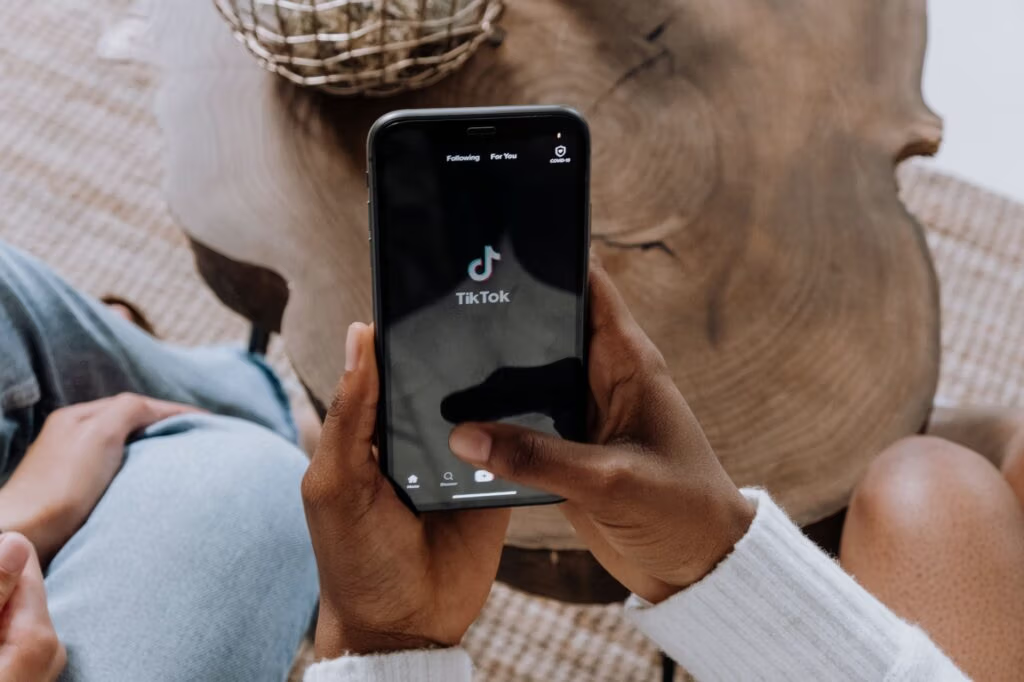
In the digital landscape of July 2026, social research represents an unprecedented technological and behavioral shift. 40% of Gen Z used TikTok to search, and Instagram and TikTok have surpassed Google for product discovery. This phenomenon is not a simple generational preference, but a rewriting of digital discovery paradigms that forces creators and publishers to completely restructure their content architecture.
Social media platforms are not a replacement for Google, but rather a fragmentation of multi-platform research. 67% of Gen Z use Instagram to search, 62% use TikTok, and 61% use Google — the share is nearly identical across all three platforms. The winning strategy isn't abandoning traditional search engines, but understanding when and how Gen Z chooses each platform to meet different search intents.
This article analyzes the technical and strategic architecture of social search dominance, providing actionable frameworks for content structure, post-algorithm hashtag optimization, and building micro-communities that convert engagement into loyalty.
The Psychology of Social Research: Intent Segmentation and Platform Selection
Social research operates according to a logic of contextual intent matching. Gen Z doesn't arbitrarily choose TikTok, Instagram, or Google for every query: they evaluate the type of answer desired and the form of content they trust.
Gen Z craves instant, visual, and community-powered answers, not static search results cluttered with ads. When a user searches for “best skincare routine for oily skin,” TikTok and Instagram provide 60-second videos from verified creators, real-time comments, and crowd-sourced recommendations. Google, on the other hand, offers long, ad-heavy articles from corporate websites.
The strategic implication is crucial: content design must diverge radically between platforms. Publishers who identically replicate the same content on Google, TikTok, and Instagram will see performance collapse on at least two of the three channels.
Content Architecture for Dominance on TikTok and Instagram Search
Principle 1: Hook Engineering and Answer Velocity
On TikTok, search algorithms reward the Video engagement over text authority. The first frame and the first 2 seconds determine whether the user scrolls past or watches the entire video. The content architecture must build immediate narrative tension.
Recommended structure for TikTok search:
- Frames 0-2 seconds: Intense visual hook or provocative statement (e.g., “Companies don't want you to know this”)
- Frame 2-15 seconds: Context setup and credibility signals (show tools, certifications, experience)
- Frame 15–55 seconds: Answer architecture (segmented response in clear steps)
- Frames 55-60 seconds: Call-to-action community (comments, shares, follow)
Instagram Reels operates with a similar logic, but is more tolerant of a polished aesthetic. Optimizing Instagram Reels for Google Search is crucial because indexed Reels appear in Google Image and Video Search.
Principle 2: Entity Authority and Credibility Clustering
TikTok and Instagram reward creators with thematically consistent profiles. The social search algorithm categorizes users not only by individual videos but also by their creation history within a specific topic. A creator who has published 200 videos on fitness has greater authority than one who has 500 videos on scattered topics.
Recommended entity authority structure:
- Optimized bio: Keyword-forward description of core expertise (“Personal trainer specializing in functional strength”)
- Link to the website: Direct to a topic authority page (blog post with E-E-A-T signals)
- Topic consistency in videos: 80-90% posts must remain in the primary vertical
- Cross-linking with articles of length: Create a connection between short-form TikTok and length trend forecasting on the main blog
Principle 3: Query-Based Video Architecture
Unlike YouTube, where titles set the expectation, TikTok search uses the Caption text and video body as signals of relevance. Structuring captions as direct answers to queries increases the likelihood of appearing in TikTok Search.
Example of SEO-optimized caption:
how to fix flaky skin“
Caption: “4 causes of cracked skin (not just dryness). Watch until the end for the fix that works even for sensitive skin.”
The caption should include the probable query, the number of points (increases scannability), and a curiosity gap (“until the end”). This pattern increases retention and makes the video indexable for specific intents.
Hashtag Strategy Post-Algorithm: Precision Over Volume
The Revolution of 2026: From 30 Tags to 5 Tags
Instagram has limited hashtags to 5 per post, E The biggest change in 2026 isn't on a single platform, but across all of them: every social network algorithm has shifted from counting hashtags to aligning with content..
This change reflects a structural evolution: Platform algorithms in 2026 have become sophisticated enough to understand content context without relying on hashtags for categorization. Instagram and TikTok can read text within images, comprehend captions, and analyze video content without a single hashtag..
New Hashtag Strategy Structure
The hashtag strategy in 2026 is about precision, not volume. You choose five tags that give the algorithm the clearest possible view of what the content is about and who it's intended for..
5-Tag Selection Framework
- Day 1 (Niche Community): Hashtags with 50k–500k posts in your specific niche. E.g., #SustainableFashionTips vs. #Fashion
- Day 2 (Micro-Community): Hashtags with 10,000–50,000 posts that bring together your specific audience. E.g., #EcoConsciousMillennials
- Tag 3 (Trending Adjacent) A hashtag that’s currently trending in your niche (monitor trends for 2–3 days before using it). E.g., #ClimateActionNow if it’s trending among eco-conscious creators
- Tag 4 (Brand or Creator Identity): Your personal or community-based branded hashtag. For example: #JoinTheMovement
- Tag 5 (Searchable Modifier) Descriptive, specific long-tail hashtag. E.g., #NaturalFabricsCheaper (query-based)
Mid-tier hashtags with 10,000 to 500,000 posts consistently outperform mega-tags for discoverability because your content can actually compete there.
#EmotionalAlignment (Post-Algorithm2026)
Algorithms no longer read hashtags literally, but analyze their emotional and contextual meaning. AI-powered feeds interpret hashtags to understand the post's theme, tone, and relevance to the audience..
Practical implication: choose hashtags whose Emotional tone matches the tone of the video. A tutorial video titled “How to Fix Your Makeup When It Breaks” shouldn’t use #BeautyGoals (aspirational) but rather #MakeupHacks (problem-solving) or #BeautyEmergencies (relatable).
Micro-Community Building: From the Feed Algorithm to Private Engagement Pockets
The Feed Visibility Crisis and the Community-First Solution
In 2026, TikTok and Instagram's algorithmic feeds will offer increasingly volatile visibility due to content saturation. The engagement-per-post metric is declining for non-super-viral creators. The strategic solution is not to optimize more for the algorithm, but building audience loyalty beyond the feed through micro-communities.
Micro-communities are small, highly focused online groups that gather around a common purpose, passion, or issue. They can range from a Discord server for amateur musicians to a Slack group for UX designers or a private subreddit for eco-conscious travelers..
The fundamental difference: while a TikTok post reaches a “random” audience through the algorithm, a micro-community is opt-in and trust-driven. Engagement quality is superior, audience lifetime value is multiplied.
Platform Selection: Discord vs. Telegram
The choice of platform for micro-communities determines the speed of growth and the depth of engagement.
Telegram: Telegram is better for fast growth and reach, while Discord is better for deep engagement and structured communities. Marketing experts prefer Telegram because it offers superior visibility, faster growth, and better content distribution.. Telegram is ideal for:
- Announcements and news broadcast (one-way channel)
- Rapid numerical growth (push notifications)
- Large-scale global communities (up to 200k+ members per supergroup)
- Creators who emphasize reach over deep interaction
Discord Discord is built for free communities, characterized by:
- Thread-based conversations and role-based access
- Voice chat and live streaming native
- Bot automation (MEE6, Arcane, Ticket Tool)
- Monetization via server subscriptions
- Deep engagement and a most loyal core audience
Hybrid Strategy (Recommended): Many brands use Telegram for traffic and ads, and Discord for community interaction. Telegram becomes an entry funnel (broadcast); Discord becomes the engagement core engine.
Content Architecture for Micro-Communities
Even within mainstream platforms like Instagram and TikTok, micro-communities thrive through niche hashtags, close friends lists, and small collaborations between creators. The shift is clear: people want spaces that feel personal and meaningful, not just performative..
Micro-community structure for TikTok/Instagram native:
- Close Friends List (Instagram): Exclusive access to Stories for core audience (500-1000 people maximum)
- Niche Hashtag Ecosystem Proprietary hashtag (#MyBrandCommunity) that becomes a virtual gathering
- Creator Collaboration Pods Small groups of 3-5 related creators who cross-promote and create collaborative content
- Reddit or Branded Subreddit Sub-community private for in-depth discussions (better Google search indexing for official content)
Micro-communities solve the problem by gathering people around shared interests, goals, or challenges.
Content Architecture Integration: Connecting TikTok/Instagram, Blog Publisher, and Micro-Communities
The optimal strategy in 2026 is not to create content silos by platform, but to build a Interconnected content funnel dove social search fuels discovery, the publisher blog validates authority, and the micro-community builds audience loyalty.
Recommended architecture:
- Layer 1 (Discovery Social): 60-90 second TikTok/Reels optimized for query-based search and hook engineering. Metadata: keyword-forward caption, 5 precision hashtags, cross-link to full blog post in bio
- Layer 2 (Authority Validation): Long-form blog post for publisher (1500+ words) with E-E-A-T signals: experience, expertise, authoritativeness. Include schema structured data (FAQPage, HowTo, Article)
- Layer 3 (Community Loyalty): Micro-community (Discord or Telegram) for in-depth engagement, live Q&A, beta access to new content, exclusive tutorials
Micro-communities are not a replacement for your main social channels; they are a complement. They give you a smaller, more focused space. where to measure retention and lifetime value accurately.
Success Metrics: What to Measure Beyond Vanity Metrics
In the context of social search dominance, traditional metrics (followers, like rate, view count) do not predict audience loyalty. The critical metrics are:
- Dwell Time (Watch Duration %): Average video view percentage. Target: >75% retention rate for full-length videos
- Conversion Rate Comments + Shares / Views (not likes, which are passive). Target: >2% on TikTok, >1.5% on Instagram Reels
- Community Conversion Rate: % followers joining the micro-community (Discord/Telegram). Target: 3–5% per niche creator
- Blog Referral Quality: Traffic from social media to the blog, measured by bounce rate and pages per session (GA4). Target: bounce rate <40%
- Audience Cohort Retention % of the audience that watches at least 3 videos per month (30/60/90-day cohort analysis). Predictor of loyalty
FAQ
Will TikTok and Instagram truly “supplant” Google for Gen Z in 2026?
No. Data from July 2026 shows that 67% of Gen Z use Instagram, 62% use TikTok, and 61% use Google for search, with nearly identical market shares. This phenomenon is not one of substitution, but rather fragmentation of multi-platform research. Gen Z uses different platforms for different intents: TikTok for visual tutorials and peer recommendations, Google for local, specific, or transactional searches. The winning strategy is to optimize for all three simultaneously, not choose one over the others.
What is the ideal number of hashtags to use in 2026?
Instagram: exactly 5 hashtags (platform-enforced limit). TikTok: 1-3 hashtags in the caption (the algorithm doesn't depend on tags). LinkedIn: 3-5 hashtags (less competitive than Instagram). X/Twitter: 0-2 hashtags (penalized by algorithm if excessive). The universal rule of 2026 is Quality over quantity: Each tag must be highly relevant to the content; it should not be used just to pad the post. Mega-hashtags (#love, #instagood) are counterproductive.
Discord or Telegram for my micro-community?
Telegram's priority is rapid numerical growth and large-scale ad reach. Discord's priority is deep engagement, thread-based conversations, live voice chat, and monetization via subscriptions. The optimal choice is hybrid: Telegram for acquisition and broadcast, Discord for retention and core community building.
How do I embed TikTok videos on my publisher blog without losing engagement?
Use the "link in bio" (Instagram) or "link in bio" (TikTok) to direct users to an intermediate landing page that summarizes the video and features the blog post below, rather than a direct link. Alternatively, create a pinned comment in the first comment section of the TikTok post with the link. For Instagram, use a CTA within the video itself (“link in bio”) with a voice-over and on-screen text. Measure the click-through rate and bounce rate from social media to the blog: if the bounce rate is >50%, the blog content isn’t meeting the expectations set by the video.
What is the ideal timing for optimizing for social search in 2026?
July-August 2026 is the critical period because: (1) Gen Z returns online after summer; (2) platform algorithms have stabilized the new post-H1 2026 rules (Instagram 5 hashtags, TikTok relevance-first); (3) micro-communities have reached critical mass (500k+ global Discord communities). Starting optimization now means leveraging Gen Z's attention window before the fall saturation.
Conclusion: Social Search as a Lasting Paradigm Shift
The dominance of social search on TikTok and Instagram in July 2026 is not an ephemeral trend, but rather a permanent recalibration of how Gen Z discovers, validates, and shares information. As people increasingly use social media as a search tool or create searchable content that solves relevant problems on channels like TikTok, it is more critical than ever for brands looking to increase awareness and followers in 2026 to strategically utilize social search..
Publishers and creators who implement an integrated strategy—social search with hook engineering and entity authority, post-algorithm hashtag precision, and micro-community loyalty building on Discord/Telegram—will have access to an audience quantitatively similar to Google, but qualitatively superior: audiences that actively choose your content, rather than arriving through random algorithm luck.
La Transition from vanity follower engagement to true micro-communities is already underway. July 2026 is the time to synchronize your content architecture with this reality.