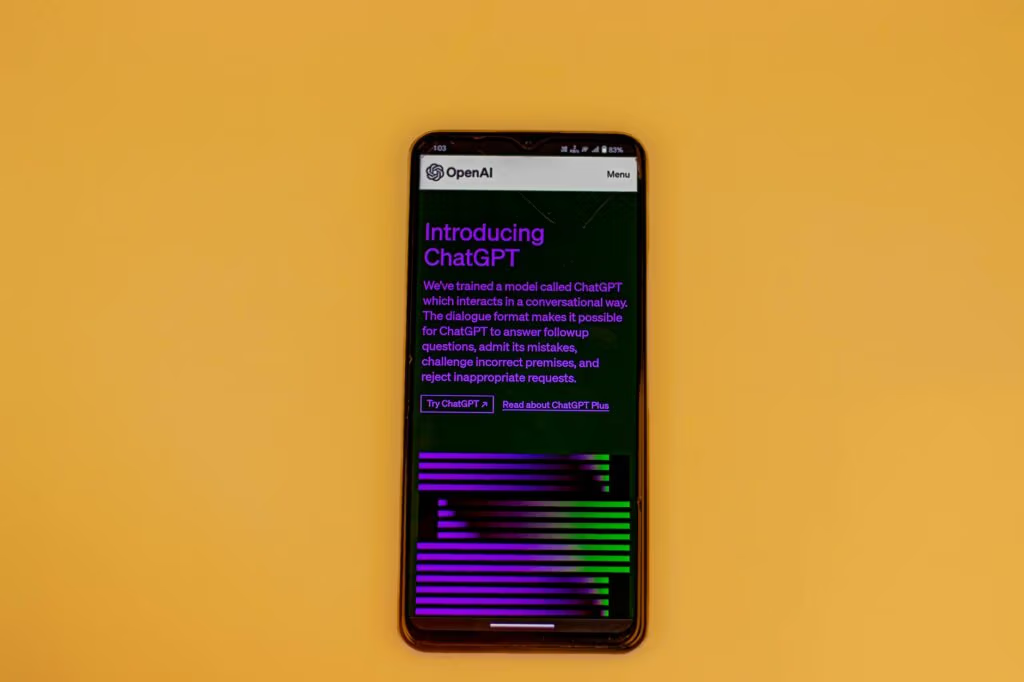
OpenAI started advertising tests on ChatGPT for U.S. users in the first half of 2026, marking a radical transformation in the landscape of conversational digital advertising. Ads will appear at the bottom of chatbot-generated responses, clearly labeled, opening a new era for marketers to completely rethink their approach to online visibility. For Italian digital marketers, this evolution represents a strategic opportunity but also a technical challenge: understanding the mechanisms of conversational targeting, optimizing content to be cited organically, and preparing for the global expansion of OpenAI's advertising platform requires a rethinking of the entire acquisition funnel.
ChatGPT's advertising system introduces a completely new paradigm compared to traditional platforms. The platform operates on the principle of “Answer Independence”: the model first generates the answer completely separately from any advertising consideration, then the ad serving system determines whether to show a relevant sponsored message. This approach aims to preserve user trust while maintaining the integrity of the answers provided by artificial intelligence.
Architecture of the Advertising System: Technical Mechanisms and Positioning
OpenAI plans to test ads placed at the bottom of responses when there is a relevant sponsored product or service based on the current conversation. Unlike traditional targeting based on keywords or demographic segments, advertisers define categories of intent and conversational themes. The technical architecture differs significantly from Google Ads systems or Meta platforms, requiring specific skills in understanding the semantic context of conversations.
The pricing model has premium features that distinguish it from established advertising platforms. ChatGPT charges a CPM (cost per thousand impressions) of $60, three times that of Meta and aligned with the launch of Netflix's advertising service in 2022. The barrier to entry is high: advertisers must invest a minimum of $200,000, a six-figure investment aimed primarily at established brands. This premium placement strategy reflects OpenAI's desire to keep the quality of the user experience high while limiting access to advertisers with large budgets.
User Tier and Segmentation: Who Will See the Ads.
OpenAI will test ads with users of the free and Go versions in the U.S., while Plus, Pro and Enterprise subscriptions will not include ads. This freemium strategy creates a clear value differentiation: users must pay a premium (at least $20 per month) to maintain a completely ad-free experience. Tier Go, available for $8 per month, offers extended messaging, image creation, file uploading and storage, representing an intermediate option for users willing to accept contextual advertising in exchange for advanced features.
Market projections highlight the platform's economic potential. Industry experts at WPP estimate that OpenAI will generate between $500 million and $800 million in advertising revenue in the first year, a figure considered lower than the internal target of several billion but still a solid start for a new advertising format. Looking at the long term, analyst Mark Mahaney of Evercore ISI predicts that ChatGPT's advertising business could reach $25 billion in annual revenue by 2030, a figure that would exceed OpenAI's total sales in 2025.
Privacy and Data Protection: Technical Framework and Limitations
OpenAI has implemented strict privacy protocols to mitigate user concerns. ChatGPT conversations remain private from advertisers, and the company never sells user data to advertisers. During the testing period, OpenAI decides which ads to show to customers by correlating topics discussed in current and past conversations with relevant ads. For example, if you search for recipes, ads for meal kits or food delivery may appear.
The system includes important restrictions for sensitive categories. The system will not show advertisements in conversations about health, mental health, or political topics, and ads will not appear to users identified as minors. OpenAI will not show ads in temporary chats, when users are logged out, after generating an image, in the ChatGPT Atlas browser, and during discussions on sensitive or regulated topics. These technical limitations represent an attempt to balance monetization and user trust.
Implications for Italian Marketers: Strategic Preparation.
For marketers in Italy, advertising on ChatGPT requires strategic rethinking on three levels: organic visibility, preparation for paid advertising, and content optimization for generative engines. Although the initial January 2026 launch is limited to U.S. advertisers targeting U.S. users, OpenAI has indicated plans to expand into additional markets during 2026, making preparation for European marketers urgent.
Content strategy becomes critical in this new ecosystem. As highlighted in the analysis on the GEO (Generative Engine Optimization), optimizing content to be cited by ChatGPT, Perplexity and Google AI Overviews is the basis for any subsequent advertising activity. Brands that already appear organically in ChatGPT responses will have a competitive advantage when launching paid campaigns, benefiting from a halo effect of authority.
Conversational Targeting vs. Traditional Targeting
ChatGPT's targeting model represents an evolution from established platforms. The technical architecture differs significantly from Google Ads or Facebook advertising systems: instead of targeting demographic segments or keyword lists, advertisers define categories of intent and conversational themes. This requires expertise in semantic understanding of conversations and in mapping the conversational customer journey.
Marketers must develop expertise in creating content that responds to specific intents rather than exact queries. Relevance is prioritized: ads leverage conversational context to ensure that placements are organically linked to the user's current query. This development relates directly to the strategies of AI-proof content: Brands that produce original content based on proprietary data and demonstrable EEAT skills will be more likely to be considered relevant by the advertising matching system.
Integration with Other AI Platforms and Answer Engine
The advertising strategy on ChatGPT should not be considered in isolation. The answer engine ecosystem is expanding rapidly-Google plans to introduce advertising in Gemini, Apple's Siri AI is evolving toward a full answer engine, and platforms such as Perplexity are experimenting with advertising models of their own. Italian marketers need to develop an omnichannel strategy that considers the full spectrum of AI-based answer engines.
Data management infrastructure becomes crucial. As outlined in industry best practices, consolidating advertising data from all platforms into centralized dashboards will allow ChatGPT to be added as an additional channel when the platform expands to Europe, without having to completely rebuild reporting systems. Integration with marketing automation and CRM platforms will allow tracking the full path from interaction in ChatGPT to final conversion.
Pre-Launch Content Strategy: Organic Positioning
The current phase, prior to the global expansion of ads on ChatGPT, represents a strategic opportunity to build organic visibility. The principles of the Generative Engine Optimization become fundamental: structuring content with appropriate schema markup, providing concise answers to specific questions, using structured data and verifiable citations increases the likelihood of being mentioned in ChatGPT's organic responses.
Content architecture on WordPress requires specific optimizations. As highlighted in the analyses on the WordPress 7.0 news and the 2026 roadmap, integrated AI and collaboration features can facilitate the production of content optimized for answer engines. The use of advanced SEO plugins that support complex schema markup, structured data for FAQs and howto, and the implementation of semantic breadcrumbs improve the comprehensibility of content by Large Language Models.
Content Supply Chain and Scalable Generation
Adobe, as a pilot program partner testing ads in ChatGPT, is working closely with OpenAI to explore how advertising can be thoughtfully integrated to deliver brand visibility and customer engagement. This underscores the importance of strategic partnerships and the adoption of content supply chain tools based on generative AI. Adobe GenStudio for Performance Marketing addresses this challenge by powering the entire content supply chain with generative AI, enabling marketers to create, assemble, activate and optimize on-brand content across paid and owned channels from a single integrated solution.
Italian marketers must invest in tools that enable rapid generation of creative variants optimized for different conversational contexts. The ability to quickly test different headlines, descriptions and call-to-actions will become critical in an environment where the conversational context determines which variant is shown. This requires the integration of automated A/B testing workflows and machine learning-based optimization systems.
Business Model and Sustainability: Long-Term Perspectives
The introduction of advertising responds to concrete economic pressures. The strategic pivot comes as OpenAI faces financial realities that would devastate most tech companies: despite reaching $12.7 billion in annual recurring revenue in 2025, infrastructure costs remain unsustainable. The move comes as the company chases sustainable revenue beyond subscriptions, with sources indicating that ads will account for less than half of long-term revenue.
This revenue diversification strategy has historical precedent. OpenAI's adoption of advertising follows a proven technological playbook: Google has turned search into a $200 billion-plus advertising empire by offering free access by monetizing user intent, while Meta's social platforms reach billions without charging subscriptions, funding operations entirely through targeted advertising. The critical question for marketers is whether ChatGPT's conversational model can replicate this success while maintaining user trust.
Competition and Positioning: The Clash with Anthropic
The launch of advertising on ChatGPT triggered significant competitive tensions. OpenAI announced Monday that it has begun testing ads in ChatGPT, a day after being teased about its advertising plans in rival Anthropic's Super Bowl spot. Anthropic's original commercial directly targeted OpenAI, with the slogan “ads are coming to AI” followed by “but not on Claude,” after Altman publicly called the campaign “clearly dishonest,” Anthropic toned down the final version aired during the game.
This competitive dynamic creates strategic opportunities for marketers. Anthropic positions itself as a premium ad-free alternative, while OpenAI focuses on a hybrid model that balances free access and advertising monetization. The premium tiers of OpenAI-ChatGPT Plus ($20 per month) and Pro ($200 per month)-will remain ad-free, preserving clear value differentiation. This freemium structure mirrors Spotify's approach, where the majority of users tolerate advertising while a minority pay for uninterrupted access. The new $8 monthly “Go” plan attempts to capture price-sensitive users willing to accept limited advertising in exchange for enhanced features.
Technical Preparation: Infrastructure and Tools for Marketer
Technical readiness requires investment in several areas. Marketers must consolidate their technology stacks to be ready for ChatGPT integration as an advertising channel. This includes setting up cross-platform dashboards that can incorporate ChatGPT metrics when the platform expands, implementing attribution systems that track conversions across conversational touchpoints, and developing in-house expertise in managing campaigns based on semantic intent rather than exact keywords.
Optimization of WordPress sites is a crucial element of preparation. Content must be structured to maximize the likelihood of organic citation, implementing complex markup schemes (Article, HowTo, FAQ, Product, Review), optimizing loading speed for users from ChatGPT who might click on sponsored links, and creating specific landing pages optimized for conversational traffic with copy that continues the flow of the conversation started in ChatGPT.
Measurement and Attribution: Conversational Advertising Metrics.
Traditional digital advertising metrics will need to evolve for the conversational context. In addition to CTR, conversions, and ROAS, marketers will need to monitor metrics specific to conversational advertising: conversational engagement rate (how many users ask follow-up questions after seeing an ad), depth of pre-conversion conversation (how many exchanges occur before a user clicks), and sentiment analysis of conversations that include brand mentions.
Attribution systems will require significant upgrades. The conversational customer journey differs profoundly from the linear paths of traditional search: a user might interact with the brand through multiple conversations on ChatGPT before final conversion, making it crucial to implement multi-touch attribution models that recognize the value of each conversational interaction in the overall journey.
Ethical Implications and Transparency: Balancing Monetization and Trust
The ethical issue of advertising in conversational AI systems raises fundamental questions. An AI assistant is not a newsfeed or a results page; it is perceived as a consultant. If a chatbot offers a safe recommendation, users assume the response is unbiased. Introducing paid influence into that interaction risks undermining the trust that makes the experience worthwhile. OpenAI has implemented specific safeguards: ads do not influence the responses ChatGPT provides, responses are optimized based on what is most useful, and ads are always separate and clearly labeled.
Transparency becomes a competitive differentiator. Brands that adopt transparent approaches in conversational advertising, clarifying when a piece of content is sponsored and providing real value rather than promotional interruptions, will build long-term trust. This links directly to EEAT (Experience, Expertise, Authoritativeness, Trustworthiness) principles: advertising on ChatGPT will reward brands that demonstrate authentic expertise and provide useful information rather than purely promotional messages.
Future Scenarios: Conversational Commerce and Native Transactions
Advertising on ChatGPT represents an initial step toward conversational commerce-transactions that occur through natural language dialogue rather than traditional e-commerce interfaces. OpenAI hinted at this potential in its January 2026 post on advertising principles, noting, “Soon you may see an ad and be able to directly ask the questions you need to make a purchase decision.”. This suggests that future iterations could allow users to interact with advertised products through follow-up questions, requesting specifications, comparing alternatives, or even completing transactions without leaving ChatGPT.
Building full conversational commerce capabilities would require substantial infrastructure including payment processing, merchant relations, and order management systems, likely through partnerships rather than full construction by OpenAI. For marketers, this future scenario requires strategic preparation: integrating product catalogs with APIs that could be exposed to ChatGPT, developing conversational customer service capabilities that can handle complex requests in real time, and creating optimized fulfillment processes for orders originated by AI conversations.
FAQ
When will advertising on ChatGPT be available to Italian marketers?
The initial January 2026 launch is limited to U.S.-based advertisers targeting U.S. users, but OpenAI has indicated plans to expand into additional markets during 2026, although specific timelines and market priorities have not been publicly announced. Italian marketers should prepare technically and strategically during 2026, expecting a potential European rollout in the second half of the year or early 2027.
How much does it cost to advertise on ChatGPT and what are the minimum budget requirements?
ChatGPT charges a cost of $60 per 1,000 impressions (CPM), three times higher than Meta currently charges and aligned with the launch of Netflix's ad service in late 2022. The barrier to entry is high: advertisers must invest at least $200,000, a minimum six-figure investment aimed primarily at large, established brands. This premium positioning initially limits access to enterprise and large brands.
How does ad targeting work on ChatGPT compared to Google Ads or Meta?
The technical architecture differs significantly from Google Ads or Facebook ad systems: instead of targeting demographic segments or keyword lists, advertisers define intent categories and conversational themes. The system analyzes the semantic context of the user's current conversation and conversational history to determine the relevance of the ad, requiring expertise in semantic intent mapping rather than exact keyword optimization.
Do ads affect the responses provided by ChatGPT?
The ChatGPT platform operates on the principle of “Answer Independence”: the model first generates the answer completely separately from any advertising consideration, then the ad serving system determines whether a relevant sponsored message should appear. Ads do not influence the responses ChatGPT provides, responses are optimized based on what is most useful to the user, and ads are always separate and clearly labeled. This architectural separation aims to preserve the integrity of the responses.
What strategies should Italian marketers adopt to prepare for advertising on ChatGPT?
Marketers should focus on three priority areas: optimizing organic visibility by implementing techniques of Generative Engine Optimization to be cited in ChatGPT responses, preparation of the technical infrastructure by consolidating cross-platform dashboards and attribution systems that can incorporate ChatGPT as a channel when available, and development of content based on semantic intent rather than exact keywords, creating resources that answer specific questions with verifiable data and demonstrable expertise according to EEAT criteria.
Conclusion: Integrated Strategy for the Age of Answer Engine Advertising
The introduction of advertising on ChatGPT represents a turning point in digital marketing, ushering in the era of large-scale conversational advertising. For Italian marketers, this change requires advance preparation despite the gradual rollout: the organic visibility built today through GEO optimization will become the basis for effective advertising campaigns tomorrow, while the technical infrastructure deployed now will allow for rapid integration when the platform expands in Europe.
The convergence of organic optimization by answer engine, paid conversational advertising, and AI-proof content strategies requires a holistic approach. Brands that invest in creating original content based on proprietary data, structured according to advanced semantic markup and optimized for citation by Large Language Model, will build assets that generate value through both organic visibility and advertising amplification. Integration with other emerging platforms such as Threads and optimization for answer engine as Siri AI will complete an omnichannel strategy for the AI ecosystem of 2026 and beyond.
The window of opportunity to strategically position themselves is open: marketers who understand the mechanisms of conversational targeting, invest in scalable content infrastructure, and develop skills in managing campaigns based on semantic intent will gain a significant competitive advantage. Advertising on ChatGPT does not replace traditional channels but represents an evolution that requires new skills, tools, and strategic approaches. Share in the comments your vision of how conversational advertising will change the Italian marketing landscape in the coming years.