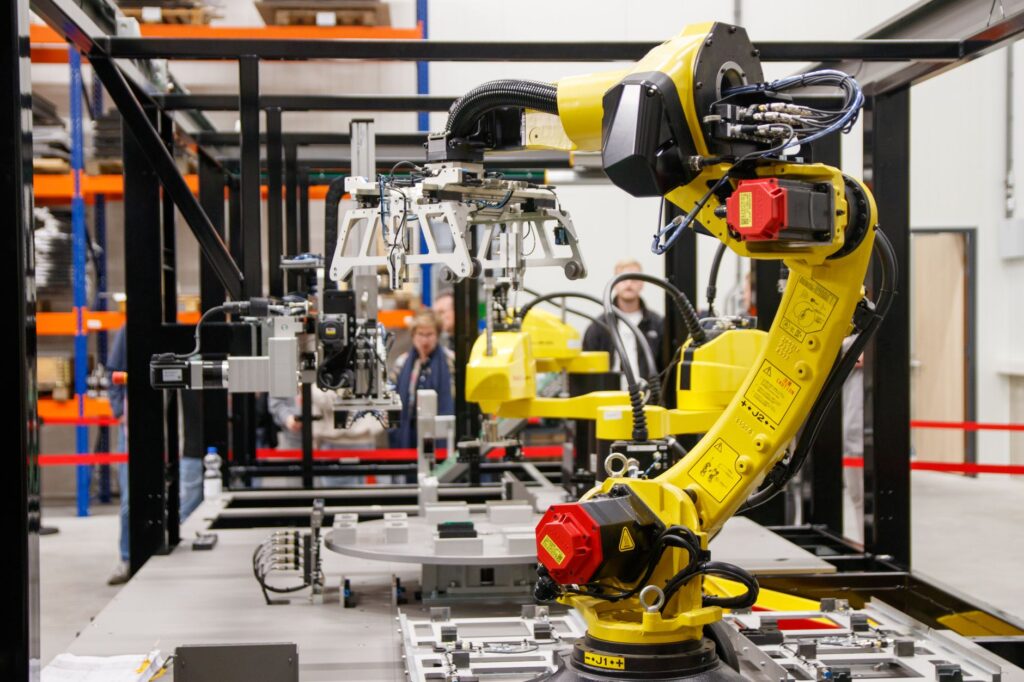
The convergence between Physical AI, Internet of Things (IoT) e Machine Learning it is transforming the Italian manufacturing landscape, redefining production processes through intelligent automation, haptic telerobotics, and decentralized decision-making systems. This article analyzes how Italian small and medium-sized manufacturing enterprises (SMEs) can integrate advanced sensorization, scalable data infrastructure, and local ML models to achieve sustainable competitive advantages, without reliance on centralized cloud vendors.
Unlike conversational or generative AI, the Physical AI operates directly in the physical domain: collaborative robots (cobots), machine vision systems, haptic (tactile) sensors, intelligent actuators, and edge computing networks that process production data in real-time. In the context of Italian manufacturing—characterized by high artisanal value, precision, and flexibility—the integration of Physical AI represents the natural evolution of Industry 4.0.
Technical Architecture: From Sensor-Based IoT to Decentralized Autonomous Control
The implementation of Physical AI in Italian industrial systems requires a architectural stack stratified
1. Sensory Level: Distributed Acquisition of Physical Data
Sensors form the foundation of the system. In the Italian manufacturing context, the integration of heterogeneous sensors—pressure, temperature, accelerometers, optical sensors, RFID—enables the granular collection of process data. The main technical challenge is to ensure Time synchronization e data quality in industrial environments with high electromagnetic noise.
Technical Recommendation: Implement robust industrial protocols such as MQTT (Message Queuing Telemetry Transport) with QoS (Quality of Service) configured at Level 2, or OPC UA (Open Platform Communications Unified Architecture) to ensure reliability in critical contexts. These protocols support both local networks and hybrid clouds.
Example MQTT configuration for an industrial pressure sensor:
// Example of an MQTT client in Python for sensor data acquisition
import paho.mqtt.client as mqtt
import json
from datetime import datetime

broker_address = "192.168.1.100"  Local # Edge gateway
port = 1883

def on_connect(client, userdata, flags, rc):
    if rc == 0:
        print("Connected to the local MQTT broker")
        client.subscribe("production/sensors/pressure", qos=2)
    else:
        print(f"Connection failed with code {rc}")

def on_message(client, userdata, msg):
    # Real-time processing of sensor data
    data = json.loads(msg.payload)
    timestamp = datetime.utcnow().isoformat()

    # Validation and filtering
    if data['pressure'] > 50:  # Alert threshold
        print(f"ALERT: Abnormal pressure {data['pressure']} bar")
        # Trigger corrective action or notification

    # Local storage for offline ML
    with open('/data/pressure_sensors.jsonl', 'a') as f:
        f.write(json.dumps({'timestamp': timestamp, **data}) + 'n')

client = mqtt.Client()
client.on_connect = on_connect
client.on_message = on_message
client.connect(broker_address, port, keepalive=60)
client.loop_forever()
2. Edge Computing Level: Localized Processing and Autonomous Decision Making
Edge computing eliminates critical latency in industrial real-time systems. Instead of sending every sensor data to the cloud, modulus edge (Industrial gateways, smart PLCs, or mini-PCs with GPUs) process data locally, perform ML inferences, and generate immediate control commands.
In the Italian context, this is particularly relevant for:
- Assembly lines Decisions in milliseconds (reject/accept components, robot calibration)
- Continuous processes (e.g., extrusion): Real-time adaptive temperature and speed control
- Predictive maintenance Anomaly Detection in Vibration Data Before Failure
Recommended technical stack for edge:
- Hardware NVIDIA Jetson Orin Nano (low power, 40 TOPS AI), or Intel NUC with Movidius accelerator for low-budget scenarios
- Runtime ML TensorRT (for NVIDIA models), OpenVINO (Intel), or ONNX Runtime for cross-platform portability
- Operating system: Linux embedded (Ubuntu Core, Yocto) for containerization and OTA updates
- Local Orchestration Docker Compose to manage inference server, MQTT broker, local database
Docker Compose configuration for an edge node with an ML anomaly detection model:
version: '3.8'
services:
  mqtt-broker:
    image: eclipse-mosquitto:latest
    ports:
      - "1883:1883"
    volumes:
      - ./mosquitto.conf:/mosquitto/config/mosquitto.conf
    networks:
      - industrial-net

  inference-engine:
    build:
      context: ./ml-inference
      dockerfile: Dockerfile.jetson  # Image optimized for Jetson Orin
    depends_on:
      - mqtt-broker
    environment:
      - MQTT_BROKER=mqtt-broker
      - MODEL_PATH=/models/anomaly_detector_v2.onnx
      - CONFIDENCE_THRESHOLD=0.85
    volumes:
      - ./models:/models:ro
      - ./inference_logs:/var/log/inference
    devices:
      - /dev/nvhost-ctrl  # NVIDIA GPU access
      - /dev/nvhost-gpu
    networks:
      - industrial-net
    restart: always

  timeseries-db:
    image: influxdb:2.7
    ports:
      - "8086:8086"
    environment:
      - INFLUXDB_DB=production_metrics
      - INFLUXDB_ADMIN_USER=admin
      - INFLUXDB_ADMIN_PASSWORD=SecurePassword123
    volumes:
      - influx-data:/var/lib/influxdb2
    networks:
      - industrial-net

volumes:
  influx-data:

networks:
  industrial-net:
    driver: bridge
3. Data Layer: Distributed Industrial Data Lake and Feature Engineering
The structured collection of production data is a prerequisite for training accurate ML models. An Italian manufacturing SME needs to implement a data pipeline I'm not sure what you mean by "che". Could you please provide more context or a clearer request?
- Aggregate heterogeneous data (sensors, ERP, MES, visual inspection)
- Apply offline normalization and cleaning
- Generate engineered features (rolling averages, FFT for vibrational signals, texture descriptors for images)
- Maintain complete data lineage for regulatory compliance
Recommended architecture: Combine local (edge) storage + central repository for long-term analytics. Open-source tools such as MinIO (S3-compatible object storage) + Apache Spark for distributed processing.
Example of a feature engineering pipeline with Spark for vibration data:
from pyspark.sql import SparkSession
from pyspark.ml.feature import StandardScaler, VectorAssembler
from scipy import signal
import numpy as np

spark = SparkSession.builder.appName("FeatureEngineering").getOrCreate()

# Reading from a data lake (e.g., historical Parquet)
df_vibration = spark.read.parquet("s3a://production-data/vibration/2024/")

# Feature engineering: FFT calculation for mechanical fault detection
def compute_fft_features(acceleration_values):
    """Extracts spectral features from a vibration signal"""
    fft_result = np.abs(np.fft.fft(acceleration_values[:1024]))  # FFT on 1024 samples
    dominant_freq_idx = np.argmax(fft_result)
    peak_amplitude = np.max(fft_result)
    return float(dominant_freq_idx), float(peak_amplitude)

# Apply to a batch (RDD)
from pyspark.sql.types import DoubleType
from pyspark.sql.functions import col, udf, array_col

compute_fft_udf = udf(
    lambda arr: compute_fft_features(np.array(arr)),
    "struct"
)

df_features = df_vibration.withColumn(
    "fft_features",
    compute_fft_udf(col("acceleration_array"))
).select(
    col("timestamp"),
    col("machine_id"),
    col("fft_features.dominant_freq"),
    col("fft_features.peak_amplitude")
)

# Normalization and Saving
scaler = StandardScaler(inputCol="dominant_freq", outputCol="dominant_freq_scaled")
df_scaled = scaler.fit(df_features).transform(df_features)
df_scaled.write.mode("overwrite").parquet("s3a://ml-features/vibration-fft/")

print("Feature engineering complete. Dataset saved to MinIO.")
Virtual Assistants for Production Line Operators
La second generation Physical AI isn't just robotic automation: it's Collaborative intelligence between humans and machines. Virtual assistants—equipped with local LLM models and integrated with real-time production data—support line operators in troubleshooting, parameter optimization, and regulatory compliance.
Use Case: Multimodal Voice Assistant in a Factory
An online operator says: “Camera 3 is making strange noises, can you help me?”
The virtual assistant
- Access Historical vibration data of Room 3
- Executes anomaly detection ML offline on the signal
- Check out internal knowledge base (technical manual, MES procedures) via semantic embedding
- Provides diagnoses with confidence: “Possible front bearing misalignment. Consult manual X, section 4.2. Call maintenance if vibration peak exceeds 8mm/s.”
- Record the event for Predictive maintenance tracking
Tech stack:
- LLM locale: Mistral 7B or Llama 2 13B (quantized to 4-bit for speed)
- Embedding model: nomic-embed-text for semantic search on a knowledge base
- Speech-to-text OpenAI Whisper (available on-premise)
- Framework LangChain + RAG (Retrieval-Augmented Generation) for grounding on company data
Python Implementation with LangChain and Local Whisper:
import whisper
from langchain.llms import Ollama
from langchain.embeddings import OllamaEmbeddings
from langchain.vectorstores import Chroma
from langchain.chains import RetrievalQA
import sounddevice as sd
import numpy as np

# 1. Load the local Whisper model
whisper_model = whisper.load_model("base", device="cuda")

# 2. Record audio from the operator (5 seconds)
print("Recording... speak now")
audio_data = sd.rec(int(16000 * 5), samplerate=16000, channels=1)
sd.wait()

# 3. Transcribe using Whisper
result = whisper_model.transcribe(audio_data)
user_query = result["text"]
print(f"Operator: {user_query}")

# 4. Load local LLM and knowledge base
llm = Ollama(model="mistral:7b-instruct", base_url="http://localhost:11434")
embeddings = OllamaEmbeddings(model="nomic-embed-text")

# Vectorization of the knowledge base (technical manual, SOP)
vectorstore = Chroma.from_documents(
    documents=load_technical_docs(),  # Custom function to load PDFs
    embedding=embeddings,
    persist_directory="./kb_industrial"
)

# 5. Create RAG chain
qa_chain = RetrievalQA.from_chain_type(
    llm=llm,
    chain_type="stuff",
    retriever=vectorstore.as_retriever(search_kwargs={"k": 3}),
    return_source_documents=True
)

# 6. Additional context from real-time data
context_data = fetch_machine_metrics(machine_id="Camera_3")
prompt_with_context = f"""
Question operator: {user_query}

Current data from Camera 3 sensor:
- Peak vibration: {context_data['vibration_peak']:.2f} mm/s
- Bearing temperature: {context_data['temperature']:.1f}°C
- Last maintenance: {context_data['last_maintenance']}

Provide a technical diagnosis based on the manual and data.
"""

# 7. Run a query with RAG
response = qa_chain({"query": prompt_with_context})

# 8. Voice output (local TTS with pyttsx3 or alternative)
from pyttsx3 import init as init_tts
tts_engine = init_tts()
tts_engine.say(response['result'])
tts_engine.runAndWait()

print(f"Assistant: {response['result']}")
print(f"Source: {response['source_documents'][0].metadata['source']}")

# 9. Log the event in the MES
log_assistant_interaction(
    operator_id="OP_001",
    machine_id="Camera_3",
    query=user_query,
    response=response['result'],
    timestamp=datetime.now()
)
Telerobotics Aptica: Remote Control with Tactile Feedback
An Italian case study of particular significance: Gold and precision manufacturing. Delicate tasks (welding, micro-component assembly, restoration) benefit enormously from teleoperation with haptic feedback, allowing expert operators to control remote robots by perceiving contact forces.
Low-Latency Haptic Telerobotics Architecture
The critical requirement is latency under 50ms round-trip to naturally perceive forces. This excludes the public cloud; it requires local edge infrastructure with a private 5G network or dedicated Ethernet.
Technical components:
- Master unit (operator): Haptic glove (e.g., HaptX G1) or force-feedback joystick (ABB IRB 1200)
- Remote Robot Subunit: Collaborative robot (Universal Robots UR, KUKA LBR iiwa) with force/torque sensors on the end-effectors
- Synchronization Gateway Edge computer with dual Gigabit NIC, running ROS 2 (Robot Operating System)
- Protocol: OPC-UA real-time or proprietary UDP with CRC for robustness
ROS 2 Configuration with Haptic Teleoperation
#!/usr/bin/env python3
# ROS 2 Node for Haptic Telerobotics

import rclpy
from rclpy.node import Node
from sensor_msgs.msg import JointState
from geometry_msgs.msg import WrenchStamped
import numpy as np
from collections import deque
import time

class HapticTeleopNode(Node):
    def __init__(self):
        super().__init__('haptic_teleop')

        # Publisher for robot commands
        self.robot_cmd_pub = self.create_publisher(
            JointState, '/robot/joint_commands', 10
        )

        # Subscriber for force feedback from the remote robot
        self.force_feedback_sub = self.create_subscription(
            WrenchStamped, '/robot/tcp_force', self.force_callback, 10
        )

        # Subscriber for haptic glove input
        self.master_input_sub = self.create_subscription(
            JointState, '/haptic_master/joint_state', self.master_callback, 10
        )

        # Buffer for latency smoothing
        self.force_buffer = deque(maxlen=5)  # 5-sample moving average
        self.last_command_time = time.time()
        self.target_frequency = 100  # Hz
        self.master_position = None

        self.get_logger().info("Haptic teleop node initialized")

    def master_callback(self, msg):
        """Receive input from the haptic master (glove/joystick)"""
        self.master_position = np.array(msg.position)

        # Scaling and linearity mapping for the robot
        scaled_command = self.scale_master_to_robot(self.master_position)

        # Send command to the robot with a safety timeout
        cmd = JointState()
        cmd.position = scaled_command.tolist()
        cmd.header.stamp = self.get_clock().now().to_msg()

        self.robot_cmd_pub.publish(cmd)

    def force_callback(self, msg):
        """Receive force feedback from the slave robot"""
        # Extract force vector
        force = np.array([msg.wrench.force.x, msg.wrench.force.y, msg.wrench.force.z])

        # Smoothing buffer to reduce artifacts
        self.force_buffer.append(force)
        if len(self.force_buffer) == 5:
            smoothed_force = np.mean(list(self.force_buffer), axis=0)
        else:
            smoothed_force = force

        # Scaling for haptic master (typically 1/10 of the actual force)
        haptic_command = smoothed_force / 10.0

        # IMPLEMENTATION MISSING: send to haptic glove driver
        # Note: Depends on the specific glove API (HaptX, bHaptics, etc.)
        self.send_to_haptic_glove(haptic_command)

        self.get_logger().debug(f"Feedback force: {smoothed_force}")

    def scale_master_to_robot(self, master_pos):
        """Linear scaling with a safety deadzone"""
        deadzone = 0.02
        scaling_factor = 0.5  # The master operator controls 50% of the robot’s range

        if np.linalg.norm(master_pos) < deadzone:
            return np.zeros_like(master_pos)

        return np.clip(master_pos * scaling_factor, -np.pi, np.pi)

    def send_to_haptic_glove(self, force_command):
        """Interface with haptic device (placeholder)"""
        # HARDWARE-SPECIFIC IMPLEMENTATION
        pass

def main(args=None):
    rclpy.init(args=args)
    node = HapticTeleopNode()
    rclpy.spin(node)
    rclpy.shutdown()

if __name__ == '__main__':
    main()
ML-Based Predictive Maintenance: Case Study
Predictive maintenance offers the most obvious ROI of Physical AI for Italian SMEs. Instead of scheduled downtime (7% average downtime in Europe), ML models identify imminent breakdowns, optimizing spare parts inventory management and minimizing unscheduled downtime.
Complete Pipeline: From Acquisition to Maintenance Triggering
Stage 1: Offline training on historical data
Premise: Company has 12+ months of sensor data + failure logs. Dataset contains pre-failure vibration signals, anomalous temperatures, vibratory degradation.
from sklearn.ensemble import RandomForestClassifier, IsolationForest
from sklearn.preprocessing import StandardScaler
import pandas as pd
from joblib import dump

# Load dati storici
df_train = pd.read_parquet('data/training_12months.parquet')

# Feature engineering
df_train['vibration_trend'] = df_train['vibration_peak'].rolling(window=24).mean()  # Media mobile 24h
df_train['temp_derivative'] = df_train['temperature'].diff()  # Variazione di temperatura
df_train['uptime_hours'] = (df_train['timestamp'] - df_train['install_date']).dt.total_seconds() / 3600

# Label: 1 se guasto entro 168 ore (1 settimana), 0 altrimenti
df_train['failure_window'] = (
    (df_train['failure_date'].shift(-1) - df_train['timestamp']).dt.total_seconds() / 3600 <= 168
).astype(int)

# Split features/target
features = ['vibration_peak', 'vibration_trend', 'temperature', 'temp_derivative', 'uptime_hours']
X = df_train[features].fillna(method='bfill')
y = df_train['failure_window']

# Normalizzazione
scaler = StandardScaler()
X_scaled = scaler.fit_transform(X)

# Training Random Forest
model = RandomForestClassifier(
    n_estimators=100,
    max_depth=15,
    min_samples_split=20,
    class_weight='balanced',  # Gestisci squilibrio (guasti rari)
    n_jobs=-1
)
model.fit(X_scaled, y)

# Salva modello e scaler
dump(model, 'models/predictive_maintenance_model.joblib')
dump(scaler, 'models/scaler.joblib')

# Valutazione
from sklearn.metrics import precision_recall_curve, roc_auc_score
y_pred_proba = model.predict_proba(X_scaled)[:, 1]
print(f"ROC-AUC: {roc_auc_score(y, y_pred_proba):.3f}")
print(f"Feature importance:")
for feat, imp in zip(features, model.feature_importances_):
    print(f"  {feat}: {imp:.3f}")
Phase 2: Real-time inference on edge nodes
import numpy as np
from joblib import load
import paho.mqtt.client as mqtt
from datetime import datetime, timedelta

# Load pre-trained model
model = load('models/predictive_maintenance_model.joblib')
scaler = load('models/scaler.joblib')

# Configure alert thresholds
WARNING_THRESHOLD = 0.6  # Probability of failure > 60%
ALERT_THRESHOLD = 0.85   # Probability of failure > 85%

# Buffer for moving averages
from collections import deque
vibration_window = deque(maxlen=24)  # 24 hours of data
temperature_window = deque(maxlen=24)

def on_sensor_data(client, userdata, msg):
    global vibration_window, temperature_window

    data = json.loads(msg.payload)
    machine_id = data['machine_id']
    vibration = data['vibration_peak']
    temperature = data['temperature']

    # Populate buffers
    vibration_window.append(vibration)
    temperature_window.append(temperature)

    # Calculate features for prediction
    if len(vibration_window) >= 6:  # Minimum of 6 samples for moving average
        features_list = [
            vibration,                          # vibration_peak
            np.mean(list(vibration_window)),    # vibration_trend
            temperature,                        # temperature
            np.diff(list(temperature_window))[-1] if len(temperature_window) > 1 else 0,  # temp_derivative
            get_uptime_hours(machine_id)        # uptime_hours
        ]

        # Prediction
        X_pred = scaler.transform([features_list])
        failure_probability = model.predict_proba(X_pred)[0, 1]

        # Trigger actions based on probability
        if failure_probability >= ALERT_THRESHOLD:
            trigger_alert(
                machine_id=machine_id,
                probability=failure_probability,
                severity="HIGH"
            )
        elif failure_probability >= WARNING_THRESHOLD:
            trigger_alert(
                machine_id=machine_id,
                probability=failure_probability,
                severity="WARNING"
            )

        # Log to local database
        log_prediction({
            'timestamp': datetime.utcnow().isoformat(),
            'machine_id': machine_id,
            'failure_probability': float(failure_probability),
            'features': features_list
        })

def trigger_alert(machine_id, probability, severity):
    """Create an automatic maintenance ticket"""
    alert_msg = {
        'machine_id': machine_id,
        'failure_probability': probability,
        'severity': severity,
        'recommended_action': 'Schedule maintenance within 24-48 hours' if severity == 'HIGH' else 'Monitor closely',
        'timestamp': datetime.utcnow().isoformat()
    }

    # Publish to MQTT topic for MES/ERP
    client.publish(
        f"production/alerts/{machine_id}",
        json.dumps(alert_msg),
        qos=2
    )

    # Integration with ticketing system (e.g., via REST API)
    create_maintenance_ticket(
        title=f"Predictive: Imminent failure {machine_id}",
        priority="high" if severity == "HIGH" else "medium",
        assigned_to="maintenance_team"
    )

# Set up MQTT subscriber
client = mqtt.Client()
client.on_message = on_sensor_data
client.connect("localhost", 1883, keepalive=60)
client.subscribe("production/sensors/+/data", qos=2)
client.loop_forever()
Regulatory Compliance and Security
The implementation of Physical AI in Italian industrial environments must respect:
- Machinery 2006/42/EC: Guidelines for the functional safety of autonomous robots and actuators. Requires risk assessment and implementation of an independent safety layer from AI control.
- General Data Protection Regulation Biometric sensor data (e.g., monitored manual lifting) or operator behavior requires consent and anonymization.
- PNRR-Industry 4.0: Access to tax credits of up to 50% for investments in smart automation by SMEs.
Recommendation: Implement Safety layer hardware Separate: emergency button, relay kill-switch, AI system-independent proximity sensor. Document audit trail for every critical autonomous decision.
Integration with the Business Ecosystem: ERP, MES, WMS
An often overlooked element: Physical AI is not isolated, but must integrate with legacy enterprise systems (SAP/Oracle ERP, MES, WMS). This requires Centralized API gateway e data normalization layer.
Suggested Architecture (API-first):
// API gateway in FastAPI for bridging Physical AI ↔ ERP
from fastapi import FastAPI, HTTPException
from sqlalchemy import create_engine, Column, DateTime, String, Float
from sqlalchemy.ext.declarative import declarative_base
from sqlalchemy.orm import sessionmaker
from datetime import datetime
import requests

app = FastAPI(title="Physical AI Integration API")
Base = declarative_base()

# ORM model for maintenance predictions
class MaintenancePrediction(Base):
    __tablename__ = "maintenance_predictions"
    id = Column(String, primary_key=True)
    machine_id = Column(String, index=True)
    timestamp = Column(DateTime, default=datetime.utcnow)
    failure_probability = Column(Float)
    recommended_action = Column(String)
    erp_ticket_id = Column(String, nullable=True)

engine = create_engine("postgresql://user:pass@localhost/physical_ai")
Session = sessionmaker(bind=engine)

@app.post("/api/v1/predictions/maintenance")
async def create_maintenance_prediction(machine_id: str, probability: float, session = None):
    """Receive prediction from ML edge node"""
    try:
        session = Session()

        # Create record
        prediction = MaintenancePrediction(
            id=f"{machine_id}_{datetime.utcnow().timestamp()}",
            machine_id=machine_id,
            failure_probability=probability,
            recommended_action="Schedule maintenance" if probability > 0.8 else "Monitor"
        )
        session.add(prediction)
        session.commit()

        # Synchronize with ERP (SAP, Oracle, etc.)
        if probability > 0.8:
            ticket_id = sync_to_erp_maintenance_module(
                machine_id=machine_id,
                description=f"Predictive maintenance triggered: {probability:.1%} failure risk",
                priority="1"  # High priority
            )
            prediction.erp_ticket_id = ticket_id
            session.commit()

        return {
            "prediction_id": prediction.id,
            "erp_ticket_id": ticket_id if probability > 0.8 else None,
            "status": "created"
        }
    except Exception as e:
        raise HTTPException(status_code=500, detail=str(e))
    finally:
        session.close()

def sync_to_erp_maintenance_module(machine_id: str, description: str, priority: str):
    """Integration with ERP API (e.g., SAP Cloud Platform)"""
    erp_payload = {
        "equipment_id": machine_id,
        "maintenance_type": "Predictive",
        "description": description,
        "priority_code": priority,
        "planned_date": (datetime.utcnow() + timedelta(days=2)).isoformat()
    }

    headers = {
        "Authorization": f"Bearer {get_erp_token()}",
        "Content-Type": "application/json"
    }

    response = requests.post(
        "https://erp-instance.com/api/maintenance-orders",
        json=erp_payload,
        headers=headers
    )

    if response.status_code == 201:
        return response.json()["ticket_id"]
    else:
        raise Exception(f"ERP sync failed: {response.text}")
Physical AI Metrics, KPIs, and ROI
An Italian SME needs to quantify the value obtained. Key KPIs:
- MTBF (Mean Time Between Failures): Expected increase of 40-60% with predictive maintenance
- Mean Time To Repair 25-35% Reduction Gear (spare parts ordered in advance)
- Overall Equipment Effectiveness (OEE): Typical increase of 8-15% by reducing unplanned downtime
- Cost per unit produced: 5-12% reduction achieved through fewer scrap parts and machine downtime
- Tempo ROI: 18-36 months for smart investments (not full automation, but AI-powered)
Empirical ROI Calculation If an assembly line has an average downtime of 2% (17 hours/month) and generates €5,000/hour, then a 1% reduction in downtime = €60,000/year. Investment in sensors + edge computing: €50,000 → ROI in 120% in year 2.
FAQ
Physical AI combines artificial intelligence with physical robots to enable them to learn, adapt, and perform complex tasks in the real world. Traditional automation, on the other hand, relies on pre-programmed instructions and fixed behaviors, making it less flexible and adaptable to changing environments. Physical AI allows robots to perceive, reason, and act, whereas traditional automation is limited to executing predefined sequences.
Traditional automation follows rigid programmed instructions (if-then); Physical AI learns from data and adapts. A traditional robot repeats the same movement every time. A Physical AI robot observes variations in the environment (component position, material deformation) and self-corrects in real-time using ML models. This enables flexibility and resilience to variability not anticipated by the programmer.
What is the initial cost of implementing Physical AI in an SME?
It varies greatly. For predictive maintenance (entry-level): €30,000–50,000 (sensors + edge nodes + software). For haptic telerobotics: €200,000–500,000 (robots + haptic devices + integration). It is important to take advantage of PNRR incentives and Industry 4.0 tax credits, which cover 40–50% of the costs for SMEs.
How to ensure ML models work “offline” without cloud dependency?
Three approaches: (1) Model quantization: reducing precision from float32 to int8 decreases size by 4x and speeds up inference. (2) Model distillation: training a small model on the predictions of a large model. (3) Docker container with ONNX/TensorRT runtime on edge hardware. The trade-off is between accuracy (better in the cloud) and latency/privacy (better on the edge). A hybrid solution is optimal: centralized training, distributed edge inference.
Python, C++, and Julia are recommended programming languages for Physical AI.
Python dominates ML/inference (TensorFlow, PyTorch, scikit-learn). C++ for critical real-time systems (low latency). ROS 2 (robot middleware) supports both. Go/Rust for scalable edge microservices. There is no Italian industrial “standard”; choose based on team skills and performance requirements.
How to manage haptic feedback without overloading the edge system?
Haptic feedback requires a 100-1000 Hz update rate (vs. 10-50 Hz for video). Techniques: (1) Local smearing/filtering (moving average) to reduce jitter. (2) Separate high-frequency control loop (hardware PLC) from the slower ML decision loop. (3) Use graduated force feedback based on a confidence model (e.g., weak feedback if contact probability is low). (4) Implement safety timeouts: if feedback latency > 200ms, activate emergency hold.
Conclusion
The Physical AI represents the natural evolution of Industry 4.0 for Italian SMEs, transforming raw sensor data into precise autonomous decisions, while maintaining the artisanal excellence that characterizes “Made in Italy.” It is not a replacement for the human operator, but Cognitive and physical enhancementVirtual assistants that suggest, teleoperated robots that extend capabilities, maintenance systems that anticipate problems.
The three implementation pillars—distributed sensing, local edge computing, and interpretable ML models—they create resilient, low-latency architectures that comply with EU regulations. Combining these elements with ERP integration and rigorous KPI measurement guarantees a concrete ROI in 18-36 months.
An SME that embarks on this path not only buys technology but acquires organizational capabilities for continuous evolution: feedback loops between machines and operators, a data-driven improvement culture, and a competitive positioning in increasingly intelligent and automated global markets.