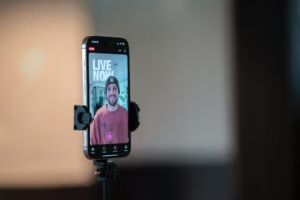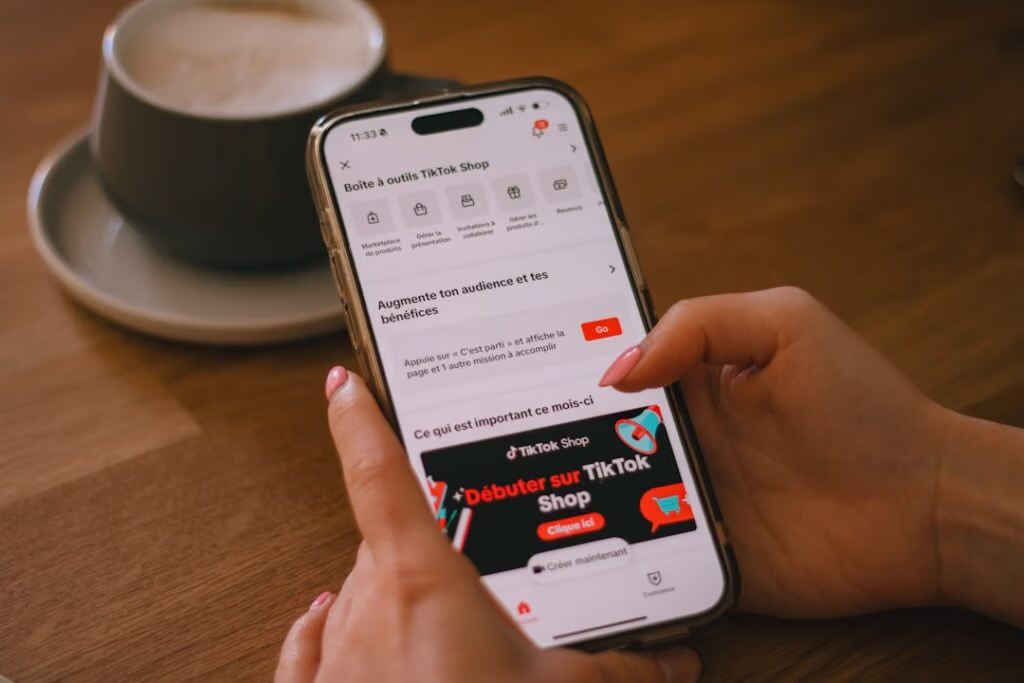
The social commerce In 2026, it will no longer represent a secondary sales channel but a structured ecosystem where TikTok Shop, Instagram Shopping, Pinterest Buyable Pins, and YouTube Shopping generate direct conversion flows from social media. The integration of video content, live streaming, and frictionless checkout is redefining the purchasing journey for Italian e-commerce, transforming social media from awareness channels into primary revenue channels. The convergence of intent-driven algorithms and embedded payment technologies represents a paradigm shift: users no longer leave the platform to complete a purchase, but conclude the transaction frictionlessly within the social ecosystem.
Industry research shows that the 76% of Italian consumers discover products through videos on social media and the 43% makes at least one purchase per month directly through social media platforms. Shoppable videos—interactive videos with clickable product tags—achieve click-through rates of 3–51% (compared to 0.5–11% for static posts), while live shopping generates conversion peaks up to 8 times higher than traditional sales. For Italian e-commerce businesses, the challenge is no longer whether to invest in social commerce, but How to structure an integrated strategy What are you combining content velocity, intent recognition, and frictionless checkout?.
Why Social Commerce Has Become Strategic in 2026
Social commerce in 2026 differs from simple “shoppable posts” of 2023-2024 due to three structural factors. First: deep integration of the checkout. TikTok Shop, Instagram Checkout, and YouTube Payment Processing no longer require redirection to an external e-commerce site. The entire transaction takes place within the app, reducing cart abandonment from 70% to 30–35%. Second: the alignment between discovery algorithms and purchase intent. TikTok, Instagram, and Pinterest's predictive algorithms analyze not only “likes” or “follows,” but also intent signals such as save-rate, add-to-cart-rate, and checkout-completion-rate. A shoppable product video can be promoted to thousands of users based on intent similarities, not just follower networks.
Third: the aggregation of micro-influencers and user-generated content (UGC) as a driver of trust. By 2026, 62% of social commerce sales will come from creators who are not “professional influencers” but power users with 10,000–100,000 followers who share authentic feedback on products. The saturation of AI-generated content on social media (see AI Slop vs. Editorial Excellence in 2026) has created an authenticity question that favors UGC content and the storytelling lo-fi.
For Italian e-commerce businesses, this means that social commerce in 2026 is not “an alternative way to sell online,” but a channel that integrates discovery, consideration, and purchase into a single flow. Strategies that separate content marketing (on social media) from conversion optimization (on e-commerce sites) lose their effectiveness. A unified vision is needed.
The Three Pillars of Italian Social Commerce in 2026
Shoppable Videos: From Viewing to Purchasing Without Clicks
Le Shoppable videos are videos produced in vertical format (9:16 or in-feed) with Interactive product tags that allow users to click directly on a visible element in the video and access the product page or add the item to the cart. Unlike old “links in bio,” shoppable videos keep the user within the social ecosystem throughout the consideration phase.
Technical Specifications for TikTok Shop:
- Optimal length: 15–60 seconds (videos between 31 and 60 seconds generate higher engagement)
- Product tag placement: Maximum 3-5 tags per video, placed during high attention moments (storytelling peaks).
- Opening hook: the first 3 seconds must clearly communicate the value (“This lipstick lasts 24 hours without smudging” vs. “Look at this lipstick”)
- Explicit call-to-action: “Click the tag to buy,” “Add to cart” (videos with an explicit CTA convert 231% more)
- Audio strategy: TikTok's algorithm favors videos with original audio or trending sounds (see Instagram SEO 2026: Audio Keyword Tagging)
Instagram Shopping technical specifications:
- Carousel with tags on Reels: each carousel card can be tagged with 1 product, allowing for multi-step narratives (“Problem → Solution → Result”)
- Collection Ads: group up to 50 products in a collection visible directly from the post, reducing the number of taps needed
- Integrated Checkout: Instagram Checkout supports credit card, PayPal, and Apple Pay payments directly in-app (no redirect).
Success metrics
- Save rate: percentage of users who save the video (indicates medium-to-long-term interest)
- Add-to-cart rate: number of clicks on product tag divided by video impressions
- Social media conversion rate: purchases completed directly on social media divided by clicks on product tags (target: 3-8%)
- Average order value (AOV): Ensure that the AOV on social commerce is not lower than -15% compared to the main website (risk of low-value traffic)
2. Live Shopping: Creating Urgency and Real-Time Interaction
The Live shopping (Go-live with products and integrated checkout) is the highest-converting format in social commerce 2026. During a live shopping event, a host (creator or brand representative) presents products in real-time, answers questions in chat, and applies time-limited flash discounts. The psychological urgency (“This discount expires in 5 minutes”) combined with social interaction (questions, comments) creates conversion rates 5-8x higher than on-demand video.
Live shopping platforms in 2026:
- TikTok Shop Live: Host can sell up to 500 SKUs per live; integrated checkout; recommended duration 30-90 minutes; average audience 1k-50k viewers per mid-size brand
- Instagram Shopping Live (Reels): native on Instagram; audience massimo 100k-500k if you have significant followers; product tagging during streaming
- YouTube Shopping: Integration with YouTube Store; critical audience retention (low drop-off rate)
- Pinterest Live Shop: less mature but growing; audience primarily fashion and home decor
Strategic Structure for a Successful Live Shopping Event:
- Pre-event (7-14 days prior): Promote the event with teaser content, build anticipation, and offer an early-bird discount (10–15% off for those who set a “remind me” reminder 48 hours in advance). For Italian brands, targeting Italy and Switzerland is strategic.
- Day-of promotion (2-6 hours before): Reminder posts, stories, and carousel with previews of products that will be sold exclusively.
- Live opening (first 5 minutes): Strong hook (“Last 500 units of [product] at [flash price]”), host presentation, immediate chat engagement
- Product narrative (25-35 minutes) Present 3-5 hero products, 2-3 minutes per product, include demonstrations, real-time testimonials, before-after visuals
- Flash deals (every 10-15 minutes): Time-limited discounts (“10 minutes for a 30% discount”) create a sense of urgency without coming across as pushy
- Engagement loop (continuous): Read comments in the chat, answer product questions, encourage purchases (“50 people just bought this—are you the next one?”), and share social proof
- Closing (last 2-3 minutes): Last chance to order, best-selling product recap, call-to-action to follow/subscribe
Live shopping metrics: critical
- Peak concurrent viewers: maximum number of simultaneous viewers (target: at least 20% of your follower base)
- Average view duration (AVD): the average amount of time a viewer spends watching a live stream (target: 70–80% of the total duration)
- Live conversion rate: completed transactions divided by unique visitors (target: 2-5%)
- Chat-to-sales ratio: What percentage of people who chat go on to make a purchase? (Target: 15–25%)
- Repeat purchaser rate: percentage of live shopping buyers who had previously purchased from you (loyalty indicator)
- Cost per Acquisition (CPA) live: revenue from live shopping divided by investments (influencer fee, flash discounts, paid promotion)
3. Intent-Driven Checkout: Reduce Friction and Optimize Conversions
The frictionless checkout (friction-less checkout) in social commerce is the difference between discovering a product, adding it to the cart, and abandoning it (70% cart abandonment rate) versus completing the transaction. On social media, cart abandonment is even more critical because it takes “minimal effort” for the user to leave the platform and forget about the cart.
Elements of frictionless checkout in 2026:
- One-tap payment Saving payment methods (Apple Pay, Google Pay, direct tokenization) enables checkout in 1–2 taps. Total time: 8–15 seconds. Target: 30–40% of social commerce transactions should be one-tap.
- Wallet integration TikTok Shop, Instagram Checkout, and YouTube Payment support Google Pay, Apple Pay, and PayPal. No redirects to external payment gateways means no drop-offs.
- Suggested shipping: The algorithm suggests the fastest shipping method (next-day, standard) based on geolocation and historical order depth. Fast shipping is clickable in 1 tap.
- Optional guest checkout: Allowing purchases without an account reduces cart abandonment by 15–20% (some users don’t want to create an account). Mandatory fallback: request an email address after purchase for receipts and shipping updates.
- Minimal upsell/cross-sell Related product recommendations (no more than 2–3) should be displayed BEFORE the final checkout, not after the item has been added to the cart. If displayed after the item has been added to the cart, they reduce completion rates by 8–12%.
- Transparent total pricing: Discounts, taxes, and shipping visible before the final tap (no “surprise costs”). GDPR compliance for billing data.
The user experience in a frictionless checkout should be:
- Click product tag (in video/live)
- Product detail page (1-2 seconds, with high-resolution product images, rating/review, size/color selector)
- Tap “Add to cart”
- Mini-cart appears (shows item + price + shipping estimate)
- Tap “Proceed to checkout”
- Checkout page: saved addresses (if known user) or quick form (name, email, address)
- Payment method (one-tap or selection from stored methods)
- Order confirmation (in-app confirmation + email)
Total time from click to confirmation: 45-90 seconds for mobile (critical target).
Content Velocity and Authenticity Strategies for Dominating Italian Social Commerce
In 2026, social commerce will be saturated with content. The difference between a brand generating €10k in monthly revenue from social and one generating €100k lies in the ability to produce high-frequency authentic content without falling into the trap of AI-generated slop. See AI Slop vs. Editorial Excellence in 2026 for an operational framework.
Content Velocity Strategies
- UGC-first strategy 60% of content should come from user-generated content (customers posting unboxing videos, reviews, and styling tips). Offer incentives such as discounts (10% off your next purchase if you share your UGC) or direct reposting. The TikTok and Instagram algorithms favor UGC over branded content by 15-25% in terms of reach.
- Micro-creator partnerships: Collaborate with 50-200 Italian micro-creators (10k-100k followers, high engagement) rather than 5-10 mega-influencers. Cost per impression: 5-10x lower; authenticity rate: 2-3x higher. See Brand Authority vs. Domain Authority in June 2026: Building Entity Reputation Through Podcasts, Videocasts, and UGC Platforms.
- Serial/episodic format Create micro-series of 5–10 episodes on a specific theme (such as how to use the product in everyday life, customer stories, or behind-the-scenes content). Episodic content generates 40–60% more views than one-off videos. See Micro-dramas and short series on social media.
- Community-driven hashtag campaigns: Launch a branded hashtag and encourage participation (e.g., a contest: the best UGC featuring #YourBrandWins [prize]). Collect the UGC, repost it, and foster a sense of community.
- Real-time content calendar Don’t plan everything 30 days in advance. Dedicate 40–50% of your content calendar to reactive content (trending topics, emergencies, spikes in demand for a specific product).
Integration with intent-driven algorithms:
TikTok's algorithm in 2026 uses a intent graph instead of a follow graph. This means that TikTok prioritizes not who you follow, but what you intend to buy, based on your past behavior (add-to-cart, wishlist, dwell time on shoppable videos). For a fashion brand, this means that a video of a shoppable fashion item will be shown not only to the brand's followers, but to all users who have:
- Saved similar products in the last 30 days
- Completed fast-fashion purchases in the last 90 days
- Spent more than 30 seconds looking at fashion/styling content
- Added similar products to cart (also on competitor storefronts)
To leverage the intent graph, the strategy is: Create content that caters to specific intents, not general followers.. If your audience is “women aged 25-35 interested in sustainable fashion,” create videos that address intents like “How to choose an ethical elegant dress,” “Fabric durability test: organic cotton vs. synthetic,” “Capsule wardrobe with 10 items.” These videos will be shown to all users with matching intent, not just your followers.
Technical Implementation: Connecting External E-commerce with Social Commerce Platforms
Many Italian brands use Shopify, WooCommerce (on WordPress), or other external e-commerce platforms. Connecting to TikTok Shop, Instagram Shopping, and YouTube Shopping requires specific technical setup.
Recommended Architecture:
- Inventory synchronization The product catalog (SKU, price, images, description) must be synchronized in real-time between the e-commerce site (source of truth) and social platforms. Use APIs or automatic feeds (CSV, XML). Maximum lag: 1 hour. If TikTok Shop shows a product as “in stock” but your Shopify says “out of stock,” you lose conversions and trust.
- Multi-channel order aggregation Orders from TikTok Shop, Instagram, and YouTube are aggregated into a single backend admin (Shopify, WooCommerce, Printful, etc.). Use API webhooks for order synchronization.
- Unified Analytics: Dashboard to track revenue, AOV, conversion rate, CAC (cost per acquisition) for each social commerce channel. Tools: Shopify Analytics (native), Google Analytics 4 with enhanced e-commerce tracking, Klaviyo for email follow-up.
- Compliance and tax: Every transaction on a social commerce platform generates a tax record. In Italy, consult an accountant for VAT compliance on cross-border transactions (e.g., TikTok Shop operating from the UK for Italy).
Example code for Shopify → TikTok Shop synchronization (via Shopify app):
Shopify provides the “TikTok Channel” app in the Shopify App Store. Once installed, the setup is:
1. Go to Shopify Admin → Apps → TikTok
2. Click "Add sales channel"
3. Authorize Shopify to access your TikTok Shop account
4. Select products to sync (all or a subset)
5. Shopify automatically syncs:
   - Product titles
   - Descriptions
   - Images (1080x1080px resolution recommended)
   - Price
   - Inventory
6. TikTok orders are imported into Shopify Orders
7. Fulfillment is managed via Shopify Shipping
For WooCommerce (WordPress):
If you use WooCommerce, connecting to TikTok Shop requires a third-party plugin (e.g., “WooCommerce TikTok Integration” from Woo Marketplace) or custom development via the WooCommerce REST API.
// PHP snippet to sync WooCommerce products to TikTok via API

add_action('woocommerce_update_product', 'sync_product_to_tiktok', 10, 1);

function sync_product_to_tiktok($product_id) {
    $product = wc_get_product($product_id);

    $product_data = array(
        'title' => $product->get_name(),
        'description' => $product->get_description(),
        'image_url' => wp_get_attachment_url($product->get_image_id()),
        'price' => $product->get_price(),
        'sku' => $product->get_sku(),
        'stock' => $product->get_stock_quantity()
    );

    $tiktok_api_url = 'https://open-api.tiktokshop.com/product/upload';
    $access_token = get_option('tiktok_shop_access_token'); // Stored securely

    $response = wp_remote_post($tiktok_api_url, array(
        'headers' => array(
            'Authorization' => 'Bearer ' . $access_token,
            'Content-Type' => 'application/json'
        ),
        'body' => json_encode($product_data)
    ));

    if (is_wp_error($response)) {
        error_log('TikTok sync failed: ' . $response->get_error_message());
    }
}
To configure WooCommerce in WordPress for social commerce, make sure that:
- The catalog is optimized (high-resolution images, keyword-rich descriptions, logical category).
- Schema markup for products implemented (see Schema Markup for the AI Era)
- WooCommerce REST API is enabled and secured (API key with limited permissions)
Critical Metrics for Measuring Social Commerce Success
Not everything that moves needs to be measured, but for social commerce, 5-7 KPIs should be monitored weekly:
| Key Performance Indicator | Formula | Target 2026 | Benchmark Industry |
| Conversion Rate (Social) | Purchases / Product Tag Clicks | 3-8% | 2-5% |
| Average Order Value (AOV) | Total Revenue / Number of Orders | No constraint (monitor site vs. main site) | Same as the e-commerce site |
| Cost Per Acquisition (CPA) | Paid Ads on a Budget / New Clients | €30 (product-dependent) | €25-50 |
| Return on Ad Spend (ROAS) | Revenue / Ad spend | 3:1 to 5:1 (sustainable minimum) | 2:1 to 4:1 |
| Cart Abandonment Rate | 1 – (Completed Orders / Add to Cart) | <40% (for social commerce) | 60-70% (e-commerce website) |
| Customer Lifetime Value (CLV) | Average Revenue Per Customer / Churn Rate | 3-5x the CPA | 2-3x the CPA |
| Live Shopping Conversions | Orders completed / Unique viewers in live | 2-5% | 1-3% |
Use Google Analytics 4 with enhanced e-commerce tracking to track these metrics. Configure custom events for each social channel (source: TikTok, Instagram, Pinterest, YouTube).
Common Challenges and How to Solve Them
Challenge 1: Cross-channel inventory management
If you sell 50 units of a product and 45 are ordered via TikTok Shop in 24 hours, the rest of the inventory (e-commerce site, physical stores) risks selling out quickly. Solution: Use a centralized inventory system (Shopify, Linnworks, Vend) that synchronizes available stock in real-time across all channels. Set up alert thresholds (e.g., “Alert when stock < 10 units”).
Challenge 2: Logistics Costs for Small Orders
An order of €25 with an €8 shipping cost quickly becomes unprofitable if you don't manage logistics. Solution: Negotiate bulk rates with Italian couriers (DHL, Poste, and GLS offer volume discounts). Consider local fulfillment or partnerships with 3PL (third-party logistics) providers. For lightweight products, consider economy shipping with 3-5 day delivery times (this reduces shipping margins by 30-40%).
Challenge 3: Creating Authentic Content at a Sustainable Pace
Producing 10-15 shoppable videos per month plus 2-3 live shopping events and UGC curation is a significant workload. Solution: Assign roles (content creator, video editor, community manager). Use pre-built editing templates (Adobe Premiere Projects with color grading, music, transitions already applied). Automate UGC curation with tools like Buffer, Hootsuite for scheduling.
Challenge 4: Attribution between Social Media and Other Conversion Sources
The user discovers the product on TikTok, abandons their cart, then 3 days later searches Google for the brand and purchases from the website. Who deserves credit? Solution: usa GA4 multi-touch attribution (Time Decay or Position-Based) to allocate credit. Track “assisted conversions” (conversions where TikTok was part of the journey, not the last source).
FAQ
Which social platform generates the most social commerce volume for Italian e-commerce in 2026?
TikTok Shop dominates with 45–50% of total social commerce revenue in Italy, followed by Instagram Shopping (25–30%) and Pinterest (15–20%). YouTube Shopping and Amazon Live are growing but remain niche. The reason is that TikTok has the youngest demographic (18-35 years old) with the highest purchase intent, while Instagram leads for mid-range fashion and home decor. For light B2B products (coaching, digital products), LinkedIn is underestimated.
The ideal duration for a shoppable video on TikTok to maximize conversions is typically between 15 and 60 seconds.
31–60 seconds is the optimal range, with a hook in the first 3 seconds. Videos between 16 and 30 seconds have high engagement but lower conversion rates (users don’t have enough time to understand the product’s value). Videos longer than 90 seconds suffer from drop-off (40% of users do not finish watching). A 45-second video structured as “Problem (0–15s) → Solution (15–35s) → CTA + Product Tag (35–45s)” is the sweet spot.
How do I handle returns for products purchased via social commerce?
TikTok Shop and Instagram Shopping allow you to set return policies (e.g., “30 days, free returns”) directly on the platform. The customer receives a return label and the refund is processed once the product is received by the warehouse. For external e-commerce (Shopify, WooCommerce), synchronize the return policy on social platforms and ensure that all touchpoints (confirmation emails, in-app order details) clearly communicate the terms.
What minimum budget should I allocate for live shopping to make it sustainable?
A generic live shopping event requires: €200-500 for influencer fees (if using an external host), €0-300 for flash discounts (discount budget), €0-200 for paid promotion (live boost). Minimum budget: €500-1000 per event. For a positive ROI, you need to generate at least €1500-2000 in revenue from the live (ROAS 2-3:1). If your audience is small (100k, a weekly live is sustainable.
How do I measure social commerce attribution when checkout is on-platform versus on my external website?
Use UTM parameters for tracking. If the flow is Shoppable Video → My Shopify Store → Checkout, add “?utm_medium=social&utm_campaign=shoppable_video” to the URL. If checkout is native to TikTok, TikTok provides analytics dashboards (TikTok Shop Dashboard → Analytics → Sales, Conversion, Revenue per campaign). To unify data, connect TikTok Shop to your Google Analytics 4 (native connector available) and view in GA4 as traffic/conversion source.
Conclusion
The social commerce 2026 represents a structural opportunity for the Italian e-commerce to transform social media from a marketing channel to a primary revenue channel. The convergence of shoppable videos, live shopping, and frictionless checkout eliminates the friction points that have historically limited social conversion. The intent-driven algorithms of TikTok, Instagram, and Pinterest allow brands to reach users with high purchase intent, regardless of their follower count.
The winning strategy in 2026 is not choosing between social commerce and traditional e-commerce, but integrate the two ecosystems with inventory synchronization, multi-touch attribution, and high-frequency authentic content. Brands investing in UGC, micro-influencer partnerships, and episodic storytelling (rather than hard-sell) achieve higher ROAS and greater customer lifetime value.
For Italian e-commerce businesses, implementation priorities should be: (1) TikTok Shop setup with Shopify/WooCommerce synchronization, (2) creation of 10-15 shoppable videos per month, (3) planning of 1-2 monthly live shopping events with Italian micro-creators, (4) unified analytics setup to track social commerce revenue and attribution. With operational discipline and continuous experimentation on formats, social commerce quickly becomes an economic pillar of Italian e-commerce.