In 2026, the online search landscape has undergone a structural transformation. About 49% of consumers use TikTok as a search engine, representing an increase of nearly 20% compared to the 2024 baseline. Social media are no longer simple distribution channels: they have transformed into genuine parallel search engines, with proprietary algorithms, distinct ranking factors, and user intent flows completely different from Google.
For publishers, brands, and creators, ignoring this evolution means losing visibility on a discovery layer where a growing volume of intentional searches, especially among Gen Z and Millennials, is concentrated. This technical guide examines how to optimize content for TikTok, Instagram, and YouTube as search engines, not as traditional social platforms.
Why Social Media Has Become a Search Engine in 2026
In 2026, search is no longer Google's exclusive game. Users are asking TikTok for product recommendations, using Instagram to vet brands, and relying on YouTube for in-depth tutorials and reviews. For many audiences, especially under 35, these platforms are now primary search engines with their own ranking factors, algorithms, and user expectations..
Traditional SEO assumes intent comes first. In 2026, algorithms surf solutions before intent forms. Scroll. A creator shows a tool. A quick demo solves a problem you didn't know you had. That moment is discovery, and it often happens before a search..
Social media platforms such as YouTube, TikTok, and Instagram collectively account for over 60% of product discovery, while Google accounts for only 34.5% of the total search share. This shift in priority requires a complete rethinking of visibility strategy: no longer search engine optimization, but Social discovery engine optimization.
Social Algorithms vs. Google: Divergent Technical Foundations
In 2026, every major platform has shifted from follow graph-based recommendation to interest graph-based recommendation. Followers no longer guarantee reach; the content itself must earn distribution. Dwell time and completion rate are the two most underrated ranking factors: both now weigh more than likes on Instagram, TikTok, YouTube, and LinkedIn..
TikTok: Follower-First Distribution and 70% Completion Threshold
In 2026, follower engagement is key to distribution. The video is first shown to a small test audience of your followers. If it performs well with them, distribution expands. If your followers don't engage, the video fades away.
You'll need a completion rate of 70%+ to go viral in 2026—up from 50% in 2024. Translation: Your hooks need to be stronger. The pacing needs to be faster. Every second counts..
Videos that people rewatch immediately receive massive algorithmic boosts. A rewatch rate above 15-20% is considered a strong signal. One viewer who watches your video three times is better than three viewers who watch it once..
Instagram: Signal Hierarchy and Saves as Intent Indicators
Reels are a signal of intent that Instagram weighs very heavily. Optimize in this sequence: hook (first 1.5 seconds) → retention curve → loop mechanic → share trigger → caption for save. Most creators optimize in reverse order and wonder why reach stalls..
Hashtags no longer drive significant discovery on Instagram or TikTok in 2026. Both platforms read captions, on-screen text, and audio to understand the topic, making natural language captions far more important than a list of tags..
YouTube: Search + Recommendation Dual Engine with Bias Towards Long-Form
YouTube is less ephemeral than social platforms. It's where content lives on over time and continues to drive search traffic, subscriptions, and long-term views. It plays a central role in upper-funnel awareness, education, and content-driven lead capture..
Search is a major discovery channel. TikTok has continued to expand its search functionality—with 84% of TikTok searches occurring during the exploration phase—making keyword-optimized captions and on-screen text more important for discoverability beyond the For You feed.
Hook Engineering: The Architecture of the First 3 Seconds
The concept of a “hook” in social research is not clickbait. It is intentional architecture of intent flow. In traditional search engines, users type queries; algorithms return answers. In social discovery, users scroll; algorithms present solutions. The hook is the mechanism that transforms passive exposure into active engagement.
Types of Hooks for Search Discovery
- Query-Answer Hook: Start with a question that directly matches how users search. Example: “How to fix dry skin in winter? Three dermatologist-approved tips.” This aligns the content with the exact search intent.
- Contrast Hook Start with a contrarian statement that piques interest.. Example: “You think volume is the secret to a viral TikTok. I disagree.” This works for exploratory searches where the user wants to challenge assumptions.
- List/Utility Hook Some creators lead with a list or quick insights right from the start. Rather than teasing information slowly, this hook promises immediate payoff. Examples: ‘Three things every new filmmaker needs to know’ or ‘Five apps that will make your life easier’.
- Curiosity Gap Hook: One of the most powerful storytelling tools is the curiosity gap, or the space between what the audience knows and what they want to know. Useful for non-commercial research where the user is looking for general information.
- Data/Proof Hook: Numbers, statistics, or data in your hooks can significantly increase their credibility and appeal. Data-driven hooks instantly establish credibility while building curiosity about the source..
Execution Time and Testing
You have 3 seconds to hook the viewers. On a technical level, this means:
- Frame 0–0.5 s: Visual, text, or audio must stop scrolling. There are no exceptions.
- 0.5-2s frames: Communicate the promise of value or curiosity. If the user doesn't feel there will be a reward in the next few seconds, they will leave.
- Frame 2-3s: Start delivering on that promise. A first concrete example, or a subtitle that confirms the direction.
Test these hook patterns using native A/B testing on each platform. Instagram Insights, TikTok Analytics, and YouTube Studio provide data on click-through rates, retention curves at 25%/50%/75%, and engagement velocity in the first 30 seconds.
Answer Architecture: Structuring Content for Semantic Indexing
When an organization publishes content in a modern social search ecosystem, the asset undergoes a multi-tiered automated evaluation process. Content Ingestion and Keyword Parsing: The platform's algorithm scans the audio transcript, on-screen text, and description tags to classify the core topic. Initial Testing Phase: The asset is distributed to a highly targeted seed group of users who have recently shown search intent for that specific subject. Engagement Analysis: The algorithm evaluates real-time user signals. If critical metrics such as watch time and completion velocity fall below the platform's threshold, distribution ceases. Velocity Extension: If the seed group demonstrates high engagement, watch completion, and sharing behaviors, the platform scales distribution widely and systematically indexes the asset for long-term search access..
This technical flow implies that content should be structured not for human reading, but for semantic extraction by the algorithms and AI systems that power both in-platform searches and Google's AI Overviews.
Technical Components of the Answer Architecture
- Captions with Natural Keywords: Using relevant keywords in captions can increase the visibility of 20-40% content. Key placement areas: Captions — Include target keywords in the first 150 characters · On-screen text — TikTok uses OCR to scan text; place keywords within the first 2–3 seconds · Voiceover/spoken audio — Say the primary keyword within the first few seconds · Profile name and bio — Optimize for search terms in your niche.
- Explicit Voiceover Audio transcription is becoming increasingly important. Saying the query and the answer in the voiceover ensures the algorithm captures the intent and topic. No background music, just a clear narrative structure.
- On-Screen Text with OCR Optimization Visible text is scanned by algorithms. Place keywords, topic markers, and step numbers where eyes naturally pause.
- Structured Subtitles/Captions Not just for accessibility. On YouTube and TikTok, closed captions are indexed and influence in-platform ranking. Use bullet points or formatting that facilitates automatic parsing.
- Logical Flow Arc Problem → Contextualization → Step-by-step solution → Validation/Proof. This narrative arc is more easily interpretable by semantic systems than digressions or circular storytelling.
Intent Matching: Align Content to Effective Queries
People use social media like search engines, but they don't search with keywords. They search with full questions and real-life situations..
For each intent, the first step is to map the real questions your audience is asking. Don't speculate. Use real research tools:
- TikTok Search Suggest Type a keyword into the TikTok search bar. Observe the suggested autocompletes. These are real queries that users are searching for in real-time on that platform.
- Instagram Search Insights: Monitor the Instagram Search tab in your creator account (if available). See how users are searching for terms in your niche.
- YouTube Search Suggestions Simile. Type a keyword. Record the 10 autocomplete suggestions. These inform content topics that have proven search demand.
- Reddit/Discord Monitoring: Read conversations in subreddits and Discord servers related to your niche. Extract unresolved questions. These are content opportunities with low search volume but extremely high intent.
Once the actual queries are mapped, structure the content as Direct answer. Non-narrative flow; answer explicitly positioned in the first few seconds, followed by validation and detail.
Example: Framework Question → Answer → Evidence
- Second 0-1 (Hook/Query): “How to remove a watermark from a TikTok video?”
- Second 1-2 (Answer Preview): “There are 3 methods. The fastest takes 30 seconds.”
- Second 2-10 (Evidence/Step 1): Show tool, click path, result on-screen.
- Second 10-20 (Alternatives/Depth): Method 2 and 3 with tradeoff comparison.
This pattern optimizes for a high completion rate, as the user knows exactly what to expect and sees the value within the first few seconds. It reduces bounce rate (users scrolling away), increases save rate (they save the video to watch later), and improves share rate (the content's solvability is clear).
Critical Differences from Traditional Google SEO
The temptation is to apply traditional SEO logic to social media. This is a costly mistake. Here are the key divergences:
| Factor | Google Search | Social Media Search Layer |
|---|---|---|
| Freshness Signal | Important, but balanced with historical authority | Critical. Strong recency bias. Older content rarely resurfaces. |
| Backlink Authority | Primary ranking factor | Irrelevant. Internal engagement and watch time determine distribution. |
| Keyword Density | Moderate match between keyword and content | Semantics and intent. Over-optimized repeated keywords trigger algorithmic penalties |
| Content Length | Long, in-depth, with the intent to rank | Optimized for platform. TikTok/Instagram: 60-180 seconds. YouTube: 8-15 minutes |
| Primary User Behavior Signal | Click-through rate; time on page | Completion rate; rewatch rate; save/share velocity |
| Follower/Authority Effect | Domain authority is basic; new domains have an uphill battle | Irrelevant. A creator with 100 followers can outperform a creator with 100K if their engagement is higher. |
Technical Implementation: Content Repurposing Without Cross-Post Penalty
Native cross-posting always beats cross-posting. Visible watermarks, wrong aspect ratios, and misaligned hook patterns all trigger distribution penalties..
The correct strategy isn't “create once, publish everywhere.” It's “plan once, execute natively on every platform.”
Correct Repurposing Flow
- Single-source sourcing: Create source content once: it could be a 15-minute long-form video, a blog article, or a recorded podcast session.
- Platform-Specific Extraction Extract clips and reformat for each platform. Do not use cross-posting software. Manual or semi-manual editing ensures each output is native.
- Per TikTok: 60-180 seconds. Aspect ratio 9:16. Overlaid captions. Hook in the first 0.5 seconds. Trending audio optional but tested. Keyword in the primary caption (first 150 characters).
- Per Instagram Reels: 30-90 seconds. 9:16 aspect ratio. Stronger visual hook (Instagram rewards early engagement). On-screen text captions. Hashtags (3-5 selected, no keyword stuffing). Secondary caption text as engagement prompt (ask to save, comment, DM).
- For YouTube Shorts: 15-60 seconds. Hook in the first 1 second. Thumbnail if clickable (YouTube is increasingly testing click-to-view Shorts). End-screen CTA (subscribe, watch full video). Rich description with keywords and timestamps.
- Platform-Native Optimization Every clip must be optimized for that platform's specific algorithm before publication.
- TikTok: Searchable captions, completion rate testing with analytics.
- Instagram: Save-optimized caption (e.g., “Save this for later”), tested engagement bait.
- YouTube: Title with keyword, description with first 150 characters containing semantic topic, secondary tags.
- Post Independently: Publish on different programs. Not simultaneously. Leave 2-4 hours between TikTok and Instagram; 4-8 hours between Instagram and YouTube. This avoids algorithmic cannibalization (Google and Meta discourage those who publish the same content in rapid succession).
Ranking and Real-Time Monitoring Metrics
Beyond vanity metrics (likes, follower count), the metrics that actually predict search rankings on social media are:
- % Completion Rate (video placement): Percentage of users who watch the video all the way through. Target: 70%+ for TikTok. 50%+ for Instagram. YouTube is less stringent but still important.
- Rewatch Rate % (ranking by video): Percentage of viewers who watch the video again. 15%+ is considered a strong signal.
- Save Velocity (first hour, normalized by viewer base): On Instagram and TikTok, saves carry more weight than likes. A high % save rate indicates usefulness and intent matching.
- Share-to-DM Ratio Users who share videos privately (DM) vs. public shares. Private shares indicate higher intent and trust in the content.
- Comment Quality (length, depth, not just count): Long and detailed comments carry more weight than one-word comments. The algorithm scans comment sentiment and relevance.
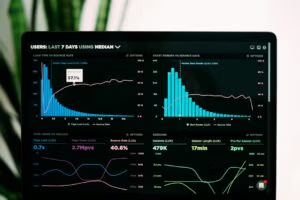
- Search Impression Share (per TikTok, Instagram, YouTube): How many users who searched for query X saw your content? Available in native analytics; crucial for social search optimization.
Configure custom dashboards in Google Sheets or Looker Studio that monitor these metrics day by day, platform by platform. Identify patterns: which hook types generate the highest completion rate? Which queries have the lowest search impression share (opportunity gap)? Which days/times generate fast engagement within the first 30 minutes?
Integrate Social Search with AI Overviews and Generative Search
Social media does not exist in isolation. As described in GEO Beyond AI Overviews: Optimizing Content for Gemini, Perplexity, and Conversational AI Assistants, AI systems crawl public social content to populate AI Overviews and conversational search responses.
Massive convergence is happening between social media architectures and AI search engine architecture. Enterprise platforms no longer operate in isolation. Instead, there is a highly integrated data loop between them: Enterprise Content Production (brands generate specific multi-modal assets with spoken audio, clear on-screen visual demonstrations, and detailed text descriptions). The Public Social Data Layer (as users interact with this content, they generate a secondary layer of real-time sentiment data, peer reviews, and unpolished user-generated content). Generative AI Ingestion (modern conversational tools and AI search treat this entire social data ecosystem as a vital repository and actively crawl community forums, social video text, and public comments to formulate contextual answers to high-intent transactional queries)..
Implication: Social content that ranks on TikTok/Instagram also influences how your brand appears in AI chatbots. Therefore, optimizing for social search isn't isolated; it's part of a broader layering of visibility that includes Google AI Overviews, Gemini, Perplexity, and other AI assistants.
See also Generative Engine Optimization (GEO) and AI Overviews: How to Get Cited by ChatGPT, Gemini, and Perplexity in 2026 for the complete GEO strategy.
Alignment with March 2026 Core Update and E-E-A-T Principles
In the March 2026 core update, Google emphasized Originality and Information Gain. For Italian publishers, this means that original research and hands-on expertise now carry more weight than generic roundups. Paradoxically, the social media search layer rewards the same (originality, experience, authenticity).
For alignment, see Information Gain Framework: How to Overcome the March 2026 Core Update Evaluation e E-E-A-T 2026: Experience Over Credentials.
Content that performs well on social media search layers (original demo videos, hands-on testing, unpolished but authentic process documentation) is the same content that Google rewards in its post-March 2026 evaluation.
FAQ
If I post on TikTok, do I have to optimize for Instagram and YouTube as well?
No. It depends on where your audience actually searches. If your niche is beauty/fashion, TikTok and Instagram Reels are mandatory. If it's tech/education, YouTube is primary. If it's B2B/professional, LinkedIn + YouTube. Cross-platform analysis reveals where to invest based on your business model. For B2B services firms in the UK, LinkedIn provides the highest quality leads per hour of effort because dwell-time-rich content reaches decision-makers. For local consumer businesses, Instagram Reels and TikTok offer more cost-effective reach to nearby customers. For something that benefits from in-depth explanation or search discovery, YouTube compounds over time.. Focus on the platform(s) where your target audience actually searches.
How long before seeing ranking improvements on social search?
Unlike Google, where ranking visibility can take weeks, social media ranking is real-time. Within 24-48 hours of publishing, you should see data on completion rate, save rate, and search impressions. If your hook and answer architecture align with the intent, you'll see velocity improvement (more views, better CTR) within that window. If not, the algorithm quickly stops promotion. This means the test-and-iterate cycle is much shorter on social versus traditional SEO.
Can I use generative AI to create hook engineering content?
Partially, but with caution. AI can brainstorm hook variations. The TikTok algorithm in 2026 will prioritize watch time over views, reward niche-specific content, and favor authentic human creators over AI-generated videos.. For the architecture of your answer, you can use AI for scriptwriting. But the hook itself, especially the first 3 seconds, needs to be human-created or at least human-tested. AI hooks often lack the specificity, urgency, and cultural context that actually makes someone stop scrolling.
Which platform should be my number one focus if I have limited resources?
YouTube, TikTok, and Instagram collectively account for over 60% of product discovery. But within that 60%, the distribution is not uniform across niches. Rule of thumb:
- E-commerce / Lifestyle / Under-35 audience: TikTok first, Instagram Reels second.
- Education / High-Consideration SaaS / How-Tos: YouTube primary, TikTok secondary.
- B2B / Thought leadership / Older demographics: LinkedIn for initial engagement, YouTube for in-depth content.
Choose one platform, master its algorithm completely (completion rate, save triggers, hook patterns), before expanding.
You can monitor search impression share and search ranking on social media by using a combination of social listening tools and analytics platforms.
Each platform provides native analytics:
- TikTok Creator Center: Videos tab > click video > Detailed Analytics. Check “Search Impression Share” (new in 2026). This shows the percentage of users who searched for a keyword and had your video shown to them.
- Instagram Insights: Professional account > Insights > Reach tab. Monitor “Impressions from Explore” and “Impressions from Search” separately. Track this weekly.
- YouTube Studio Analytics > Reach > Traffic Source. Filter by “YouTube Search.” See which videos generate search traffic and their associated keywords. Use YouTube's “Search Traffic” report.
Set up monthly tracking spreadsheets that track search impression share trends. If you choose to go down, re-optimize captions, hook format, or topic alignment.
Conclusion
In 2026, social media is no longer just an awareness channel. It's a competing search engine with radically different functionality from Google. Social media SEO is replacing Google as the starting point for search..
For publishers, brands, and creators, the change is in effect:
- Abandon the keyword-stuffing mentality of traditional SEO.
- Adopt Tailored platform-specific engineering hooks and architecture.
- Optimize per completion rate, rewatch rate, and save velocity — not per like count.
- Integrate Social search optimization with a broader GEO strategy to maintain visibility in AI assistants.
- Monitor real-time search impression share and ranking, not weekly or monthly.
The framework presented in this guide—hook engineering + answer architecture + intent matching + platform-native execution—is not a tactic that will disappear next year. It is the technical architecture of how discovery works in 2026, and likely beyond. Mastering this framework is non-negotiable for builders who want to maintain organic visibility.