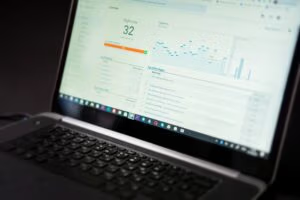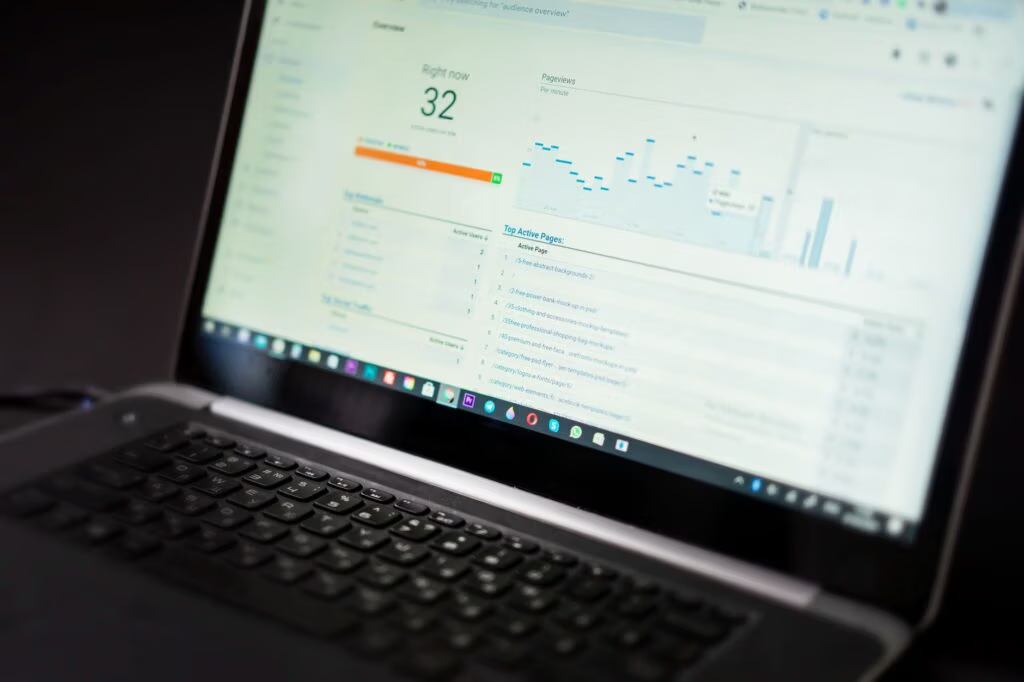
The real-time monitoring of citations in Google AI Overviews represents a fundamental operational discipline for Italian publishers in 2026. The research shows that the overlap between the top 10 organic results and AIO citations has decreased from 76% in mid-2025 to a percentage ranging from 17% to 38%, indicating a structural divergence between traditional rankings and visibility in AI Overviews. This separation renders conventional tracking metrics inadequate, as The citation measures whether the AI-synthesized answer is actually drawing content from your pages and referencing you as the source., a radically different signal from the SERP position.
The loss of zero-click traffic is permanent. Queries that trigger AI Overviews generate an average zero-click rate of 83%, which means that users get answers without visiting any websites. For Italian publishers of tech, news, and content marketing, this entails directly measurable implications: When Google shows an AI Overview for a search query, it registers in Google Search Console as an impression, just like any other organic result. Therefore, impression counts can appear healthy, or even grow, while actual clicks decline. This is called the Great Decoupling: impressions rising while clicks decrease. It’s one of the clearest diagnostic signals that AI Overviews are absorbing your traffic..
Understanding the Attribution Chain in AI Overviews
The attribution chain in AI Overviews follows a radically different logic from traditional SEO metrics. Key winners in 2026 will monitor traditional SEO metrics (rankings, traffic, CTR, time on page) alongside AI metrics (citation frequency, share of voice, brand mentions, attribution quality)..
In the context of Italian publishers, the attribution chain is structured in three levels:
- Citation Frequency: How often are you mentioned across all AI platforms? Query your target keywords monthly and document the results..
- Share of Voice (SoV) your citation rate compared to competitors for the same queries.
- Attribution Quality: if the citations include your brand name, URL, or a specific content reference.
Visibility in AI Overviews isn't a binary variable (cited/not cited). It's a complex hierarchy: the first cited result captures most of the residual traffic, while secondary citations receive almost nothing. For this reason, the technical monitoring architecture must track what position The word *occupi* in the quote, not just if you come to be quoted.
Why Traditional Tracking Tools Fail
A tool built around keyword positions will miss out on up to 62% of visibility opportunities where your brand appears or does not appear as an AI source. This is a critical point: standard SEO dashboards cannot answer crucial questions for editorial survival in 2026.
The technical problem is that AI citation monitoring is the practice of checking when and how AI response engines – ChatGPT, Perplexity, Google AI Overviews, Claude, Gemini, Copilot – reference your brand, cite your URLs, or show your competitors instead of you. It's a distinct measurement level from traditional SEO ranking tracking. A page can rank number one on Google and be completely absent from ChatGPT's response to the same query..
For Italian publishers, this means that a monitoring strategy must integrate:
- Organic Ranking Tracking (Traditional) (Search Console API)
- AI Citation Monitoring in Real-Time (Scriptable + Citation Tracking API)
- Attributable analytics for each AI source (BigQuery + GA4 export)
- Predictive Analysis of Quote Volatility (BigQuery ML)
Step 1: Set up the Google Search Console API and BigQuery
To get the most detail and minimize discrepancies in data, we recommend exporting Search Console data to BigQuery and joining it with your Google Analytics BigQuery export data..
Setting up GSC Export to BigQuery
- Login Google Cloud Console and create a new project (or use an existing one).
- Enable the Google Search Console API.
- In Search Console, go to Settings → Export data to BigQuery.
- Select the BigQuery project.
- Allow daily GSC data dumps (impressions, clicks, average position, CTR).
Using the GSC API, it is possible to store the positions for each keyword for each country and date. This creates a historical baseline that standard Search Console does not provide.
GA4 Export to BigQuery
Choose the BigQuery project. Select the same Google Cloud project that you used for the GSC export. This is important. Both datasets must be in the same project, otherwise you will have to configure cross-project permissions on your service account later..
-- Basic SQL query for GSC diagnostics in BigQuery
SELECT
  date,
  page,
  query,
  SUM(clicks) AS total_clicks,
  SUM(impressions) AS total_impressions,
  AVG(position) AS avg_position,
  ROUND(SUM(clicks) / SUM(impressions), 4) AS ctr
FROM
  `project-id.dataset.search_analytics_*`
WHERE
  date BETWEEN '2026-05-01' AND '2026-06-18'
  AND page LIKE '%blog%'
GROUP BY
  date, page, query
ORDER BY
  total_clicks DESC
LIMIT 1000;
This result highlights the blog pages that experienced the biggest drop in clicks. If impressions remain stable or grow while clicks plummet, it's a diagnostic of loss from AI Overviews.
Step 2: Monitoring Multi-Platform with Scriptable on iOS
Scriptable supports JavaScript ES6. Scripts are stored as plain JS files on disk. You can run scripts from Siri Shortcuts. For lean teams operating across iOS devices and desktop dashboards, Scriptable provides a lightweight automation layer that can query citation tracking APIs and send real-time alerts.
Scriptable Script for Daily Queries to AI Models
It is possible to leverage JavaScript to automate tasks, integrate with APIs, access device features, display analytics, or even simplify processes. It is possible to consume any RESTful API that returns data in formats like JSON or XML..
// Script Scriptable per monitoraggio quotidiano delle citazioni in AI Overviews
const API_KEY = "your-api-key-here"; // Da LLM Pulse, Profound, o altra piattaforma
const TARGET_KEYWORDS = [
  "WordPress 7.0",
  "AI Publisher WP",
  "Google AI Overviews",
  "content moderation WordPress"
];
const AI_PLATFORMS = ["google_aio", "chatgpt", "perplexity", "claude"];

async function checkAICitations() {
  let results = {};

  for (let keyword of TARGET_KEYWORDS) {
    console.log(`Monitoraggio: ${keyword}`);

    for (let platform of AI_PLATFORMS) {
      try {
        let url = `https://api.llmpulse.io/check-citation?keyword=${encodeURIComponent(keyword)}&platform=${platform}&api_key=${API_KEY}`;
        let req = new Request(url);
        let response = await req.loadJSON();

        results[keyword] = results[keyword] || {};
        results[keyword][platform] = {
          cited: response.cited,
          position: response.citation_position,
          url: response.source_url,
          timestamp: new Date().toISOString()
        };
      } catch(e) {
        console.error(`Errore per ${keyword} su ${platform}: ${e}`);
      }
    }
  }

  // Salva i risultati in iCloud/Files.app per successiva importazione in BigQuery
  let fm = FileManager.iCloud();
  let fileName = `ai-citations-${new Date().toISOString().split('T')[0]}.json`;
  let dirPath = fm.documentsDirectory();
  let filePath = fm.joinPath(dirPath, fileName);

  fm.writeString(filePath, JSON.stringify(results, null, 2));
  console.log(`Risultati salvati: ${fileName}`);

  // Opzionale: invia notifica
  let notification = new Notification();
  notification.title = "Citation Tracking Completato";
  notification.body = `Monitorati ${TARGET_KEYWORDS.length} keyword su ${AI_PLATFORMS.length} piattaforme`;
  await notification.schedule();
}

await checkAICitations();
This script automates the daily process of querying AI models with your target keywords. The results are saved locally and can be later imported into BigQuery for historical analysis.
Step 3: Real-Time Dashboard with BigQuery and Looker Studio
Direct integration is with Google's Looker Studio: this combination allows you to create powerful SEO dashboards that automatically update as new data flows into BigQuery..
BigQuery Schema for Citation Tracking
-- Main table to store AI citations
CREATE OR REPLACE TABLE `project-id.ai_tracking.citation_log` AS
SELECT
  CURRENT_TIMESTAMP() AS measurement_date,
  'keyword-placeholder' AS keyword,
  'platform-placeholder' AS ai_platform,
  TRUE AS is_cited,
  1 AS citation_position,
  'https://aipublisherwp.com' AS cited_url,
  'high' AS citation_confidence,
  0.85 AS relevance_score
WHERE FALSE; -- Initialize empty, populated by Scriptable

-- Daily summary table for the dashboard
CREATE OR REPLACE TABLE `project-id.ai_tracking.daily_summary` AS
SELECT
  DATE(measurement_date) AS report_date,
  ai_platform,
  COUNT(DISTINCT keyword) AS unique_keywords_tracked,
  COUNTIF(is_cited = TRUE) AS citations_earned,
  ROUND(COUNTIF(is_cited = TRUE) / COUNT(*) * 100, 2) AS citation_rate_percent,
  AVG(relevance_score) AS avg_relevance,
  AVG(citation_position) AS avg_position
FROM
  `project-id.ai_tracking.citation_log`
GROUP BY
  report_date, ai_platform
ORDER BY
  report_date DESC;
These schemas allow for efficient storage and aggregation of citation data for subsequent reporting.
Looker Studio Configuration
- Login lookerstudio.google.com.
- Create a new Report.
- Add Google BigQuery as a data source.
- Select the `ai_tracking.daily_summary` dataset.
- Create the following widgets:
- Citation Rate Trend Show the evolution of the citation rate over time.
- Platform Breakdown (Pie Chart): distributes the quotes among Google AIO, ChatGPT, Perplexity, and Claude.
- Keyword Performance Table: List each keyword with its citation count and average position.
- Alerts Card Highlights any declines in citations greater than 15% compared to the previous day.
The dashboard must be built for action, not vanity. Each visual element must answer a specific operational question: “Which keyword lost mentions this week? For which platform? At what speed?”
Step 4: Integrating the Search Console API for Traditional Ranking
Data-driven SEO with GSC API and BigQuery means automatically collecting Search Console performance data daily, storing it in a queryable data warehouse, and using SQL to transform clicks, impressions, CTR, and position into prioritized, measurable SEO actions. A GSC API + BigQuery workflow solves the problem by turning search performance into a repeatable measurement system..
-- Diagnostic Query: Impression/Click Decoupling (AI Overviews Signal)
WITH monthly_trend AS (
  SELECT
    DATE_TRUNC(date, MONTH) AS month,
    page,
    SUM(clicks) AS total_clicks,
    SUM(impressions) AS total_impressions,
    ROUND(SUM(clicks) / SUM(impressions), 4) AS monthly_ctr
  FROM
    `project-id.dataset.search_analytics_*`
  WHERE
    date BETWEEN '2025-06-01' AND '2026-06-18'
  GROUP BY
    month, page
),
month_over_month AS (
  SELECT
    *,
    LAG(total_clicks) OVER (PARTITION BY page ORDER BY month) AS prev_month_clicks,
    LAG(monthly_ctr) OVER (PARTITION BY page ORDER BY month) AS prev_month_ctr,
    ROUND((total_impressions - LAG(total_impressions) OVER (PARTITION BY page ORDER BY month))
          / LAG(total_impressions) OVER (PARTITION BY page ORDER BY month) * 100, 2) AS impression_change_pct,
    ROUND((total_clicks - LAG(total_clicks) OVER (PARTITION BY page ORDER BY month))
          / LAG(total_clicks) OVER (PARTITION BY page ORDER BY month) * 100, 2) AS click_change_pct
  FROM
    monthly_trend
)
SELECT
  month,
  page,
  total_impressions,
  total_clicks,
  monthly_ctr,
  impression_change_pct,
  click_change_pct,
  CASE
    WHEN impression_change_pct > 5 AND click_change_pct > 15 THEN 'HIGH_AI_OVERVIEW_RISK'
    WHEN impression_change_pct < -5 AND click_change_pct  5 AND click_change_pct  -15 THEN 'MODERATE_AI_OVERVIEW_RISK'
    ELSE 'NORMAL'
  END AS ai_overview_impact_signal
FROM
  month_over_month
WHERE
  month = '2026-06-01'
ORDER BY
  click_change_pct ASC;
This query automatically identifies the pages most affected by zero-click loss. The key diagnostic signal is “Decoupling”: stable or increasing impressions, but rapidly declining clicks.
Step 5: Monitor AI Platform Attributable Traffic in GA4
AI referral traffic currently accounts for 1.08% of the website’s total traffic and is growing by about 1% month over month. ChatGPT accounts for 87.4% of that traffic. Set up a custom GA4 segment to track referrals from AI platforms.
// Configure custom channel group in GA4 using Admin UI
// Path: Admin → Data Display → Channel Group Definitions → New Channel Group

Channel Group Name: "AI & Answer Engines"

Rule 1: "ChatGPT"
  Condition: Session Source CONTAINS "openai"
  OR Session Source CONTAINS "chat.openai"

Rule 2: "Perplexity"
  Condition: Session Source CONTAINS "perplexity.ai"

Rule 3: "Claude"
  Condition: Session Source CONTAINS "claude.ai"

Rule 4: "Google AI"
  Condition: Session Source CONTAINS "google" AND Session Medium CONTAINS "ai"

Rule 5: "Gemini"
  Condition: Session Source CONTAINS "gemini"

-- Note: Priority order: place "AI" BEFORE "Referral" and "Direct"
-- to avoid cross-channel misattribution
Once this channel group is set up, GA4 disaggregates traffic from chatbots and AI response engines, allowing you to compare the conversion value of this channel against traditional Google Search. Traffic that is attributed converts at an exceptional rate. Traffic from AI search converts at a rate of 14.2%, compared to Google's 2.8%..
Step 6: Automating Reports and Alerts
Alerts when organic traffic drops below expected thresholds · Automatic detection of technical issues affecting key pages… This automation can save countless hours of manual reporting, ensuring you never miss significant SEO developments.
-- Scheduled Query in BigQuery: runs daily
-- Alert for sudden drops in citations

CREATE OR REPLACE PROCEDURE `project-id.ai_tracking.check_citation_drops`()
BEGIN
  DECLARE alert_message STRING;
  DECLARE affected_keywords STRING;

  SET alert_message = (
    WITH today_data AS (
      SELECT
        keyword,
        ai_platform,
        COUNT(DISTINCT IF(is_cited, 1, NULL)) AS today_citations
      FROM `project-id.ai_tracking.citation_log`
      WHERE DATE(measurement_date) = CURRENT_DATE()
      GROUP BY keyword, ai_platform
    ),
    yesterday_data AS (
      SELECT
        keyword,
        ai_platform,
        COUNT(DISTINCT IF(is_cited, 1, NULL)) AS yesterday_citations
      FROM `project-id.ai_tracking.citation_log`
      WHERE DATE(measurement_date) = DATE_SUB(CURRENT_DATE(), INTERVAL 1 DAY)
      GROUP BY keyword, ai_platform
    )
    SELECT STRING_AGG(
      CONCAT(
        keyword, ' on ', ai_platform,
        ': ', yesterday_citations, ' → ', today_citations,
        ' (', ROUND((today_citations - yesterday_citations) / yesterday_citations * 100, 1), '%)'
      ),
      'n'
    )
    FROM today_data t
    LEFT JOIN yesterday_data y
      ON t.keyword = y.keyword AND t.ai_platform = y.ai_platform
    WHERE (yesterday_citations - today_citations) / yesterday_citations  15%
  );

  -- If there is an alert, send a notification (integrate with Slack, email, etc.)
  IF alert_message IS NOT NULL THEN
    INSERT INTO `project-id.ai_tracking.alerts_log` (alert_date, alert_message, severity)
    VALUES (CURRENT_TIMESTAMP(), alert_message, 'HIGH');
    -- Here you would integrate a call to the Slack API or similar
  END IF;
END;
Key Metrics for the Operational Dashboard
An effective dashboard for Italian publishers must track:
- Citation Share of Voice (SoV): Percentage of earned citations vs. identified competitors.
- Citation Position Hierarchy: First mentioned (85-90%, restricted traffic) vs. second (10-15%) vs. third (0-5%).
- Citation Stability Weekly volatility of the composition of cited sources.
- AI-Driven vs. Organic Search Split What percentage of your traffic comes from AI vs. organic SERP.
- Relevance Score per Query-Platform Citation quality (brand name + URL vs. anonymous URL).
- Traffic Attribution Chain: (Citation → Impression in AI) → (AI Referral in GA4) → (Conversion event).
FAQ
How do I distinguish traffic lost from AI Overviews from other organic drops?
The most reliable diagnostic is the “Decoupling” observed in GSC: compare it to the same period last year. If impressions remain stable or increase by 5–10%, but clicks drop by 30–50%, it is almost certainly AI Overviews. Pair this with The pages with the most drop-off boxes are your highest impact ones. For each page, note three things: the impressions it's still getting, the CTR now versus a year ago, and what type of content it is.. If the content is informative (how-to, definitions, explanations), the suspicion of AI Overviews turns into certainty.
Which citation tracking platform should I choose if I manage an Italian editorial blog?
The citation overlap between Google AI Overviews and ChatGPT is only 12%. What earns you citations in AIO might do nothing for your visibility on Perplexity or ChatGPT. For Italian publishers on a tight budget, start with Scriptable + BigQuery (an open-source, low-cost solution), then scale up to dedicated platforms like LLM Pulse (€49/month) or Profound ($300+) if the ROI justifies it. The 3 features that separate top AI citation tracking tools from mediocre ones are: real-time alerts on citation drops, cross-platform coverage including newer LLMs, and exportable raw query data for custom analysis..
What do I do if I get cited but receive almost zero clicks (“citation without clicks”)?
Being cited in an AI Overview provides visibility but minimal traffic. The primary source cited receives most of these limited clicks, while secondary citations get almost nothing. The first source cited captures the lion’s share of the limited clicks · Content must be citable: AI systems draw from authoritative and well-structured sources · Traditional ranking metrics can be misleading: a #1 ranking under an AI Overview generates much less traffic than before. The strategic priority becomes: obtaining the position of first mentioned For your target keywords, don't just be mentioned.
How do I import Scriptable data into BigQuery for historical analysis?
Scriptable saves JSON files locally. Use Google Cloud Storage as an intermediary:
- Configure a GCS bucket.
- Modify the Scriptable script to upload the JSON directly to GCS via signed URLs.
- Set up a Cloud Function that, upon file upload, executes a BigQuery load job.
- The data automatically flows into the `citation_log` table.
Manual alternative: export JSON from Scriptable via iCloud, upload them manually to BigQuery via the web interface (up to 1GB).
Which metric should I focus on more: organic CTR or citation frequency?
The most important mental shift in AI Overviews SEO: a user reading an AI-generated summary powered by your content has still encountered your thought, your data, and your brand. That influence has value—even without a click.. In 2026, your north star metric should not be aggregate organic traffic, but rather two separate KPIs: (1) Direct clicks from organic research, (2) Citation impressions from AI platforms. Brands that establish citation authority will now have compounding advantages that laggards won't be able to overcome.
Conclusion
Real-time citation monitoring in Google AI Overviews is not an optional SEO add-on for 2026; it's the operational foundation. For Italian publishers, implementing a dashboard integrated with Scriptable, BigQuery, and Search Console APIs is the only way to transform zero-click traffic loss from a crisis into a strategic opportunity.
The attribution chain is only visible if you measure it. Daily frequency is the minimum required for actionable insights. AI mentions are volatile—40-60% of the mentioned domains changes monthly. Weekly or biweekly snapshots lose the momentum needed to determine whether a gain or loss in mentions is a trend or a fluctuation.. Implement a system that collects data at least daily, stores it in BigQuery, and creates dashboards that answer a simple operational question: “Which keyword lost a mention today? On which platform? Why?”. Only then can you build an editorial response that regains visibility.
For Italian tech publishers, 2026 is the year of the shift from “ranking-based SEO” to “citation-based SEO.” This article provides the technical architecture to execute that shift without relying on expensive third-party platforms. The decision to invest in monitoring is not a matter of if, but come. Start today.