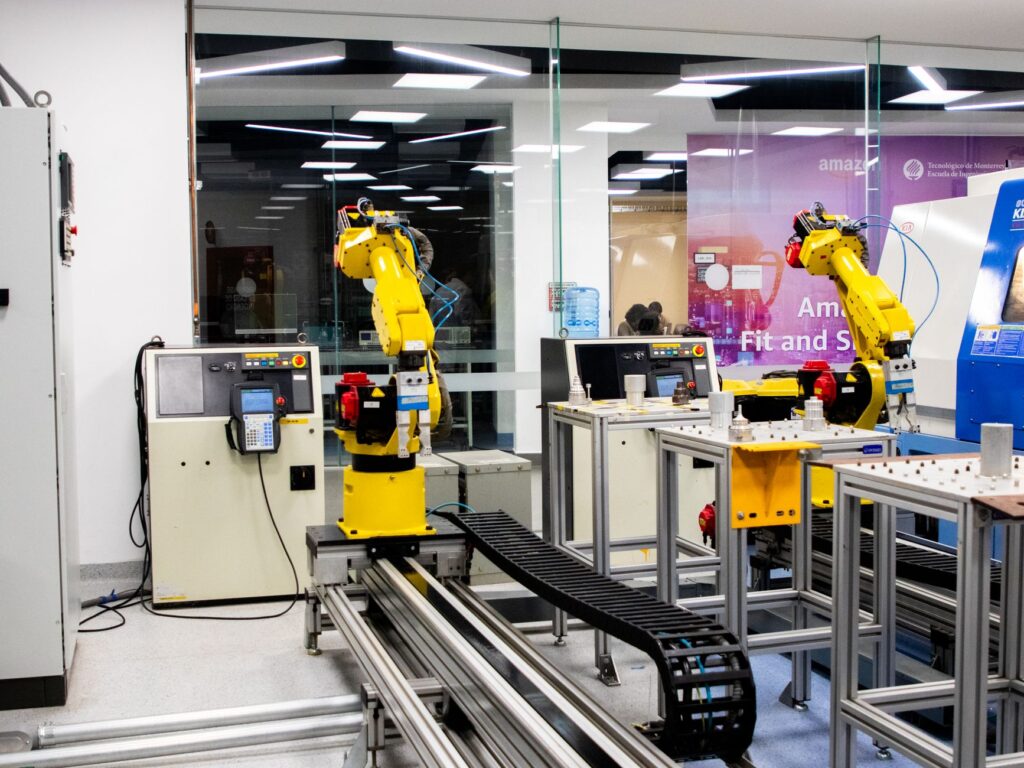
Physical AI represents the evolutionary leap from programmed machines to adaptive intelligences that perceive, reason, and act in the physical world. In the context of Italian manufacturing, this technological transition opens significant opportunities for SMEs and mid-market companies aiming to scale production efficiency without exclusively relying on investments in traditional robotics.
What is Physical AI in a Manufacturing Context
Physical AI refers to the next generation of robotic systems capable of perceiving and acting within the physical world, operating in unstructured or dynamic environments, performing delicate manipulation tasks comparable to those performed by human hands, and are able to reason about the physical consequences of their actions. They can infer human intent, adapt to unknown situations, and autonomously plan and execute workflows to achieve defined goals.
Unlike traditional artificial intelligence that operates on screens and datasets, Physical AI must handle the constraints of real physics: gravity, friction, variability in objects, and unstructured environments. Physical AI helps robots understand space, recognize objects, judge distances, respond to movement, and perform physical tasks safely. In production, this allows robots to work in changing environments where both precision and awareness are essential.
The State of Technology in 2026: From Proof-of-Concept to Production
Physical AI is expected to reach an inflection point in 2026. Advances in how robots understand the real world, reason, and plan actions are fueling the transition from research and development to commercial deployment across various industries, including manufacturing. Earlier this year at CES in Las Vegas, Nvidia CEO and co-founder Jensen Huang stated that the “ChatGPT moment for physical AI is here,” marking an inflection point in the robotics space.
Physical AI shifts the focus from proof-of-concept to implemented systems with measurable results. Shortages in skilled labor are accelerating the adoption of robots focused on applications in critical industries.
In Italy, this transition represents a strategic opportunity for the local manufacturing sector. The The Italian Ministry of Economic Development (now called the Ministry of Business and Made in Italy) is funding the application of AI to manufacturing processes to improve efficiency and promote the development and modernization of Italian SMEs.
Key Components of a Physical AI-Enabled Smart Factory
1. Integrated Sensor Technology and Industrial IoT
Machines, sensors, people, and software platforms continuously exchange data instead of operating in silos. A smart factory combines a network of machines, sensors, systems, and processes that use data, automation, and AI to optimize production. By analyzing performance data, smart factories can continuously improve production efficiency and quality levels.
In the context of Italian industrial infrastructure, critical elements include:
- Distributed sensors IoT tags, sensors, and location systems enable real-time visibility of high-value tools, materials, and equipment, reducing losses and improving utilization.
- Edge Gateway: Data aggregation devices positioned at the cell or production line level that process data locally
- Robust Connectivity The continuous improvement of connectivity capabilities, such as 5G, Wi-Fi 6, and LPWAN, along with the development of robust and secure cloud computing platforms, has facilitated the emergence of new applications and better collaboration along supply chains.
The sensors are not an end in themselves: they must integrate with reliable communication systems and standardized protocols (Modbus TCP, OPC-UA, MQTT) to ensure interoperability with the legacy automation systems still widespread in Italian SMEs.
2. Decentralized Processing and Edge AI
The integration of edge AI in manufacturing introduces opportunities for decentralized, low-latency processing, which is crucial for real-time operations in smart factories. Edge AI enables data-driven decision-making directly on the factory floor, minimizing delays associated with communication to centralized cloud servers. This shift towards distributed intelligence allows manufacturers to rapidly adapt to changes in production demands, offering more personalized products and services.
Advantages for Italian Tech SMEs:
- Reduced latency AI edge models continuously run on sensor streams, identifying degradation patterns in equipment before they result in failure. Unlike cloud-based analytics which rely on periodic data uploads, edge-based predictive maintenance operates in real-time, capturing defects at the earliest possible stage.
- Bandwidth saving: Industrial IoT environments generate enormous volumes of raw sensor data. Transmitting it all to the cloud is expensive and, for many use cases, unnecessary.
- Data privacy and sovereignty Sensitive production data remains on-site, critical for companies operating in regulated sectors or for SMEs that fear the loss of intellectual property.
Practical implementation: An Italian manufacturing SME can initiate an edge AI project with low-cost hardware (Nvidia Jetson, SECO embedded modules, enabled industrial controllers) and lightweight ML models running directly on these devices, avoiding critical cloud dependencies.
3. Adaptive Automation and Collaborative Robotics
Autonomous robotic automation and Physical AI are transforming next-generation manufacturing by bringing intelligence to physical operations. From material handling and quality control to safety and flexible production, the benefits are becoming apparent. Real value lies in combining machine precision with adaptive decision-making.
Modern manufacturers often need to quickly switch between product variants. Customer demand changes faster than in the past, and long, rigid production setups can become a disadvantage. Autonomous robotic automation and Physical AI help factories become more flexible. Robots can identify different components, adapt gripping methods, change movement paths, or support new production sequences with less reprogramming. This is particularly valuable in industries like electronics, automotive, medical devices, and consumer products where product cycles move rapidly.
Implementation in Tech SMEs: Instead of immediately implementing humanoid systems, Italian SMEs derive value from collaborative robots (cobots) equipped with computer vision and lightweight perception models. These devices can be reprogrammed for new tasks in hours rather than days, with drastically reduced training time thanks to learning models that capture task distributions comprehensively, allowing a graduate student with a single consumer GPU to fine-tune a VLA model on their robot in a matter of hours, impossible 18 months prior.
The Role of the Sim-to-Reality Gap and Synthetic Data Generation
One of the historical barriers to the widespread adoption of Physical AI in production has been the inability to transfer models trained in simulation to real-world environments. For decades, the “sim-to-real gap” has been the most persistent bottleneck in industrial robotics. Robots trained in simulation would behave differently on the factory floor because virtual environments couldn't accurately replicate real-world lighting, materials, and physics. This gap has kept physical AI stuck in labs and pilot programs.
Combined with ABB’s Absolute Accuracy technology, which reduces positioning errors from 8–15 mm to approximately 0.5 mm, the system can generate synthetic training data that accurately represents factory conditions. Robots trained entirely in simulation can then be deployed on production lines with minimal real-world debugging. The practical impact is significant. ABB claims that manufacturers using the technology can reduce setup and commissioning times by up to 80% and cut costs by up to 40% by eliminating physical prototypes.
For Italian SMEs, this means the possibility of testing complex robotic solutions virtually before any hardware investment, a capability previously only available to large companies.
Concrete Applications in the Italian Manufacturing Context
Quality Control and Visual Inspection
Quality remains central to manufacturing success. Physical AI supports advanced inspection systems through computer vision, sensor fusion, and real-time analysis. Robots can identify scratches, alignment issues, missing components, or dimensional errors with high consistency.
Production is where the ROI of physical AI is most immediate, as a visual inspection system pays for.
Supply Chain Management and Optimization
Physical AI isn't just about movement and manipulation systems; it's also about factory systems optimization. AI models integrated with digital supply networks allow factories to predict demand spikes, manage bottlenecks, and adapt without human intervention.
Decentralized Predictive Maintenance
Autonomous robotic automation also generates valuable operational data. Performance metrics, movement patterns, battery health, cycle times, and component wear can all be analyzed. Physical AI systems can use this data to predict maintenance needs, improve movement efficiency, and refine task performance over time. This creates machines that don't just operate. They continuously learn and become more effective. For manufacturers, this means less downtime and better long-term return on investment.
Technical Obstacles and Mitigation Strategies for SMEs
Integration with Legacy Systems
Most Italian manufacturing SMEs still use previous automation systems: legacy controllers, disconnected MES, non-standardized sensors. The solution is not rip-and-replace, but progressive IT/OT convergence.
IT/OT convergence is becoming a reality. The fusion of information technology's data processing power with operational technology's physical control capabilities is a fundamental trend. This integration enables real-time data exchange between digital management systems and physical machinery – the prerequisite for deploying AI-driven robots that learn and adapt in production environments.
Practical recommendation: Implement edge gateways positioned between legacy systems and the cloud, translating protocols (Modbus TCP → MQTT) and normalizing data before passing it to ML models.
Cost of Specialized AI Models
The commoditization of components and open-source development are lowering the entry costs for physical AI systems. However, because these robots require advanced AI chips and processors, they remain more expensive than traditional industrial robots. For the time being, this cost gap is likely to persist, even as overall prices gradually decrease.
Italian SMEs should focus on:
- Open-source models (SmolVLA, RT-1) instead of proprietary solutions
- Fine-tuning on specific company datasets rather than training from scratch
- Partnerships with Italian universities and research centers for access to computational resources (see. EuroHPC JU signing a procurement contract to deploy a new AI-optimized supercomputer at the IT4LIA AI Factory in Italy, offering specialized services in key vertical sectors such as agritech, cybersecurity, meteorology, climate, and manufacturing)
Safety and Cybersecurity Considerations
The integration of Physical AI introduces new attack surfaces. Connected robots, distributed sensors, and ML models represent potential vectors of compromise. The adoption of these technologies requires careful planning. Initial costs, integration with legacy equipment, workforce training, and cybersecurity all need attention. Factories must also define where autonomy is useful and where human approval should remain essential. Not every process needs a fully autonomous solution. The best results usually come when companies focus on practical business needs rather than adopting technology for its own sake.
Italian SMEs must implement:
- Network Segmentation Between OT and IT
- Multi-factor authentication for robots and gateways
- Complete audit trail of robotic actions
- Automatic rollback for AI models behaving abnormally
Adoption Framework for Italian Tech SMEs
Phase 1: Assessment and Prototyping (Months 1-3)
Activities
- Map critical processes where ultra-low latency and adaptability would yield maximum ROI (not all processes are candidates)
- Inventory existing sensors and automation; classify as “smart,” “semi-smart,” or “legacy.”
- Collect preliminary data from pilot lines for model training
- Evaluate edge hardware (Jetson, SECO, ABB RobotStudio) that integrates with the current infrastructure
Phase 2: Edge AI Implementation (Months 3-6)
- Deploy edge gateways with a lightweight software stack (Grafana + Prometheus for monitoring, MQTT broker)
- Train lightweight ML models on-premise using historical company data
- Testing predictive maintenance and quality inspection in a sandbox environment
- Implement feedback loops: collect incorrect predictions, refine the model, repeat
Phase 3: Scale and Optimization (Months 6-12)
- Expand sensor coverage to other lines
- Integrate collaborative robotics with refined perception models
- Automate orchestration: from monitoring to decision to action, with minimal human-in-the-loop
- Measuring KPIs: downtime reduction, throughput increase, defect reduction
Internal Links and In-depth Information on AI Publisher WP
The transition to Physical AI in manufacturing also requires consideration of AI governance and large-scale operational adoption. The article on Infrastructure AI vs. AI Tools 2026 provides the technical and organizational framework for moving from experimentation to scalable operations.
Furthermore, for those adopting Physical AI in WordPress or web-based environments (for example, factory monitoring dashboards built with WordPress Headless), The guide on WordPress Headless Architecture and Decoupled CMS explains how to scale content speed and API integration without blocking the core.
Finally, as Physical AI introduces new safety surfaces, The WordPress 7.0 security roadmap covers the Abilities API and defense against prompt injections., relevant for dashboards and web-accessible control systems.
FAQ
The substantial difference between Physical AI and traditional robotic automation lies in their approach to problem-solving and adaptability. **Traditional Robotic Automation** typically relies on **pre-programmed, deterministic instructions**. Robots are taught a specific sequence of movements and actions to perform a task. They excel at repetitive, well-defined tasks in structured environments where deviations are minimal. If something unexpected occurs, the robot usually stops or requires human intervention to reset. **Physical AI**, on the other hand, combines the physical embodiment of a robot with advanced AI capabilities, including **machine learning, computer vision, and reasoning**. This allows Physical AI systems to: * **Perceive and understand their environment:** Instead of just following commands, they can "see" and interpret their surroundings, recognize objects, and understand spatial relationships. * **Learn from experience:** Through machine learning, they can adapt their behavior over time, improve their performance, and learn new tasks without being explicitly reprogrammed for every variation. * **Make decisions and problem-solve:** They can analyze situations, assess risks, and make intelligent decisions in real-time, even when faced with novel or unpredictable circumstances. * **Exhibit adaptability and flexibility:** They can handle variability in tasks, adjust to changes in the environment, and collaborate with humans more effectively. In essence, traditional robots are like highly skilled workers following a very precise manual, while Physical AI systems are more like intelligent agents that can learn, adapt, and make informed decisions in the physical world.
Traditional robotic automation follows preprogrammed paths in highly structured and controlled environments. Physical AI, on the other hand, perceives the environment in real-time, interprets variability (irregular shapes, undefined positions, unexpected obstacles), and adapts its behavior without reprogramming. Physical AI helps robots understand space, recognize objects, judge distances, respond to movement, and perform physical tasks safely. In the factory, this allows robots to work in changing environments where both precision and awareness are essential. A traditional robot doesn't know what to do if it encounters an object in an unexpected position; a robot with Physical AI recognizes it, judges whether it can lift it, and adapts its grip strength.
Is edge computing truly necessary, or can I centralize everything in the cloud?
It depends on the use case. For applications that tolerate latency of hundreds of milliseconds (e.g., aggregate reporting), the cloud is fine. But for real-time control, predictive maintenance, and worker safety, AI edge models continuously operate on sensor streams, identifying degradation patterns before failures. Unlike cloud analytics which depend on periodic data uploads, edge predictive maintenance operates in real-time, capturing defects at the earliest possible stage. Furthermore, Industrial IoT environments generate enormous volumes of raw data. Transmitting everything to the cloud is expensive and, for many use cases, unnecessary.
How long does it take for a positive ROI on a Physical AI project in an SME?
In well-focused projects (predictive maintenance, quality inspection), SMEs see payback between 12-24 months. Manufacturers who use this technology can reduce setup and commissioning time by up to 80% and cut costs by up to 40% by eliminating physical prototypes. However, success depends on use case selection: not all lines derive value in the same way. Starting with high-volume, high-variability processes (electronics assembly, food packaging) maximizes initial ROI.
Do Italian SMEs have access to dedicated cloud/HPC resources for Physical AI?
Yes. EuroHPC JU has signed a contract to deploy an AI-optimized supercomputer at the IT4LIA AI Factory in Italy, which offers specialized services in key vertical sectors such as manufacturing, along with a comprehensive suite of horizontal services to support all AI ecosystem stakeholders, including tools for secure data management and analysis, metadata creation and verification of compliance with Italian and European regulations, and development capabilities, training initiatives, and innovation support, enabling startups, SMEs, and research organizations to access advanced computing capabilities and technical expertise.
The main security risks when integrating Physical AI into connected factories include: * **Physical Tampering/Sabotage:** AI systems controlling physical machinery could be deliberately manipulated by attackers to cause damage, disrupt operations, or create unsafe conditions. This could involve altering sensor readings, overriding safety protocols, or rerouting production processes. * **Data Integrity and Trust:** Physical AI relies on data from sensors, cameras, and other physical inputs. If this data is compromised or manipulated (e.g., through sensor spoofing or poisoning attacks), the AI could make incorrect decisions, leading to production errors, equipment damage, or safety hazards. * **Unauthorized Access and Control:** Hackers could gain unauthorized access to the AI system itself or the connected industrial control systems (ICS). This could allow them to take control of machinery, steal sensitive operational data, or shut down critical processes. * **Supply Chain Risks:** The physical components and software used in Physical AI systems can be vulnerable. Compromised hardware or embedded malware in components could introduce backdoors or vulnerabilities that attackers can exploit. * **Robotics and Automation Vulnerabilities:** Robots and automated systems powered by AI are prime targets. Attacks could lead to robots malfunctioning, harming personnel, or damaging products and equipment. For example, an attacker could reprogram a robot's movements to cause collisions. * **Denial of Service (DoS) Attacks:** Attackers could flood the AI system or its supporting infrastructure with excessive requests, overwhelming it and causing it to fail or become unresponsive. This could halt production and lead to significant financial losses. * **Intellectual Property Theft:** Physical AI systems often involve proprietary algorithms and data. Unauthorized access could lead to the theft of valuable intellectual property related to manufacturing processes, product designs, or optimization strategies. * **Privacy Concerns (for human workers):** If AI systems are used for monitoring human workers in the factory (e.g., through computer vision for safety or productivity), there are privacy implications. Unauthorized access or misuse of this data could violate employee privacy. * **Erosion of Trust in Automation:** A significant security breach involving Physical AI could lead to a loss of trust in automated systems, potentially hindering future adoption and investment in advanced manufacturing technologies. * **Lack of Audit Trails and Forensics:** Inadequate logging or the ability to tamper with logs can make it difficult to investigate security incidents, identify the root cause, and hold perpetrators accountable.
The main risks include: (1) compromise of robots causing them to perform unintended actions; (2) poisoning of training data that degrades the model; (3) leakage of proprietary process data through connected sensors. Mitigation requires strict OT/IT segmentation, multi-factor authentication on all devices, and continuous monitoring for anomalous robot behavior. No system is 100% secure, but the “defense in depth” approach is standard in critical manufacturing facilities.
Conclusion
Physical AI and Decentralized Automation for Italian Manufacturing: Towards Mature Industry 4.0
In 2026, next-generation manufacturing is increasingly defined by intelligent machines that can do more than automate. They can think, self-regulate, and continuously improve. Autonomous robotic automation and Physical AI are transforming next-generation manufacturing by bringing intelligence to physical operations.
For Italian SMEs and tech companies, the message is clear: Physical AI is no longer science fiction or an academic proof-of-concept. It is a production capability available today, with documented ROI in reduced downtime, increased quality, and operational flexibility. The key to success is not the adoption of every technology, but the disciplined selection of high-impact processes, incremental implementation, and investment in edge-cloud integration that preserves corporate data sovereignty and privacy.
The convergence of IoT sensors, edge computing, and lightweight AI models also enables SMEs to scale without exclusive dependence on global cloud giants – a critical value for the Italian manufacturing sector, which continues to be the engine of innovation in Europe.
The question is no longer “If to implement Physical AI?” but rather, “Which processes do I choose first, and how do I measure success?”. Public resources, university partnerships, and national HPC infrastructure (IT4LIA) provide support: the time to move is now.