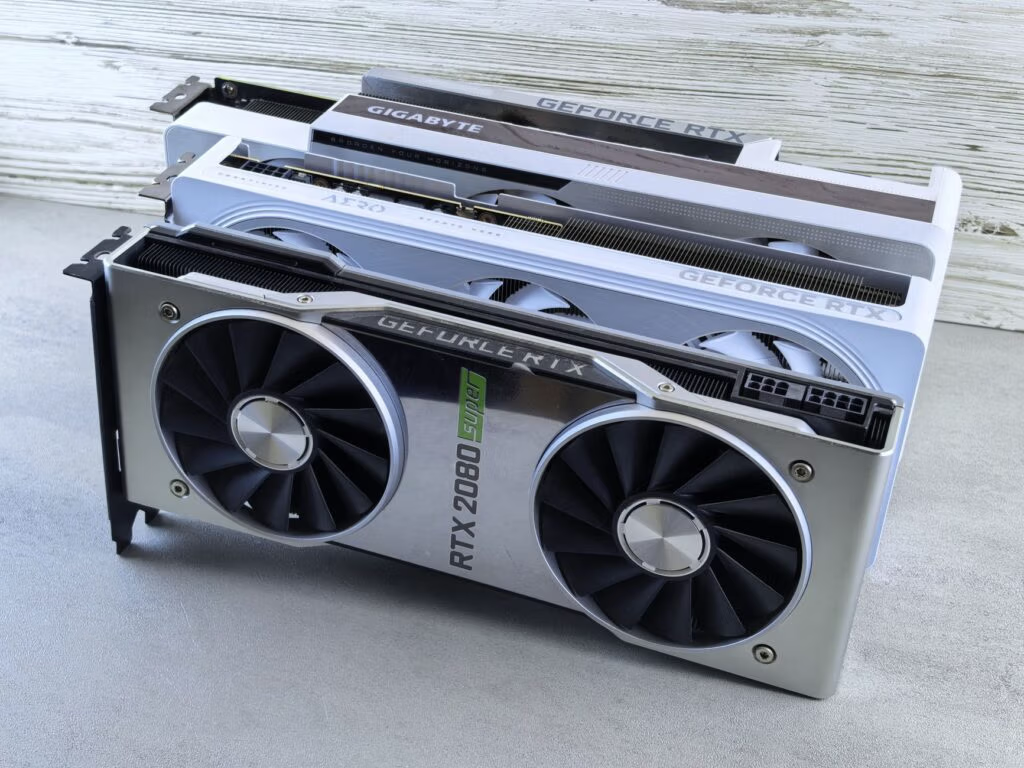
AI infrastructure in 2026 is divided into two parallel paths: centralized cloud services and local inference on consumer hardware. The deciding factor is Privacy, . the Data control and the zero marginal cost per query. As organizations grapple with regulatory compliance (EU AI Act deadline August 2026), intellectual property, and data sovereignty, the ability to run powerful AI models on consumer hardware has shifted from a niche hobby to production architecture.
This article analyzes the maturity of the local stack in 2026: open-weight models (Llama 4, Gemma 4, Qwen 3.5), inference runtimes (Ollama, LM Studio, vLLM), quantization techniques (GGUF Q4_K_M), and architecture patterns for AI agents with custom knowledge bases, all running offline on consumer workstations.
Privacy-First Architecture: The Technical Case for Local AI in 2026
Running an AI model locally means the model file resides on your computer and all processing happens on the user's hardware — no prompts are sent to OpenAI, Google, or Anthropic. For organizations handling sensitive data (proprietary strategy, source code, legal documentation, clinical data), This is a necessity, not a choice..
The technical drivers are three:
- Zero-Trust Data Residency: Your local prompts, database schemas, and API keys remain physically isolated from company telemetry. If you're building medical, financial, or strictly compliant software, sending user data to a cloud API is an immediate security violation; local models are literally the only solution..
- Predictable Unit Economics Cloud APIs charge fractions of a cent per token, which scales horribly. If you build an autonomous logic pipeline evaluating millions of requests a day, you'll bankrupt the project. With local inference, you pay for the hardware upfront, and variable monthly expenses remain at absolute zero..
- No Network Bottleneck: Goodbye to HTTP rate-limiting (429 Too Many Requests), heavy TLS handshakes, and sudden service interruptions. The model activates the exact moment you send the prompt to your localhost..
Open-Weight Models: Performance Parity with Cloud in 2026
The paradigm shift starts with models. In 2023, only ChatGPT was practical; in 2026, Open-weight models—the kind you can download and run on your own hardware—have become extraordinarily capable. Llama 3, Qwen 2.5, Mistral, Gemma 2, and their successors can handle tasks that would have required GPT-4-class APIs just 18 months ago..
Local inference on consumer hardware delivers 70-85% of Frontier model quality at zero marginal cost per request. The trade-offs are real: The Frontier cloud models (GPT-4o, Claude 3.7 Sonnet, Gemini 2.0 Ultra) maintain a significant lead in complex reasoning, instruction adherence, and multimodal capabilities.. But for the vast majority of operational tasks (summarization, code completion, Q&A, drafting), a well-chosen local model is indistinguishable in a double-blind test.
The main candidates in 2026:
- Llama 4 Scout: Meta's flagship for consumer deployment — a Mixture-of-Experts model where only a fraction of the total 109 billion parameters activates per token, meaning you get big-model quality at small-model speed. The 10 million token context window is the largest of any open model..
- Gemma 4 (31B): A dense 31B model that ranks 3rd among all open models on the Arena AI leaderboard, outperforming models 20 times its size. The benchmark results are extraordinary for this size—89.2% on AIME 2026 Math, 80.0% on LiveCodeBench v6, and 84.3% on GPQA Diamond. It has native multimodal support (text, images, video), configurable thinking modes for step-by-step reasoning, a 256K context window, and supports over 140 languages..
- Qwen 3.5 (27B): The 27B dense model is the sweet spot for most local users—it fits on a single 16 GB GPU in Q4 and delivers cutting-edge coding performance (72.4% on SWE-bench Verified). In instruction following (IFBench 76.5%), it outperforms GPT-5.2 and significantly outperforms Claude. For coding, it is essentially on par with Gemini 3 Pro on SWE-bench.
- Phi-4 (14B): A 14-parameter model from Microsoft that excels at reasoning, math, and logic tasks. It consistently outperforms larger 30B–70B models on structured problem-solving benchmarks while running on 16 GB of hardware. On the MATH benchmark (mathematical problem-solving), Phi-4 scores 80.4%, compared to Llama 3.3 8B at 68.0% and Qwen 2.5 14B at 75.6%. For analytical tasks requiring step-by-step reasoning, Phi-4 delivers the best results per GB of RAM in 2026.
Hardware Consumer 2026: Memory Bandwidth, Not TOPS
The broader engineering critique of 2026: The bottleneck for local inference is not compute, it's memory.. Memory bandwidth sets your decoding ceiling; memory capacity sets which models you can run at all. TOPS, the number plastered on every box, moves the needle little for single-user inference—it counts for prefill and batching, not for the tokens you see appear. Token generation reloads every weight from memory once per token, so decode speed tracks bandwidth, not raw compute..
The 2026 hardware matrix:
- RTX 5090 (32 GB GDDR7): The current consumer inference performance leader. It handles 70B class models at practical quantization levels with good token throughput.. Cost: ~€5000–6000.
- RTX 4090 (24 GB GDDR6X): Paired with an AMD Ryzen 7 7700 and an NVIDIA RTX 4090 (12 GB VRAM) GPU, it is the most recommended starter GPU compilation in 2026. It handles quantized 7B and 13B models with ease, doubles as a capable gaming machine, and leaves room for growth.. Cost: €3000–3500 used.
- Apple Silicon (M4 Pro/Max with unified memory): Apple Silicon is emerging as the sweet spot for local AI in 2026. The reason is its unified memory architecture: all your RAM is available for model loading, unlike on a PC where you're limited by the VRAM of a separate GPU. The machine runs almost silently and uses around 65 watts under full AI load.. An M4 Pro Mac Mini with 48GB of unified memory runs 30B-class models at 12–18 tokens per second. That's real-time chat speed. Cost: €2500–3500.
- AMD Ryzen Mini PC + Dedicated GPU If infrastructure flexibility is important, consider a high-end AMD mini PC running Ubuntu instead of macOS. Native Docker support for network isolation and headless deployment.
The 2026 rule of thumb: start with 32 GB of RAM as your absolute floor — all that is above is headroom for larger and better models as the open-weight ecosystem continues to evolve.
GGUF Quantization: How 70B Becomes 40GB
GGUF Q4_K_M quantization compresses a ~60–75% model with typically less than ~5% of quality loss, so a model that requires ~16 GB at full precision fits into about 4.7 GB.
The technical mechanism is simple but powerful:
- GGUF Format: GGUF (GPT-Generated Unified Format) is a binary file format for large AI models designed to make models efficient, portable, and easy to run locally, especially on consumer hardware. In simple terms, GGUF is a way to package a language model's weights and metadata so that they can be loaded quickly, use less memory, and support features like quantization (e.g., 4-bit, 5-bit, or 8-bit weights) to drastically reduce model size while still maintaining good performance..
- Q4_K_M quantization: Using the GGUF Q4_K_M format reduces memory usage by approximately 75%, while maintaining nearly the same quality (less than 1% of loss). For example, a 7-billion-parameter model that would normally require 16 GB of VRAM now requires only about 4 GB..
- Scalability A 70B model with 4-bit quantization (Q4_K_M) shrinks to around 40GB, and a smaller 7B model fits into just 4–5GB. As a quick rule of thumb, 4-bit quantized models need about 0.5GB of RAM per billion parameters..
The 2026 ecosystem has normalized this practice: Ollama reached 52 million monthly downloads in Q1 2026. This is a 520x increase from 100K in Q1 2023. HuggingFace hosts 135,000 models in GGUF format optimized for local inference, up from 200 three years ago..
Inference Stack: Ollama, LM Studio, vLLM, Jan
Four runtimes dominate in 2026:
Ollama: LM Studio offers a ChatGPT-style chat interface that runs entirely on your machine. It has the strongest model browser, an OpenAI-compatible server (port 1234), MLX acceleration on Apple Silicon, and MCP tool-calling for agent workflows — which is why many call it the most capable local app in 2026..
GPT4All (by Nomic AI) is the lowest-friction entry point, and its LocalDocs feature allows the model to answer questions from your files, completely offline. An installer, offline by default, brings 4891. Best for: absolute beginners and anyone doing private document Q&A (researchers, lawyers).
vLLM per Throughput in Team: Startup teams managing sensitive data: vLLM on an RTX 5090 or multi-GPU server. Production-quality throughput, continuous batching for concurrent users, and performance headroom to serve a team..
Jan (Open-Source): Jan is built privacy-first: zero telemetry, open-source code anyone can inspect, no accounts, chat history stored locally.
Custom Knowledge Bases: RAG Offline for AI Agents
Running an LLM locally is the first layer. The second is giving the model access to custom knowledge bases without sending data to the cloud — this is RAG (Retrieval-Augmented Generation).
Retrieval Augmented Generation (RAG) connects Large Language Models to external data sources, giving LLMs access to customized knowledge without fine-tuning. RAG enables organizations to give AI models new knowledge without the hassle and expense of fine-tuning the language model..
Local RAG Architecture in 2026:
- Ingestion Documents (PDF, Markdown, CSV) + Web scraper → Semantic chunking (200–1000 tokens per chunk).
- Embeddings A personal knowledge base built on local AI in 2026 has five layers: capture (web clipper, email forwarding, mobile share sheet), storage (Markdown vault or document folder), embeddings (a local model via Ollama), retrieval (RAG), and interface (chat or semantic search).. Recommended local embedding model: nomic-embed-text (GGUF Q4, runs locally).
- Vettore Storage ChromaDB, Weaviate, Milvus on-premises.
- Retrieval: Semantic search based on cosine similarity of the query vector.
- Generation Update the local model prompt with the retrieved chunks (context window: 4K–8K tokens).
Use Obsidian + Smart Connections + Copilot for Obsidian + Ollama if you write notes daily and want semantic search across your vault; this scales cleanly to ~50,000 notes on a 16GB M3 Pro Mac or PC. Use AnythingLLM + Ollama if your knowledge lives primarily as documents (PDFs, exports, web clippings) rather than notes; scales to ~100,000 documents and bundles ingestion, RAG, and chat into one app. Build a custom Python + ChromaDB + Llama 3.2 3B stack only if you have 100,000+ items, multi-user access, or specific schema needs — the maintenance burden is real..
Concrete use case: Local research agent
Instead of sending searches to Perplexity or ChatGPT Pro Search, Cloud-based “deep search” tools like Perplexity Pro or ChatGPT Search query web indexes and synthesize the results with an LLM. You can build a local equivalent using Ollama. The approach: break down a research topic into sub-questions, run each through a local LLM for deep analysis, then synthesize the results into a structured brief..
AI Agents: Standalone Agents When Models Become Autonomous
The next evolution is autonomous multi-step agents — models that plan, retrieve tools, execute actions, and refine autonomously without human intervention between steps.
In local standalone architecture:
- Base Model: Gemma 4 31B or Qwen 3.5 27B (local execution).
- Tool Definitions: JSON schema for functions (file search, query execution, local API).
- Context Window 8K–16K tokens to maintain reasoning history and tool results.
- Orchestration Loop: Think → Call Tool → Observe → Refine → Repeat.
- Knowledge Base: RAG ChromaDB integrated for document search during agent execution.
This architecture is completely offline: no data leaves the machine, no token costs, no rate limits.
Memory Constraints & Trade-offs
No architecture is perfect. The practical limitations of local AI in 2026:
- Context Windows Even local frontier models (Llama 4 Scout) have smaller context windows than cloud services. Llama 4 supports 10M tokens, but for practical inference at an acceptable speed, keep it under 8K-16K.
- Generation Speed: Achieve 30 to 80+ tokens per second on 30B–70B class models with proper configuration. The cloud (OpenAI, Anthropic) generates 100+ tokens/sec for large models. A 2–3 second latency for a response is acceptable for batches; not for real-time interactive chat.
- Complex Reasoning Open-weight models are genuinely capable for a wide range of tasks, but frontier cloud models still lead on complex reasoning, multimodal, and reliable agentic behavior tasks by about 3–6 months.. For “deep reasoning” tasks, a local model still needs aggressive prompt engineering.
Hybrid Architecture: The Pragmatism of 2026
Local AI makes more sense for high-volume workloads, privacy-sensitive data, latency-critical applications, and use cases requiring fine-tuned or custom models. This hybrid architecture gives you frontier reasoning capabilities for tasks that need them, with local cost and privacy advantages for tasks that don’t..
Recommended pattern 2026:
- Tasks involving proprietary data → Local (Ollama + Gemma 4 31B).
- Complex reasoning / Multi-step reasoning → Cloud (Claude 3.7, OpenAI GPT-5.x).
- Retrieval + Synthesis from a knowledge base → Local (RAG + ChromaDB).
- Fine-tuning on specific domain → Locale (Phi-4, Qwen 3.5 + LoRA).
- Low-latency autonomous agents → Local (vLLM batching).
Technical Setup Step-by-Step: Ollama + Gemma 4 + ChromaDB
Phase 1: Runtime Installation
# macOS / Linux / Windows (WSL2)
curl https://ollama.ai/install.sh | sh

# Check installation
ollama --version
Phase 2: Pull GGUF Model
# Download the quantized Gemma 4 31B model
ollama pull gemma4:31b-instruct-q4_k_m

# Or directly from Hugging Face
ollama run hf.co/bartowski/Gemma-4-31B-Instruct-GGUF:Q4_K_M
Phase 3: Start Local OpenAI-Compatible API
# Ollama listens on localhost:11434 by default
ollama is running

# In another terminal, test
curl http://localhost:11434/api/generate -d '{
  "model": "gemma4:31b-instruct-q4_k_m",
  "prompt": "Explain GGUF quantization in 100 words"
}''
Phase 4: Install ChromaDB (Local Vector Storage)
pip install chromadb ollama

# Python Script for RAG
from chromadb import Client
from ollama import Client as OllamaClient

# Initialize the client
chroma = Client()
ollama = OllamaClient(host='http://localhost:11434')

# Create a collection for your documents
collection = chroma.get_or_create_collection(name="my_knowledge")

# Add documents
collection.add(
    ids=["doc1"],
    documents=["Quantization reduces the model size by 75%"],
    metadatas=[{"source": "wiki"}]
)

# Run a RAG query
results = collection.query(
    query_texts=["How does GGUF work?"],
    n_results=3
)

# Generate a response with local context
context = results['documents'][0]
prompt = f"Based on this context: {context}nnAnswer: How does GGUF work?"
response = ollama.generate(model="gemma4:31b-instruct-q4_k_m", prompt=prompt)
print(response['response'])
Phase 5: IDE Integration (VS Code)
USA Continue.dev extension:
{
  "models": [
    {
      "title": "Gemma 4 Local",
      "provider": "openai",
      "model": "gemma4:31b-instruct-q4_k_m",
      "apiBase": "http://localhost:11434/v1"
    }
  ]
}
Compliance and Governance 2026
Local AI compliance requires two considerations:
- EU AI Act (Deadline August 2026): EU AI Act Compliance for Italian Publishers — August 2026 Deadline: Transparency, Data Licensing, Model Training Disclosure, and Copyright-Safe Operational Checklist Local models reduce compliance risk because you don't send data to third-party vendors.
- Model Transparency If you use open-weight models (Llama, Gemma, Qwen), document the license (Apache 2.0, MIT, OpenRAIL). If you modify them via fine-tuning, state it.
- Supply Chain GGUF: GGUF model files downloaded from community sources are binary blobs that your inference engine loads directly into memory. This is a supply chain risk. Prefer models from verified publishers on HuggingFace, where community scanning and vetting mechanisms exist..
Comparison: Local vs. Cloud in 2026
When to use Local AI:
- Proprietary data / confidential source code.
- High query volume (>1M tokens/day) - cost margin becomes dominant.
- Sub-100ms latency critical.
- Domain-specific fine-tuning.
- Strict compliance (medical, legal, financial).
- Low-latency autonomous agents.
When to use Cloud API:
- Complex multi-step reasoning.
- Frontier models (GPT-5.x, Claude 3.7, Gemini 2.0 Ultra).
- Advanced multimodal capabilities (video, audio).
- Rapid prototyping (no hardware setup).
- Variable/burst loads (pay per what you use).
FAQ
Can an 8GB RAM laptop run an LLM locally in 2026?
Yes. A laptop with 8GB of RAM and no dedicated GPU will run capable AI models locally in 2026. This is the single most common doubt, and it is mostly unfounded.. The key is aggressive quantization: A GGUF Q4_K_M build compresses a model of ~60–75% with typically less than ~5% of quality loss. For 8 GB, use Phi-4-mini (3.8B) or Llama 3.2 8B at Q4.
What is the recommended local model for programming in 2026?
Mistral 7B is the alternative if speed matters more than quality — it only uses 4.1 GB on disk and 6-7 GB of RAM, making it the fastest option for light hardware. For coding on 8 GB, Qwen 2.5 7B is the better choice over Llama 3.3 8B base.. For 16 GB+, Qwen 3.5 27B is the standard choice.
Do RAG knowledge bases require dedicated GPUs?
No. Install Ollama, pull nomic-embed-text, and start the ChromaDB server locally. Ingest your codebase using function-aware chunking that respects code boundaries. Generate embeddings locally so proprietary code never leaves your machine.. A moderate CPU is sufficient; a GPU accelerates 10–20 times.
Can I use Local AI to build autonomous multi-step agents?
Yes, but with compromises. Local models like Gemma 4 31B and Qwen 3.5 27B support tool-calling and chain-of-thought reasoning. However, to deep multi-step reasoning e complex planning, the Cloud Frontier models (GPT-5.x, Claude 3.7) outperform 20–30%. For deterministic low-latency agents, locale wins.
How much does it cost to run an LLM locally versus in the cloud?
Local inference on consumer hardware delivers 70-85% of Frontier model quality at zero marginal cost per request. An RTX 4090 (€3500) amortized over 12 months with daily use is €9/month + €10/month for electricity = €19/month. Cloud API: ChatGPT Pro (€20/month) + additional tokens. If you use >100M tokens/year, local is 10–50x cheaper.
Conclusion: Local AI is Now Production-Grade
In 2026, running powerful AI models on consumer hardware is not a compromise—it's architecture. Running LLMs locally on consumer hardware is not only feasible but, for an increasing number of developers and organizations, the preferred default.
The three pillars are clear:
- Privacy: Zero Trust. No data leaves the machine. For organizations with proprietary data, this is the only acceptable architecture.
- Economics: Zero Marginal Cost. Pay for hardware once. Afterwards, each inference costs only electricity (~0.001 cents per query at 1M tokens/year).
- Performance: Frontier-Adjacent. Gemma 4 31B, Qwen 3.5 27B, and Llama 4 Scout achieve a Frontier Quality score of 70–85% for 90% of operational tasks.
Agentic AI for Content Workflows: Multi-Step Editorial Automation with Search, Drafting, SEO, and Scheduling Orchestration show how to apply this pattern to content production. Setting Up Multi-Agent Content Workflows in WordPress 7.0 with Claude API and Gemini 3.5 Flash: A Step-by-Step Guide to Intelligent Editorial Automation extends the concept to the cloud, but the decision of which path to choose (on-premises vs. cloud) is now informed by data sovereignty, regulatory compliance, and the token economy.
By publisher, developers, and organizations facing EU AI Act compliance, protect intellectual property and optimize inference costs, Local AI is not a niche: it's the foundational infrastructure of 2026.