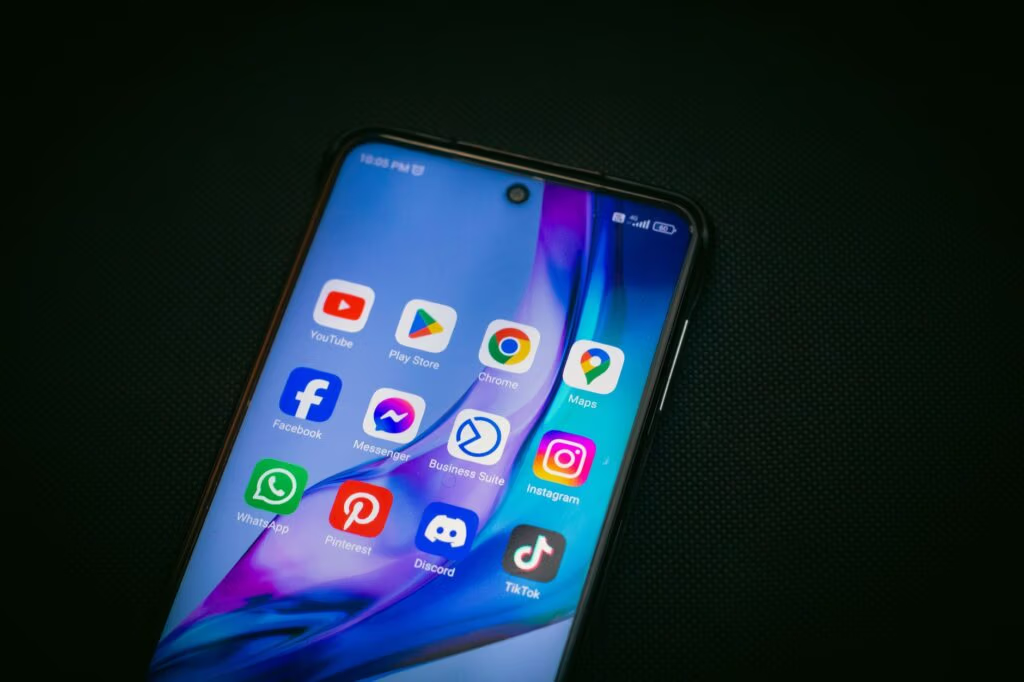
In 2026, the online search landscape has changed radically. TikTok, Instagram, and YouTube are no longer passive entertainment platforms; they have transformed into true specialized search engines, with their own ranking systems, sophisticated algorithms, and users who consult them daily for immediate answers. This shift represents an existential challenge for brands and creators who continue to optimize solely for Google.
In 2026, search is no longer exclusively a Google game. Many users, especially those under 35, consider social media to be fully-fledged primary search platforms, with their own ranking factors and algorithms.. The implications are significant: content that manages to dominate in the coming months will need to be optimized simultaneously for three completely different discovery channels, each with unique ranking mechanics.
This guide analyzes how the hook engineering (the strategic architecture of the first few seconds of content) and the’answer architecture (Structuring content around specific queries) represent the two pillars for competing effectively in 2026. These are not minor updates: it's a fundamental redefinition of how to create discoverable content.
The Paradigm Shift: From Feed-Based to Search-Based Discovery
TikTok has become a full-fledged search engine, with nearly 40% of Gen Z users preferring to search on TikTok rather than on Google. The same phenomenon concerns YouTube, where the internal search function has become crucial, and Instagram, where on-screen search and the hashtag ranking algorithm have undergone significant overhauls.
When users search for “fish facts,” short-form videos from creators on TikTok, Facebook, Instagram, and YouTube Shorts appear. This means TikTok videos are not only competing on the For You Page but also for search visibility across multiple platforms..
The change isn't just about traffic coming directly from within the platform. Starting in 2026, short-form videos will appear more frequently in AI-powered search tools like ChatGPT and Google Gemini, through dedicated short video results..
Universal Ranking Factors on Social Platforms 2026
Despite platform-specific differences, a consistent ranking model emerges. Dwell time and completion rate are the two most underrated ranking signals: both now carry more weight than likes on Instagram, TikTok, YouTube, and LinkedIn..
On TikTok, the model is particularly transparent. The TikTok algorithm in 2026 prioritizes watch time above all other metrics, followed by search relevance and content originality. Each video starts with approximately 200 test viewers, and high completion rates push the content to larger audiences..
Critical factors for social ranking in 2026:
- Completion rate: You'll need a completion rate of 70%+ to go viral in 2026, up from 50% in 2024
- Rewatch rate: The rewatch rate (percentage of viewers who watch the clip more than once) is the top signal for ranking
- Search relevance Using relevant keywords in captions can increase the visibility of 20-40% content
- Engagement quality: Completion, shares, and dwell time are prevalent across all platforms. Note what is absent: likes and follower count. Both have been demoted to weak signals.
Hook Engineering: The Science of the First Few Seconds
Each platform has built its algorithm around a universal intuition: openness is the most reliable predictor of whether content is worth distributing. This means the hook is the most impactful thing you can improve..
The hook is not a creative choice: it is a timing mechanism. The TikTok recommendation engine evaluates content through a cascade of micro-signals: watch-through rate in the first loop, early engagement velocity, and critically, whether users pause scrolling within the first 1.5 seconds. The algorithm doesn't care about brand equity or follower count. It cares about behavioral arrest..
Hook Test Architectures in 2026
1. Specificity + Timeframe Hook
Opening with a specific, verifiable time-based claim: “I used this for 47 days — here's what happened.” This architecture works because specificity signals authenticity to both the viewer and TikTok's content quality classifiers. According to TikTok's advertising platform, content with specific numerical claims within the first three seconds has higher engagement rates compared to vague superlatives..
2. Confessional Tone Hook
Starting in a lower voice, conspiratorial tone, and a frame that looks like it wasn't meant to be shared: “I probably shouldn't say this about [category], but...” This mimics the native content format that the TikTok algorithm already prioritizes—raw, unstylized, confessional..
3. Pattern Interrupt Hook
Your creative must use a “Pattern Interrupt”—a visual or auditory trigger that immediately addresses a specific user pain point or sparks curiosity, effectively “targeting” the audience through the content itself..
Critical Metrics for Hook Testing
In 2026, a “Hook Rate” (calculated as 3-second video plays divided by total impressions) below 25% signals to AI-driven platforms such as Meta’s Lattice or TikTok’s recommendation system that the content has low value, leading to higher CPMs and reduced distribution.
The brands getting the most ROI from social commerce on TikTok Shop aren't testing different products or offers— They are A/B testing hook architectures across creator cohorts while keeping the product constant..
Answer Architecture: Structuring Content for Query-Based Discovery
While the hook stops scrolling, the’answer architecture Determine if the content effectively provides a useful answer structured enough to generate shares, saves, and rewatches.
TikTok search favors topic clarity, keyword alignment, engagement quality, and watch behavior. Most searchable content declares the topic early, uses the language users search for, includes spoken and on-screen keywords, and holds attention through a helpful answer rather than a vague hook..
Framework: Answer Architecture Step-by-Step
Phase 1: Query Clarity (First 3 Seconds)
When you create a video, think about what question you are answering. The clearer the answer, the easier it will be for TikTok to understand your content and show it to the right people..
Don't “dance around” the topic. If a brand wants to rank for “how to choose payroll software,” the video shouldn't beat around the bush. It should state it directly in the first few seconds, show it in text, explain the decision criteria, and use a caption that reinforces the query in natural language..
Phase 2: Keyword Layering (Text, Voiceover, Captions)
Actual keyword placement: Captions — Include target keyword in the first 150 characters; On-screen text — TikTok scans OCR of visual text; place keyword in the first 2-3 seconds; Voiceover/spoken audio — State your primary keyword in the first few seconds; Profile name and bio — Optimize for your niche search terms.
Phase 3: Depth + Structure (Mid-Content)
The response must be structured in a way that is both understandable and citable by AI systems. Titles, descriptions, and tags on YouTube and other video platforms are directly analyzed by AI models. Brands should segment their video strategy between cultural content (optimized for hook and engagement) and search-oriented content (optimized for direct answers and query-responsive). Full video transcripts are analyzed by AI engines, providing a significant opportunity to incorporate relevant search terms and answer common category questions in a conversational format..
Phase 4: Save/Share Trigger (Closing)
Optimize in this sequence: hook (first 1.5 seconds) → retention curve → loop mechanic → share trigger → caption for saves. Most creators optimize in reverse order and wonder why reach stalls..
Platform-Specific Ranking Factors 2026
TikTok: Search-First Logic
Gen Z's 40% uses TikTok as a search engine. Keywords in the first 3 seconds of on-screen text carry the most weight.
At the algorithmic level, The TikTok For You Page is the reference implementation of a pure interest graph algorithm. Follower count is functionally irrelevant to a single video's reach—each video is evaluated cold against a small test audience, then progressively expanded if performance signals cross the threshold of each tier..
Critical tactic 60-180 second videos are surpassing 15-second clips. TikTok has rebalanced to reward more original audio over trending sound. Trending sounds still work, but original audio is getting a boost. Create your own audio or use sounds within the first 24 hours after they start trending..
YouTube: Session Duration per Single View
YouTube optimizes for one top-level metric: total session time. Every underlying signal rolls up into that optimization. Unlike TikTok, YouTube treats each video as part of a channel-level audience model and rewards channels that are able to keep viewers across multiple videos..
Session duration is the underestimated signal. YouTube wants viewers to keep watching on the platform, so videos that end in a way that naturally leads to another view, through end screens, playlists, or genuine topical relevance, are rewarded. The recommendation is to build content in clusters where one video naturally leads to the next, the same logic of topical authority that works for search..
Instagram: Dwell Time + Save Rate
Engagement content, especially Reels, is vital for discoverability through the Instagram algorithm. Use on-screen keywords in captions and overlays to reinforce content alignment with user queries..
Structurally, Saves are a signal of intent that Instagram weighs very highly. Optimize in this sequence: hook (first 1.5 seconds) → retention curve → loop mechanic → share trigger → caption for saves.
Competing with Google: AEO + Social Search Alignment
2026 is not a world of “SEO vs. Social.” It is a world of AEO (Answer Engine Optimization) + Social Search Integration.
Answer Engine Optimization (AEO) refers to the practice of structuring content so that AI platforms like ChatGPT, Gemini, and Claude can find it, trust it, and surface it in response to user queries. Unlike traditional SEO, which is built around keyword rankings and link authority, AEO is built around the question: Does this content directly and credibly answer the question?
YouTube has emerged as the dominant social media platform for AI citations. Data from BrightEdge shows that Google AI Overviews cite YouTube videos in about 30% of responses, and AI engines reference YouTube at a rate about 200 times higher [than other social media platforms].
Strategy The strongest digital strategy connects all three layers. Social content should feed website content. Website content should reinforce social narratives. Both should create a clean signal for search engines..
Critical Metrics: Beyond Vanity Metrics
In 2026, effective social performance tracking goes beyond “likes” and “followers.”
Focus on a small set of measurable metrics that predict reach and business outcomes: Rewatch rate (top) — % of viewers who watch the clip more than once; Completion/hold rate — % viewers who watch the key POV (first 15 seconds) and the entire clip; Traffic source — FYP vs. Search vs. Profile (helps determine the type of discovery); Follower conversion — follows per session — indicates sustained interest.
Track retention curve, save rate, share rate, and follower conversion — not vanity metrics. These four signals correlate best with compound reach..
Q4 2026 Practical Optimization Checklist
Per TikTok:
- Put the primary keyword in on-screen text in the first 2-3 seconds
- Declare the keyword in the initial voiceover as well
- Test 3-5 diverse hook architectures on creator cohorts (specificity, confessional, pattern interrupt).
- Track the hook rate (3-second play rate / total impressions). Target: 25%+
- Target completion rate for 70%+
- Post 3-5 times a week (consistency signals algorithmic relevance)
Per YouTube:
- Video structure in thematic clusters where one video naturally leads to the next
- Add chapter markers (chapter markers) that contain keywords
- Optimize video transcription with answer architecture — answer the query directly within the first 30 seconds
- Track session contribution: A video that keeps viewers on YouTube for a total of 40 minutes beats one that generates a 5-minute exit.
- Use long descriptions (2000+ characters) with semantically related keywords
On Instagram:
- Optimize bio profile with 2-3 searchable keywords
- Use strategic hashtags (3–5 relevant to your niche; avoid generic tags like #fyp)
- Insert on-screen text keywords in captions and overlays
- Design a Reel for “saveability” — content users want to save
- Track save rate: target 8-12% of total views per highly searchable content
Across All Platforms (AEO Integration):
- Skipping alt text, transcripts, captions, or chapters deprives algorithms of structured information they can use to match your content to queries. By 2026, these fields will not be optional extras; they will be core parts of social SEO.
- Build a content ecosystem on your website + social media: social media content should link to web insights (and vice versa)
- Cite authoritative sources in captions to signal E-E-A-T to AI systems
- Monitor where traffic comes from: search vs feed vs direct. Allocate creative variations to channels with the highest search volume.
FAQ
What is the difference between an algorithm-optimized hook and a conversion-optimized hook?
The opening must serve two masters simultaneously: it must activate the algorithm's distribution logic and instill the viewer's buying psychology. Most briefs optimize for one or the other. Brands that win on social commerce TikTok Shop optimize for both.. In 2026, these two objectives are not in conflict if structured correctly: a scroll-stopping hook that also communicates value to the viewer is ideal.
If we optimize for TikTok search, will we lose organic virality on the For You Page?
No. TikTok has officially confirmed that follower count is not a direct factor in its recommendation system. The algorithm evaluates each video independently based on engagement signals from test audiences.. If you optimize your content around a real query (search-first thinking), but maintain high completion rates and authentic engagement, the content will have access to both search and FYP distribution.
How do I integrate AEO (Answer Engine Optimization) into my 2026 social media plan without diluting authenticity?
The good news is that AEO optimization doesn't require a complete overhaul of your content. It requires intentionality regarding the content already being produced.. This means: maintain your creator's authentic tone and style, but structure the content around real questions your audience asks. Don't “create AI content” — create human content that answers verifiable queries.
Which platform should a B2B brand prioritize in 2026 — TikTok, YouTube, or LinkedIn?
For B2B, LinkedIn is becoming increasingly important for searchable expertise.. However, YouTube remains the most versatile: YouTube is the dominant social media platform for AI citations, cited in approximately 30% of Google AI Overviews responses. The optimal strategy: create long-form assets on YouTube (with optimized transcripts), repurpose on LinkedIn with trend insights, and use TikTok only if your B2B niche has a young audience. For most B2B, interconnected YouTube + LinkedIn + website content beats TikTok.
How do I know if my hook architecture is effective before investing significant creative resources?
Quick test: Within 15-20 creator posts, you will have statistically significant data on which architecture drives the best ROAS for your specific category. This type of systematic testing aligns well with optimizing vertical video format for algorithmic ranking. Brands seeing the highest conversion rates on TikTok social commerce are not testing different products or offers – they are A/B testing hook architectures across creator cohorts while keeping the product constant.. Briefly create 3 per week with a single architecture, monitor 3-second retention vs baseline, and scale the one that wins.
Conclusion: Social media as a search engine requires complete re-engineering
In 2026, TikTok, Instagram, and YouTube have definitively transformed from platforms for casual feed-based browsing into structured search engines, with explicit ranking logic, quantifiable relevance criteria, and users searching them with specific query intent.
Competing means abandoning the “create viral content and hope” mentality and embracing a scientific model of Hook Engineering (design the first 1-3 seconds to stop scrolling AND signal algorithmic relevance) and Answer Architecture Structure the content as a direct and credible response to real queries.
The numbers speak for themselves: TikTok distributes ~6,268 average impressions per post compared to ~2,635 on Instagram, and engagement rates are 5-8x higher.. YouTube remains the most durable channel for explanation and proof. Instagram Reels offer access to mature audiences and direct commercial intent.
The framework doesn't change between platforms: All major platforms in 2026 have shifted from “follow graph” to “interest graph” ranking. Your followers no longer guarantee reach — the content itself must earn distribution through watch-time, engagement velocity, and content-signal matching..
The brands and creators who will dominate Q4 2026 won't be those with the largest followings. They will be the ones who understand the behavioral engineering behind the initial hook, the computational structure of searchable content, and the audience psychology on each platform. To delve deeper into how this logic applies to AI training and licensing systems, consult the Guide to Data Licensing with LLM Providers. For those who want to compete on more advanced technical fronts as well, the Guide to Generative Engine Optimization Strategies for appearing in AI citation systems.
Start this week: audit your last 10 posts. Measure hook rate (3-second play / total impressions). Choose a single hook architecture, brief 3 creators, and see which generates the best retention + save rate. Scale that. This is the framework for 2026.