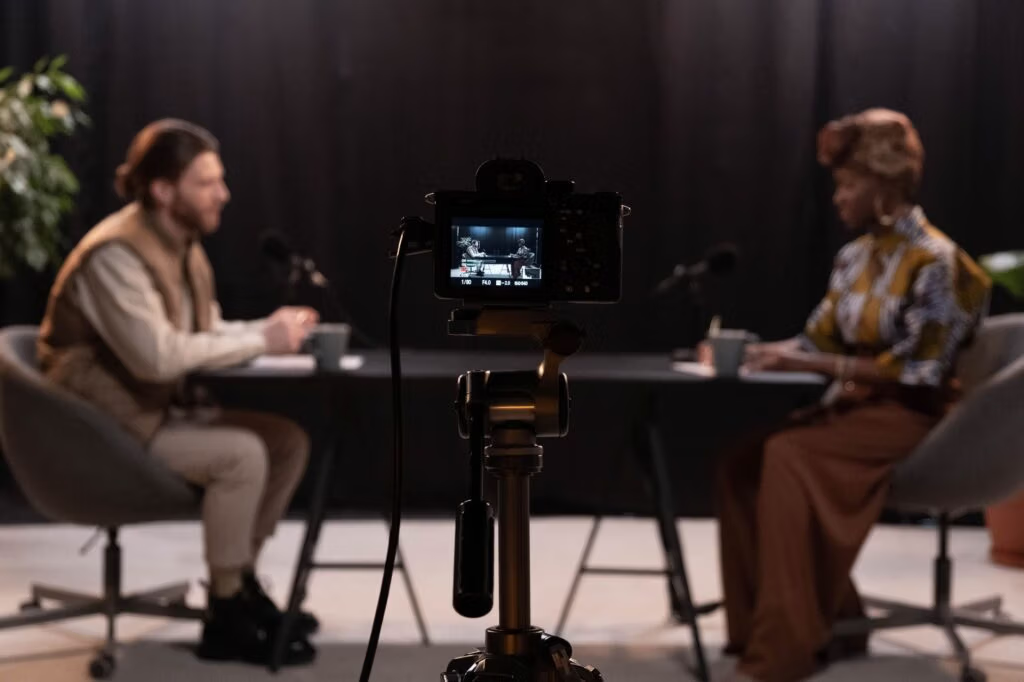
The creator economy is transforming the Italian media landscape. In 2026, newsrooms face a paradoxical challenge: top journalists are leaving traditional media to build independent personal brands on TikTok, YouTube, and LinkedIn, where potential earnings exceed editorial salaries. At the same time, readers reward’authenticity and the personality of creators compared to standardized corporate content. For Italian publishers, retaining top talent requires a radical strategy: transforming journalists from writers a creator, build in-house multimedia production studios and manage conflicts between editorial authority and personal branding.
This article analyzes the operational framework for implementing a strategy of Creator Economy & Media Hybrid, with a focus on talent retention, journalistic empowerment, and managing the tension between editorial control and creative freedom.
The Context: Why Talents are Leaving Traditional Media
In 2025-2026, the migration of journalists to the creator economy has reached critical acceleration. The data shows:
- Asymmetric compensationsA well-established YouTube creator earns 5-15x the salary of a traditional journalist (considering AdSense, sponsorships, affiliate marketing).
- Control OwnershipOn TikTok and LinkedIn, the creator directly owns the relationship with the audience, whereas in newsrooms, this value belongs to the company.
- Algorithm vs. EditingTikTok and Instagram's algorithms reward frequency, format, and personality more than traditional editorial values do.
- Creative flexibility: Independent creators choose topics, formats, and frequency. Newsrooms impose centralized editorial guidelines.
The consequence: The best journalists see editorial work as a training ground for their personal brand.. Once consolidated, they leave.
Strategy 1: Build In-House Creator Studios
The structural response is to transform the publishing house into a media production ecosystem where every piece of content is designed to multi-channel and multi-format simultaneously.
Hybrid Studio Architecture
An in-house creator studio is not a physical space, but a operational workflow that connects three components:
- Content Factory (Input)Traditional reporting, investigations, interviews. The source remains journalistic.
- Transformation Hub (Processing)AI-assisted repurposing. A single report generates: long-form article, short-form reel (15-60 sec), podcast transcript, newsletter, social snippets, optimized featured snippet.
- Distribution Engine (Output)Publish simultaneously on website, TikTok, Instagram, YouTube, LinkedIn, Substack, Discord.
The key is intelligent automation without losing authenticity.
Step 1: Native Format Inventory
Each editorial staff must map the formats that work for their audience:
- TikTok / Instagram Reels15-60 seconds, hook in the first frame, vertical video, captions.
- YouTube Shorts / Long-form: 8–12 minutes for analytics optimization (YouTube rewards videos with an average view duration of 50%+).
- LinkedIn Video1-3 minutes, key insight in the first 3 seconds, educational tone.
- Podcast / Audio25-45 minutes, full transcript, chapters marked for Answer Engine Optimization.
- Featured Snippet / Blog800-1500 words, How-To structure, Q&A, Step-by-Step, schema markup.
The data-driven format selection predict: record which format generates higher engagement for a specific topic (e.g., your audience might prefer YouTube Shorts for tech and LinkedIn for business analysis).
Step 2: Implement Transformation Workflow with Multi-Agent AI
Use a multi-agent workflow (Claude + Gemini) to automate repurposing:
STAGE 1: Ingestion
- Journalist writes article in WordPress (1800 words)
- Uploads into a custom shortcode: [create_assets source="article_id"]

STAGE 2: AI Transformation (Multi-Agent Orchestration)
Agent A (Extractor): Reads article, extracts key insights (5-7 points)
Agent B (Video Writer): Converts insights into TikTok script (60-90 words max)
Agent C (Podcast Outliner): Generates podcast outline (bullet points, sections)
Agent D (Featured Snippet): Structures article into How-To schema
Agent E (Social Copy): Writes 5 variations of LinkedIn post (150-280 chars)

STAGE 3: Human Review
- Editor approves/modifies AI output in WordPress admin
- Visual assets (images, videos) are manually requested or via API (Unsplash, Pexels)

STAGE 4: Distribution
- System automatically publishes with staggered schedules
- TikTok: 3x week
- LinkedIn: 2x week
- Blog: 1x week long-form
To implement in WordPress 7.0, consult the Guide to Multi-Agent Workflows with Claude and Gemini 3.5 Flash.
Step 3: Infrastructure for Production Quality
Production quality distinguishes those who retain talent.
- Studio RecordingA space with lighting, green screen, and microphone upgrade (Rode Pro, Shure SM7B). A film studio is not necessary: a €2000-€4000 setup provides professional-grade quality.
- Editing Team1-2 freelance video editors (contract-based, not full-time) who refine raw files in 24-48 hours.
- Thumbnail / Graphic Design: Figma templates to ensure consistency. AI tools like Canva Pro can cut the time required by 50%.
- Analytics DashboardTrack real-time performance on TikTok, Instagram, YouTube Shorts. Show journalists their personal metrics It's motivational.
The psychological effect is crucial: when a journalist sees their video reach 50K views on TikTok (in 48 hours, as happens with viral-ready content), the perception of personal value changes. It's no longer “I write for the newspaper”; it's “I'm a content creator who works for the newspaper.”.
Strategy 2: Empower Journalists as Creators — Personal Brand Alignment
Modern retention doesn't block personal brands; it enhances them amplify and legitimize it.
The Model: Creator + Publisher Partnership
Instead of competing with journalists on their personal channels, the publisher integrates the personal brand into the value of the editorial team.
- Creator Identity within the BrandThe journalist publishes as “First Name Last Name @ Publication Name” (e.g., “Marco Rossi @ Wired Italia”). The byline becomes a hybrid identity.
- Cross-Link StrategyEach TikTok/Reel by the journalist links to the publisher's long-form article on the website. The publisher provides traffic; the journalist provides audience growth.
- Revenue Share Transparency: If a video generates 500,000 views and brings in €2,000 in sponsorship revenue, 30% goes to the journalist. Visible and merit-based compensation align incentives.
- Negotiated Sponsorships - CentralThe publisher negotiates contracts with brands (sponsorships, product placement) that generate 3-5x the margin of self-promotion. The journalist receives a share, the publisher gets the rest.
Implementation: Hybrid Creator Contracts
The journalist's salary for 2026 should include:
Fixed Component: €2,500/month (editorial base)
Variable Creator Component: +10–30% based on:
  - Average monthly channel growth (personal audience)
  - Video view targets (e.g., 100K views/month = bonus)
  - Engagement rate (community sentiment, not just numbers)
  - Negotiated sponsorships (revenue share)
Welfare Component: Stock options / equity in the publisher (long-term alignment)
Flexibility Component: 2 days/week in a home studio for personal content production
This model turns the journalist into a hybrid creator-reporter with clear incentives.
Case Study: The Double Publish Tactic
A public finance journalist:
- Monday morningWrite an investigative report on Luxottica's finances (1500 words) in the publisher's CMS.
- Monday afternoonAI turns into TikTok script. He records 3 videos himself: “3 Things Wall Street Doesn't Tell You About LVMH,” “Why Luxottica Dominated for 30 Years,” “Reading a Financial Statement in 90 Seconds.”.
- Tuesday morningThe 3 videos are published on TikTok/Instagram Reels with a link to the long-form article.
- Realistic resultTikTok → 150K views in 48h → 15K blog clicks → 8K qualified sessions. Affiliate revenue + sponsorships: €800-1500.
- Journalist compensationSalary + €300 creator bonus that opportunity.
After 6-12 months of this pattern, the journalist has a community of 200K+ followers closely aligned with the publisher's brand. Retention is not a cost; it's a growing asset.
Strategy 3: Managing Conflict — Editorial Authority vs. Personal Brand
The most critical tension emerges when the The creator's personal brand contradicts the publisher's editorial line..
Typical Conflict Scenario
A tech journalist who has been publishing a newsletter on AI criticism (skeptical tone, focus on biases) on Substack for two years is hired by a mainstream Italian tech publisher. During onboarding:
- The publisher has partnerships with Hugging Face and OpenAI for data licensing (see Data Licensing Agreements with LLM Providers).
- The journalist continues to write skeptical articles on the personal newsletter.
- The publisher complains: “Your personal brand is cannibalizing our pro-AI positioning.”.
- The journalist replies: “My credibility lies in my independence. If I remove criticism, I lose audience.”.
This conflict has destroyed 20+ talent relationships in 2025. The solution requires Clear governance structure.
Governance Framework: Editorial Independence with Guardrails
Implement a Creator Charter (legal document) stating:
- Owned Content vs. Publishable Content:
Owned by the journalist (no approval required): Personal newsletter, Substack, independent podcast, unbranded personal social media.
Publishable by publisher (Editorial approval required): Content appearing on the homepage, official newsletter, social media @publisher, affiliate links.
Soft boundaryContent that mentions the publisher or commercial partners requires disclosure. - Topic Boundaries:
Areas of complete editorial independenceJournalist freely criticizes policy, competitor analysis, opinion pieces on ethical issues.
Areas of co-creationArticles that cite customers/partners of the publisher require editorial approval (for accuracy + disclosure, not censorship).
Area ForbiddenDon't write identical content for personal brand + publisher (duplicate content cannibalizes SEO). Do not sign content that violates EU AI Act compliance requirements. - Disclosure Transparency:
Every article with an affiliate link, sponsorship, or partner mention must include a checkbox in WordPress:
[✓] This article includes partnerships. Disclosure: Hugging Face supports us with API credits.
This transparency protects both the journalist and the publisher. - Non-Compete Clause (Soft Version):
During the publisher's exclusive period (e.g., 3 years), the journalist cannot publish identical content on competing media within 14 days. This protects the publisher's exclusive value without blocking the personal brand.
Operational Implementation: Workflow Governance Tool
In WordPress 7.0, implement a custom post type “Creator Asset” with governance metaboxes:
Custom Post Type: creator_asset
Metadata Fields:

┌─ Author Name (giornalista)
├─ Asset Type: [Blog | TikTok | Newsletter | Podcast]
├─ Intended Publication: [Personal | Publisher | Hybrid]
├─ Contains Partner Mention: [Yes / No]
├─ If Yes → Partner Name (dropdown)
├─ Requires Editorial Approval: [Yes / No]
├─ Disclosure Statement (textarea)
├─ Publishing Status: [Draft | Approved | Published | Archived]
├─ Personal Brand Link (URL to personal blog/newsletter)
└─ Analytics Connect: [TikTok ID / YouTube ID / Substack ID]

Workflow Rules:
- If Intended Publication = "Hybrid" OR Contains Partner Mention = Yes → Auto-trigger Editor notification
- Editor approves within 24 hours
- If approval pending >48h → Auto-escalate to Content Director
- Publishing timestamp staggered: Publisher content first, personal brand 14 days later (if applicable)
To further explore the setup of intelligent moderation with the Abilities API, consult the Guide to Setting Up AI Content Moderation.
Case Study: How to Manage Contradictions Without Censorship
A business journalist publishes on Publisher: “Metaverse is a bubble, Meta lost 20M users.”.
The same journalist publishes in a newsletter: “Facebook won't die. The metaverse is a failure, but the core business remains resilient.”.
This apparent contradiction is actually strategic:
- Publisher article: Newsjacking Meta Earnings, Concrete Data, Strong Headlines for SEO / Google Discover.
- Newsletter: Deep analysis per subscriber loyalist, nuance, forward-looking perspective.
The governance framework allows this because:
- It is not identical content Avoid duplicate content cannibalization.
- Both. factually accurate non-contradiction, but layering of perspectives).
- Publisher benefit: Article generates traffic / SEO authority.
- Journalist benefits: Newsletter maintains audience loyalty and revenue.
The key is distinguish between editorial voice (variable) and brand promise (consistent).
Technological Implementation: Recommended Tech Stack
To operationalize this model, the minimum tech stack includes:
Content Management Layer
- WordPress 7.0 with Full Site Editing: Performance & Security as Baseline in WordPress 2026.
- Custom Post Type per “Creator Asset” (as described above).
- Zapier / Make.com Integration for auto-publishing on TikTok, Instagram, LinkedIn (intelligent scheduling).
AI Transformation Layer
- Claude API (Anthropic) for extracting insights and transforming text.
- Gemini 3.5 Flash (Google) for video script generation (faster and more cost-efficient).
- Setup multi-agent via WordPress Connectors API Automation 7.0.
Distribution & Monitoring
- Buffer / Later.com for multi-platform scheduling.
- Sprout Social For analytics, consolidate (TikTok, Instagram, LinkedIn, YouTube in a single dashboard).
- Google Search Console API to track real-time quotability (brand mentions in AI Overviews).
Success Metrics: How to Measure Retention & Creator ROI
Traditional KPIs are not enough. Implement dashboards with:
Retention Metrics
- Average Creator TenureTarget >3 years (vs. industry average 1.8 years).
- Voluntary Turnover Rate: 10%, the model failed).
- Career Progression: % journalists promoted to editor/director roles (proof that there is a career path).
Creator Economy Metrics
- Audience Growth Velocity: Average number of new followers per creator per month (target: 10–20% month-over-month growth).
- Cross-Channel Traffic: % of traffic from TikTok/Reels to the publisher's site (target: 15–25% of total organic traffic).
- Content Reuse Rate: # of formats generated from a single article via AI transformation (target: 5+ outputs per input article).
- Engagement per FormatWatch time / engagement rate per TikTok vs. YouTube vs. Podcast (identify format winner).
Revenue Metrics (Creator Revenue Share)
- Creator Bonus Pool: Total amount paid in creator bonuses (target: 5–151% of the editorial payroll).
- Revenue Attribution per Creator: $ generated from sponsorships / affiliate links linked to the creator (via UTM tracking).
- Payback Period: How long for a creator to “recoup” their salary in ad revenue generated (target: 18-24 months).
Common Challenges & Troubleshooting
Challenge 1: “The Journalist Refuses to Make Videos”
Many journalists see video/TikTok as “beneath them.” The solution:
- Reframing: It’s not about “making videos”; it’s about “reaching the audience where they are” (60%: the under-40 demographic consumes only short-form video).
- Training InvestmentPublisher finances a “Video Journalism” course (3 days, external). This is not a cost, it's a skill upgrade.
- Optional TransitionDon't force everyone. Some journalists remain text-only + podcast (hybrid format). Otherwise, the best will leave.
Challenge 2: “AI Generated Content Cannibalizes Editorial Quality”
AI transformation must preserve the journalistic voice. Implement:
- AI Suggestion, Human EditAI generates 5 TikTok script variations. Journalist chooses + edits (+10 minutes of work, vs +60 minutes from scratch).
- Quality GateBefore publishing on social media, editors approve 1 out of 10 videos. This sampling maintains standards.
- Transparency ModeMandatory caption “Edited with AI assistance” if AI contribution is prominent (ref. EU AI Act Compliance).
Challenge 3: “How to Manage Competitor Poaching?”
If the journalist becomes a star, competitors will call them. Mitigation:
- Golden handcuffs: Equity/stock options that vest over 3–5 years. If the employee leaves in year 2, they forfeit 60% of the benefits.
- Non-Compete SmartNot legal in Italy for freelance journalists. But for employees: “first refusal” clause (if they receive another offer, the publisher has the right to match).
- Unique OpportunityOffer exclusive topics or special roles that only the publisher can provide (investigative unit, sabbatical paid every 3 years).
Integration with Overall SEO Strategy
The Creator Economy model integrates with modern SEO strategy:
- Entity Authority (Entity Authority as a Ranking Factor 2026): When a journalist is a recognizable entity (established byline, Wikipedia presence, ORCID), articles receive ranking boosts.
- Brand Authority vs. Domain Authority (Brand Authority in 2026Podcasts and videocasts from creators build publisher E-E-A-T more quickly than standalone articles.
- Answer Engine Optimization (AEO Beyond AI Overviews): Longform creator video + structured featured snippet + podcast transcript → multiple signals for citation in ChatGPT, Perplexity, Google Deep Research Agent.
- Google Discover Optimization (Google Discover 2026Author topical authority (“Marco Rossi = AI regulation expert”) is a signal for Discover ranking. Creators with a consistent voice win over generic news.
FAQ
What is the most competitive compensation model for retaining editorial creators in 2026?
The hybrid model includes: a base salary (€2,500), a variable creator bonus (10–30% of total revenue based on audience growth and view targets), a revenue share from sponsorships (20–30% of total revenue), and equity with a 3–5-year vesting period. This aligns the journalist’s incentives (personal brand growth) with those of the publisher (traffic + audience) without conflict. The equity component is critical for retention beyond 3 years.
How to prevent AI transformation from devaluing editorial content?
Implement an “AI Suggestion + Human Edit” workflow where AI generates drafts, but the journalist approves and edits them (10 minutes, not 60). Quality gate: the editor approves a sample of 10% content before publication. Add a “Edited with AI assistance” disclosure if required by the EU AI Act. In this way, AI accelerates production without compromising journalistic integrity.
What to do if the journalist wants to maintain total independence from the publisher on their personal brand?
Tolerate mild differentiation (different voice on newsletter vs. publisher). But require: no identical duplicate content (cannibalizes SEO), disclosure if citing publishers or commercial partners, no competitor media for 14 days on identical stories. If the journalist refuses even these minimal guardrails, retention is not possible—they are a candidate for non-hire.
How does the Creator Economy model impact traditional publishing?
The role of the editor is shifting from “gatekeeper” to “curator + strategist.” Editors approve assets (no longer just articles), orchestrate multi-agent workflows, monitor cross-platform analytics, and negotiate sponsorships. The editorial department becomes a media production studio, not a traditional newsroom. This requires reskilling 60–70% of the team—a mandatory investment.
What is the biggest risk in launching an In-House Creator Studio?
The primary risk is Content fatigueTransforming one article into seven formats (TikTok, Reel, LinkedIn, Podcast, Blog, Newsletter, Featured Snippet) can produce mediocre output if not managed with AI + human review. Second risk: Journalists with an already established personal brand (100K+ followers) might see this model as restrictive, increasing voluntary turnover. Mitigate with a flex option (optional video for those who prefer text-only) and aggressive revenue sharing for top creators.
Conclusion: Creator Economy as a Retention Lever
In 2026, the The creator economy is not a threat to traditional media.—it's their future. Italian publishers who implement a model hybrid creator-journalist They will win the war for talent. The key strategies are:
- In-House Creator StudiosTransform traditional reporting into multi-format content (TikTok, Podcast, Featured Snippet) via AI-assisted workflows.
- Personal Brand EmpowermentAlign the journalist as an independent creator with publisher incentives through revenue share and audience growth bonus.
- Smart GovernanceManaging conflicts between editorial authority and creative freedom with a clear framework (Creator Charter, disclosure policy, soft non-compete).
- Tech InfrastructureWordPress 7.0 + multi-agent AI + distribution automation.
- Metrics-DrivenMeasure retention, audience growth velocity, cross-channel traffic, and revenue per creator.
The alternative is losing talent. In 2027, the average journalist will have two opportunities: earn €2500 in a newsroom for 40 hours/week, or earn €3000-€5000 as a freelancer on TikTok+Substack for 25 hours/week. The choice is obvious—unless the publisher offers partnership, autonomy, upside sharing. This article is the roadmap to do it.